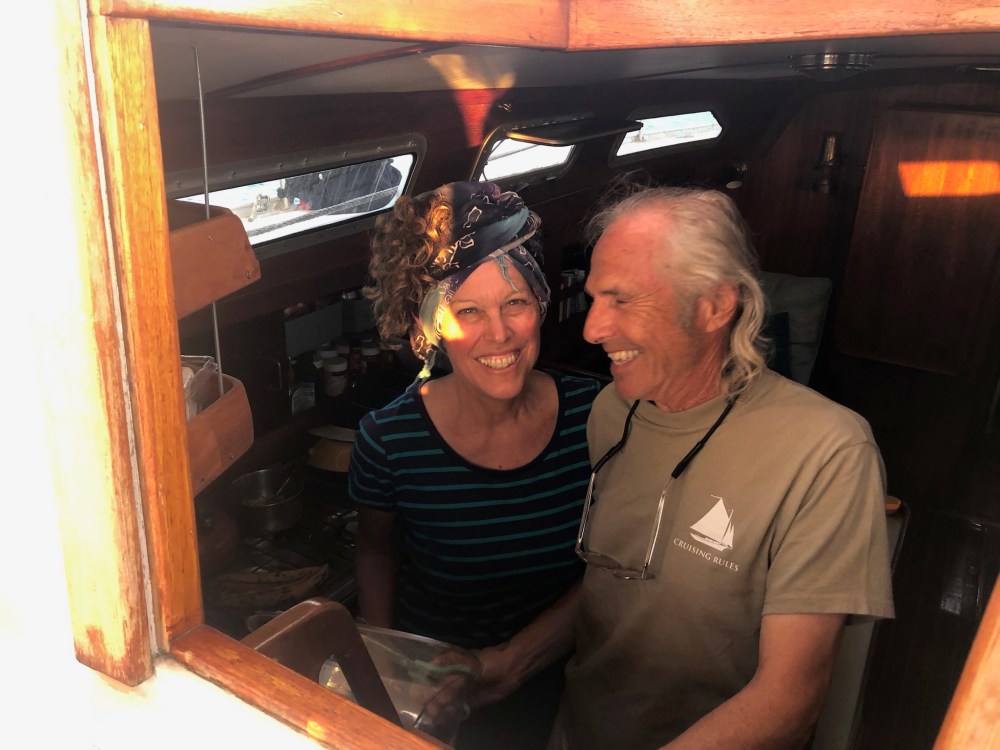
NIRVANA S4:E7

May 13 and April 10, 2023

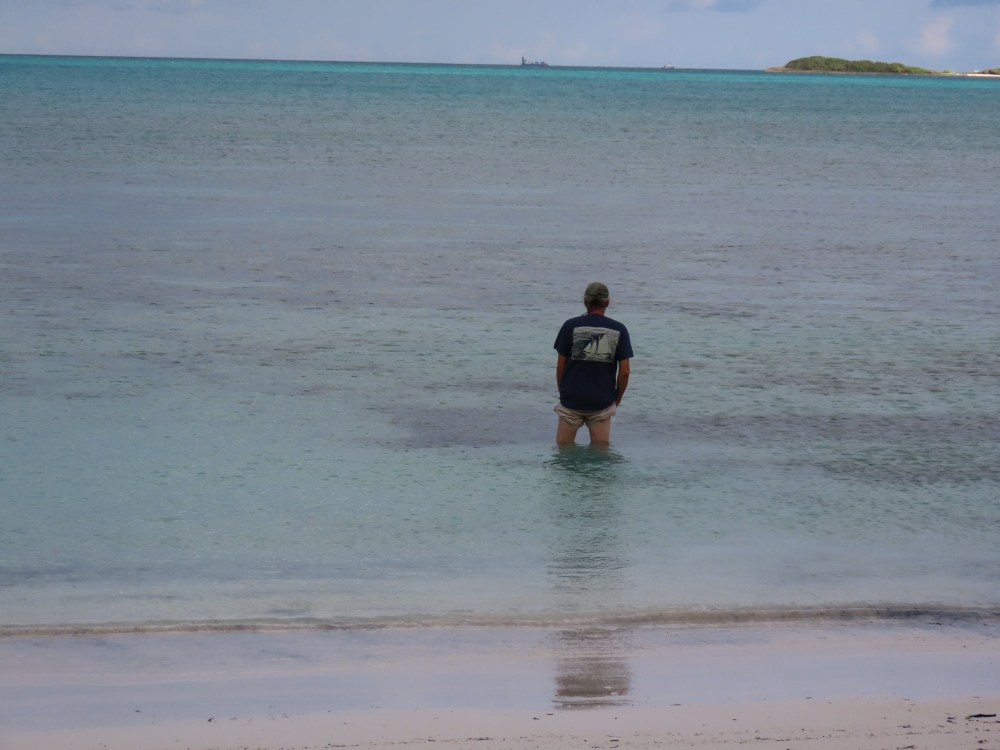
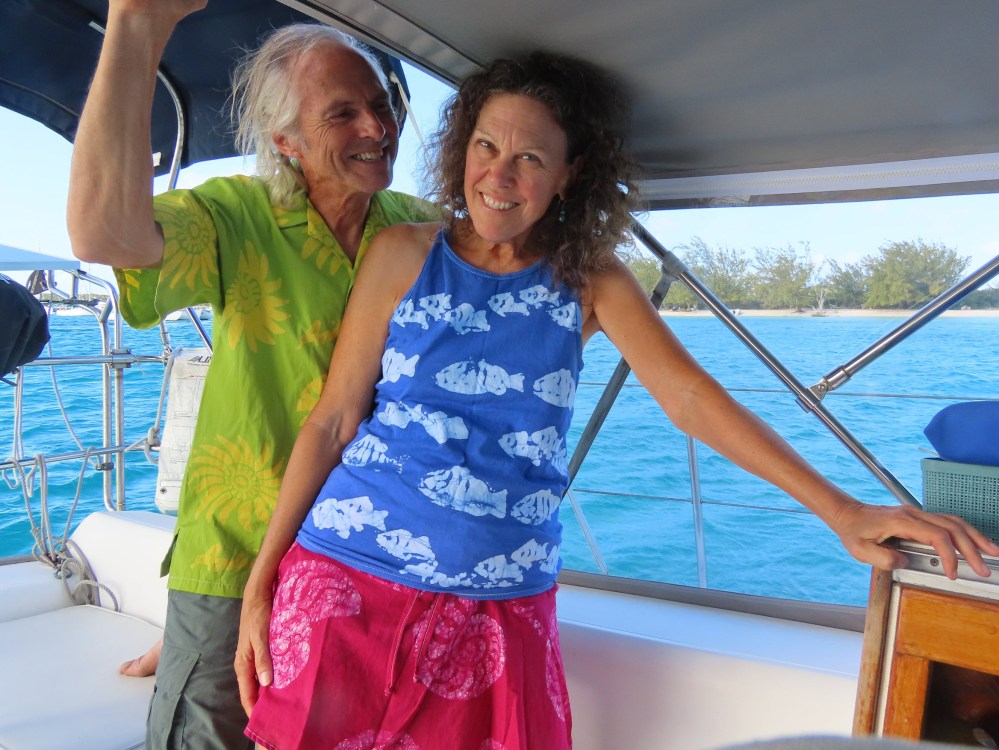
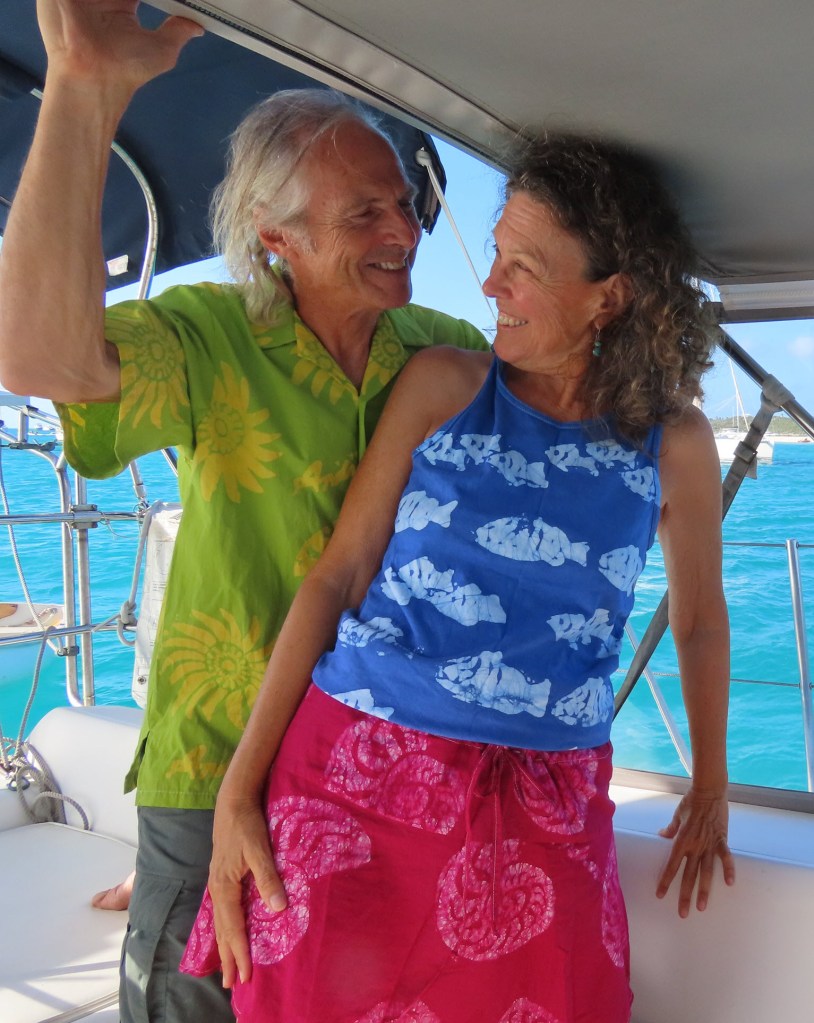
Suddenly, our sailing season is over. As is the NIRVANA adventure—at least for me.

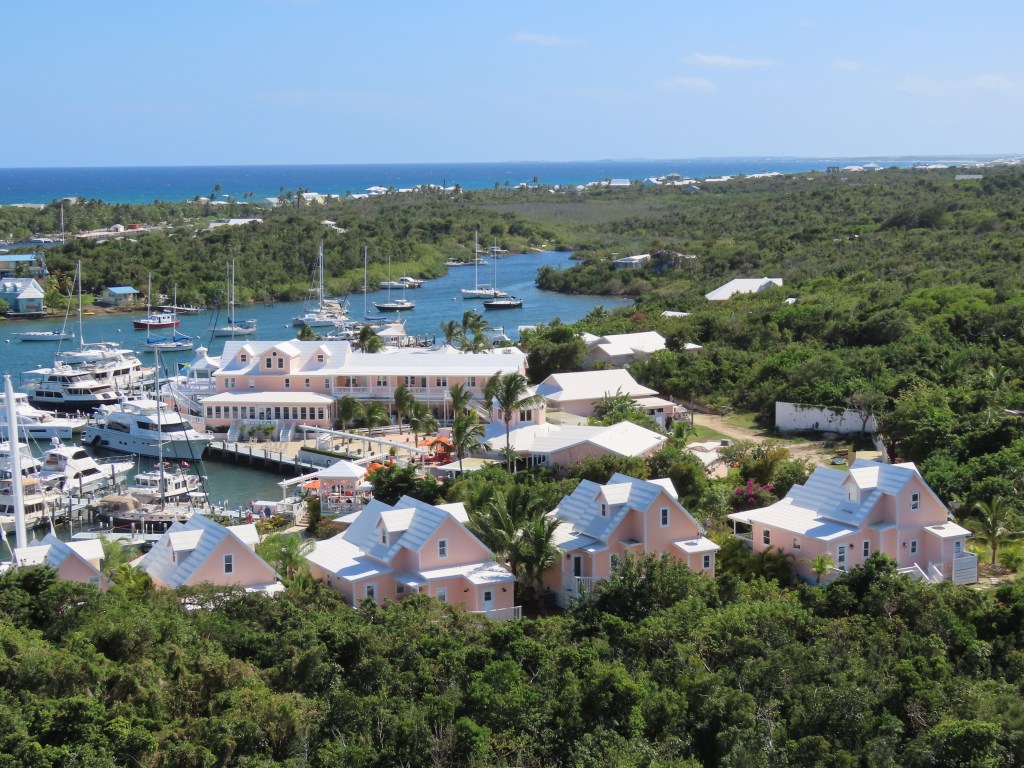
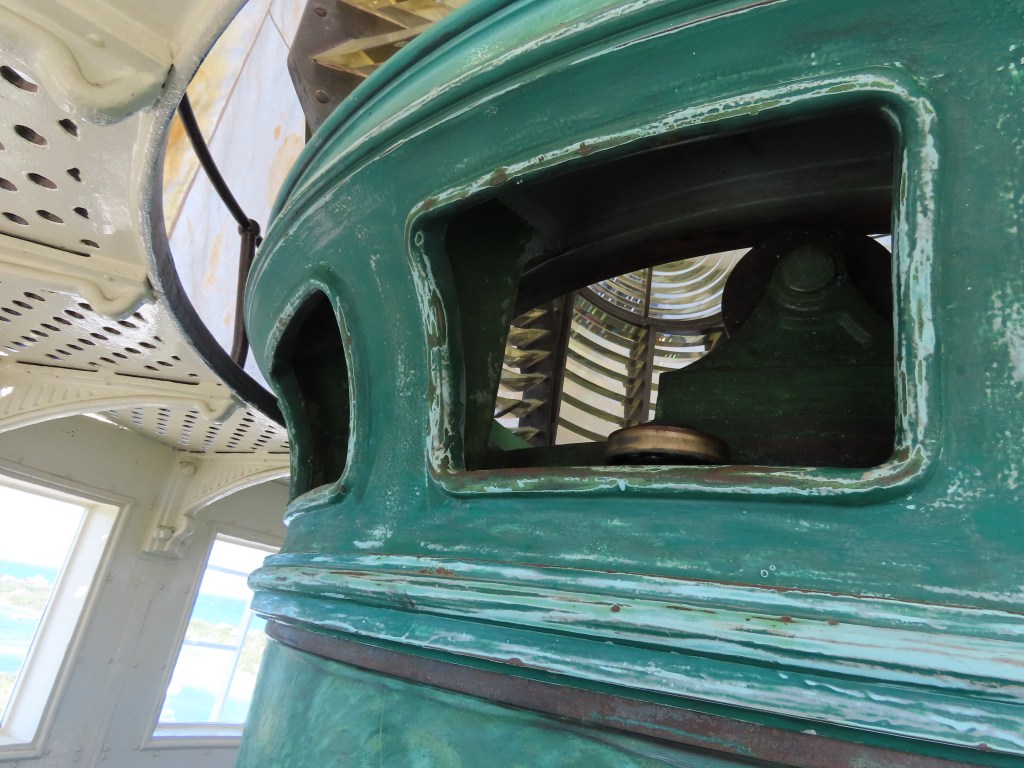
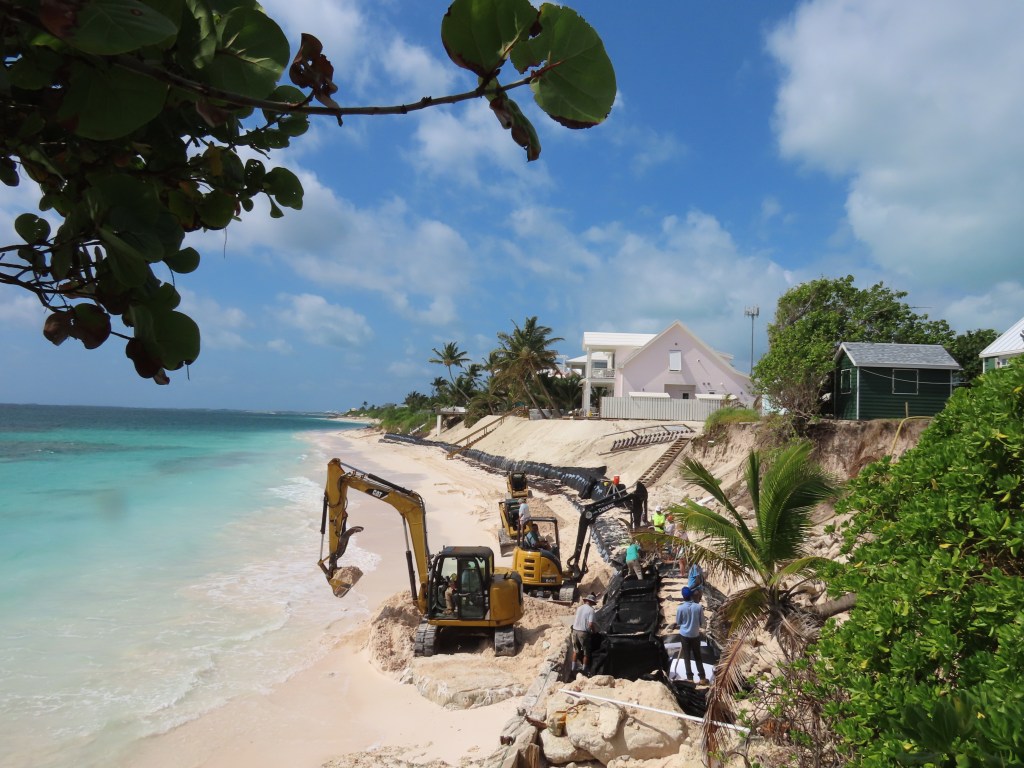
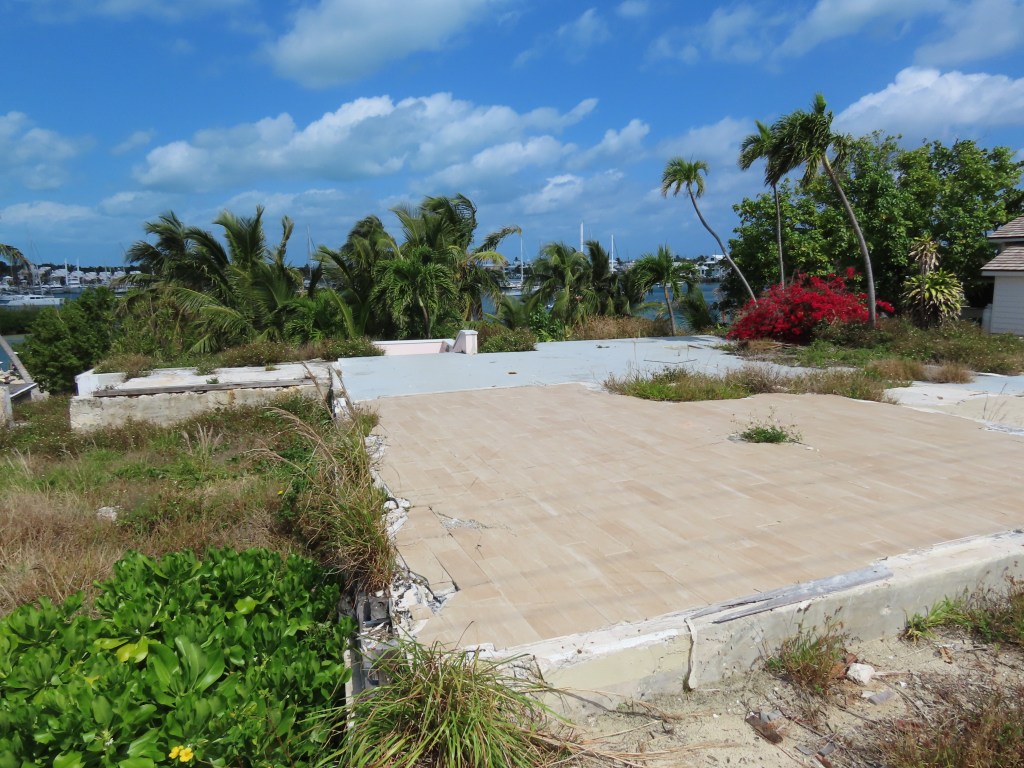
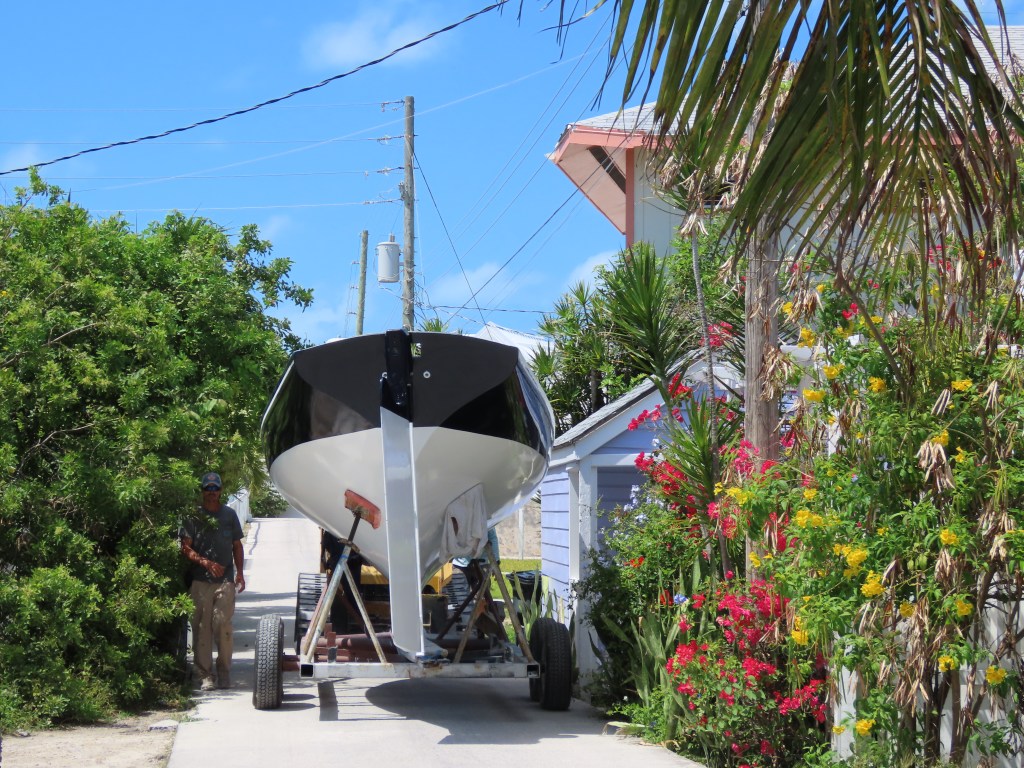
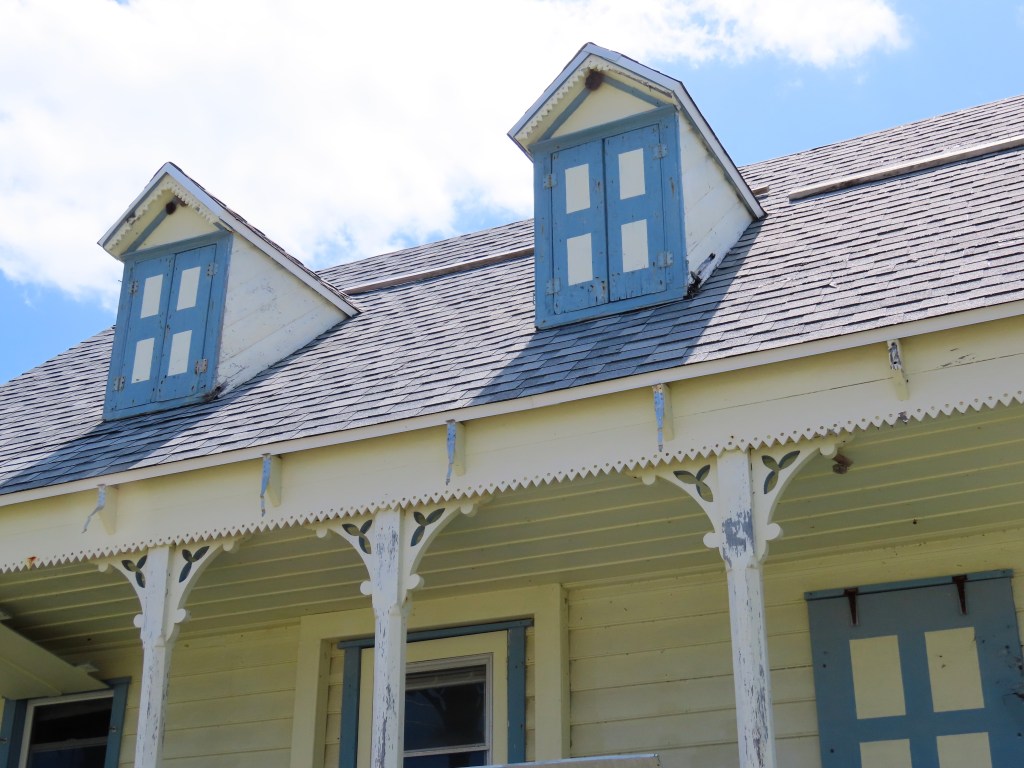
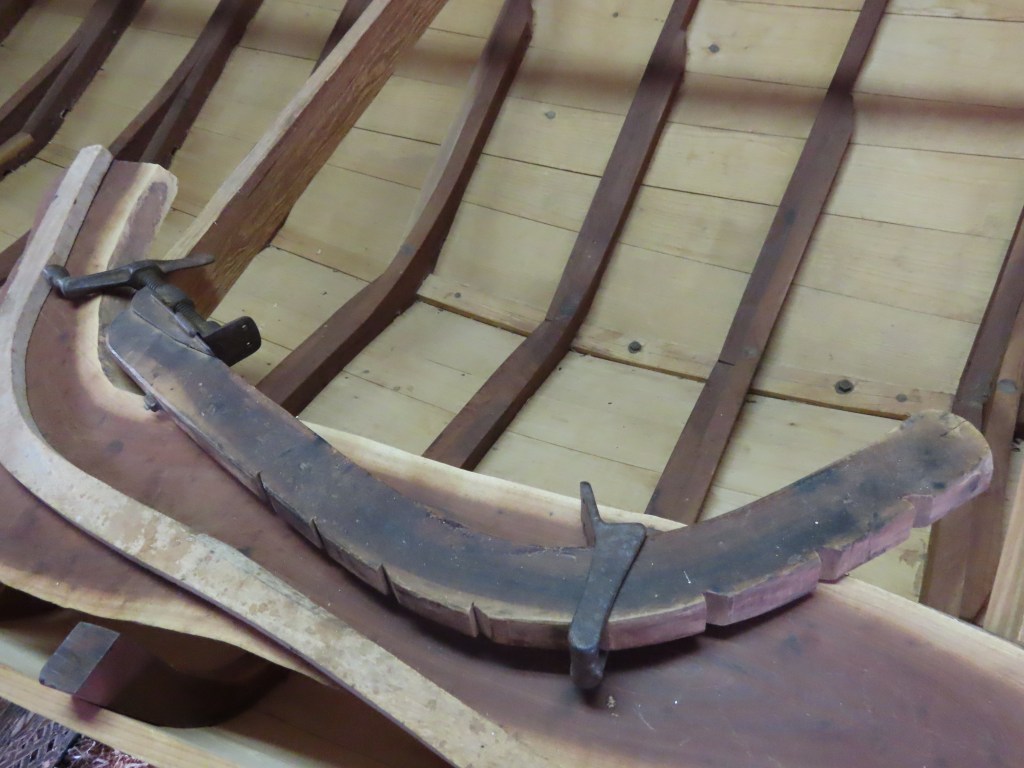
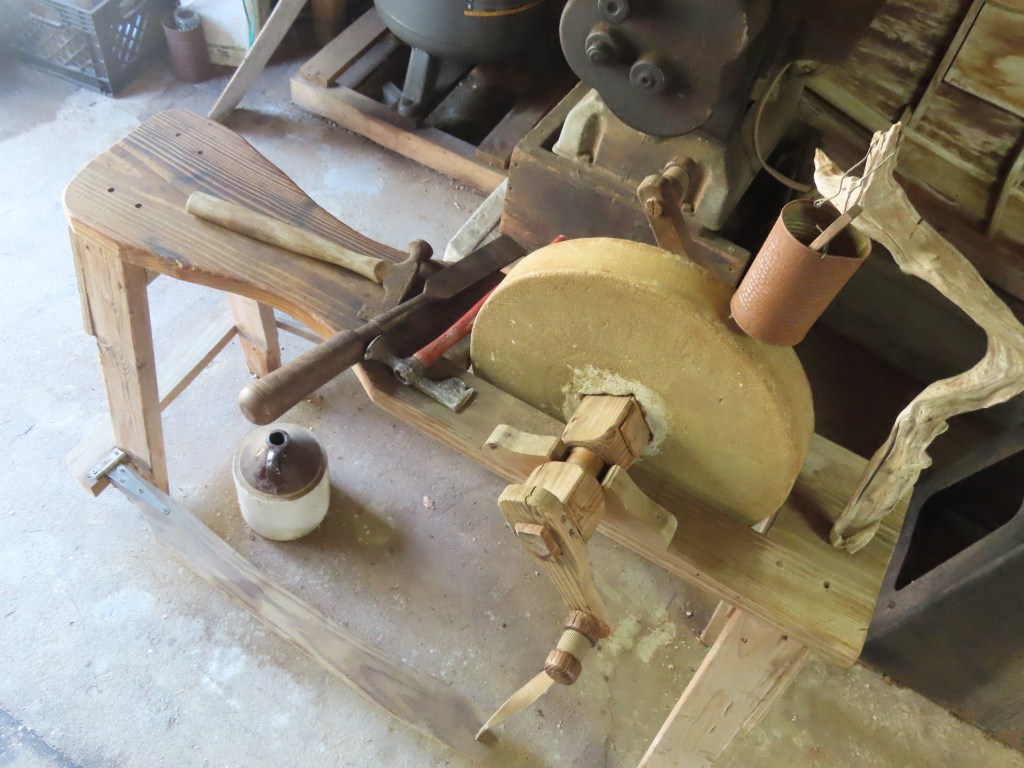
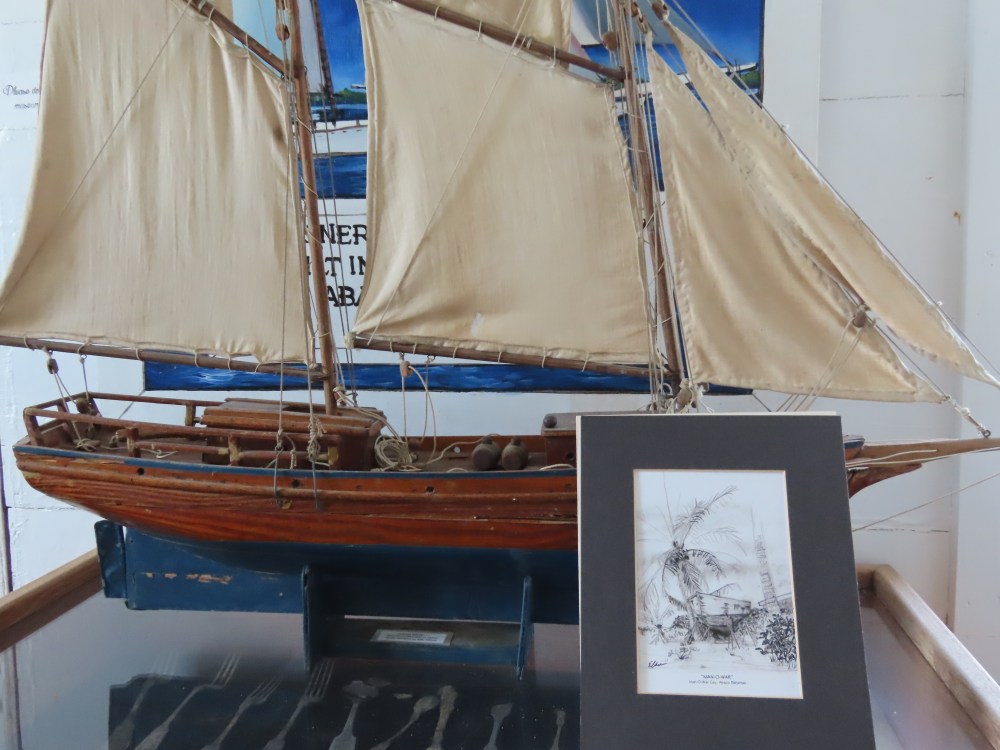
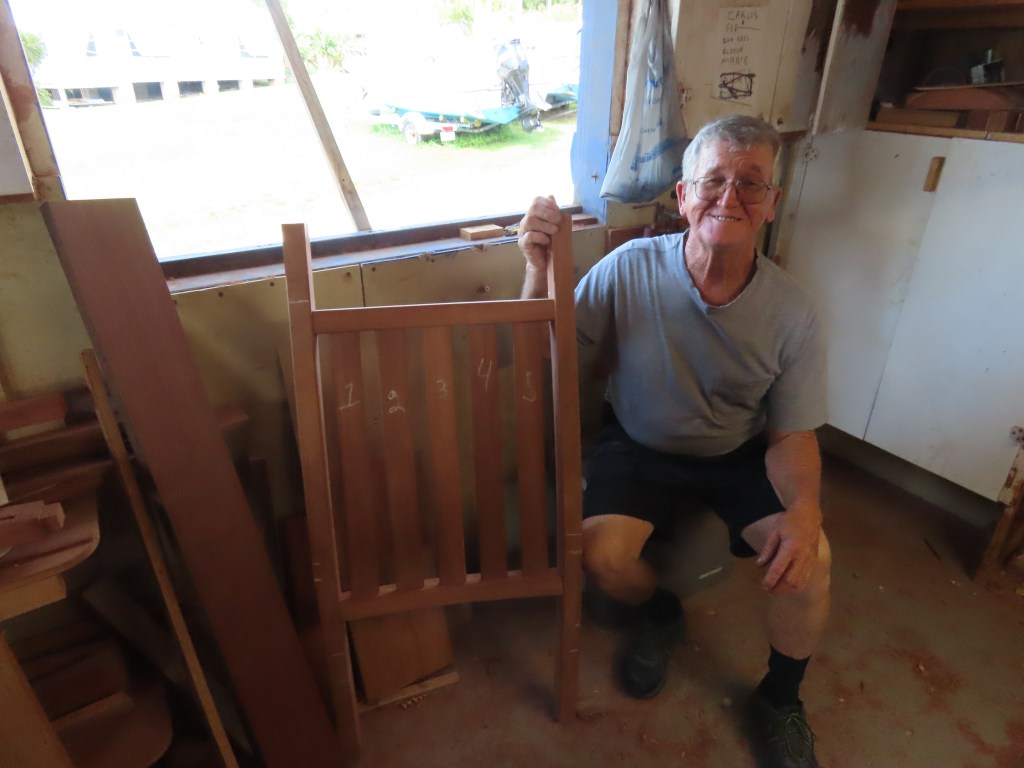
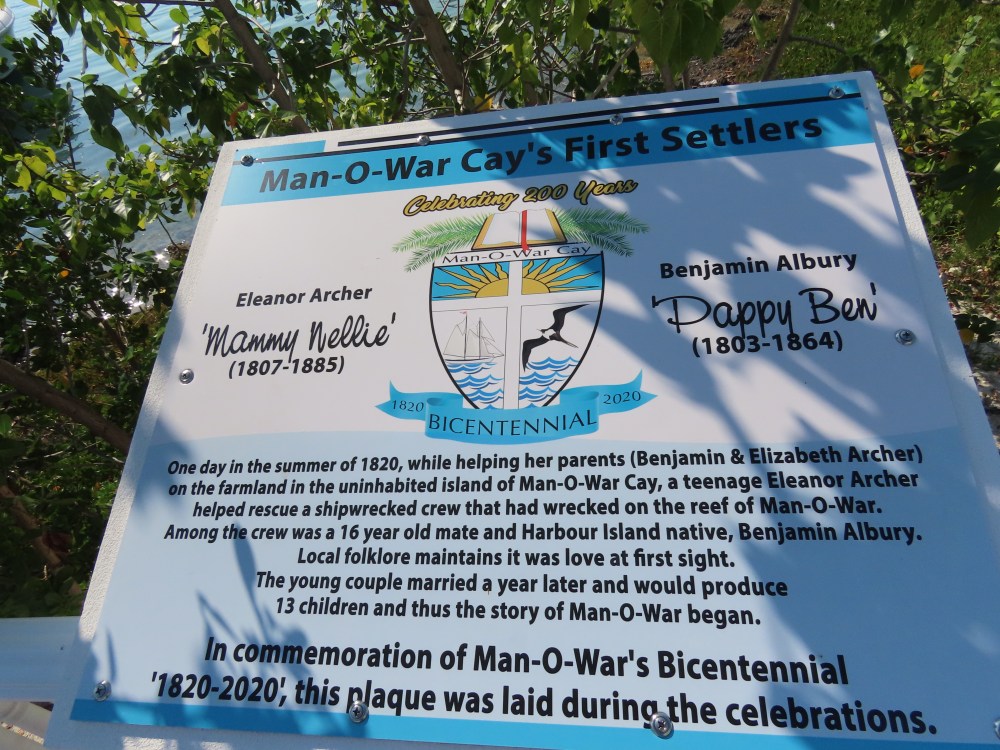
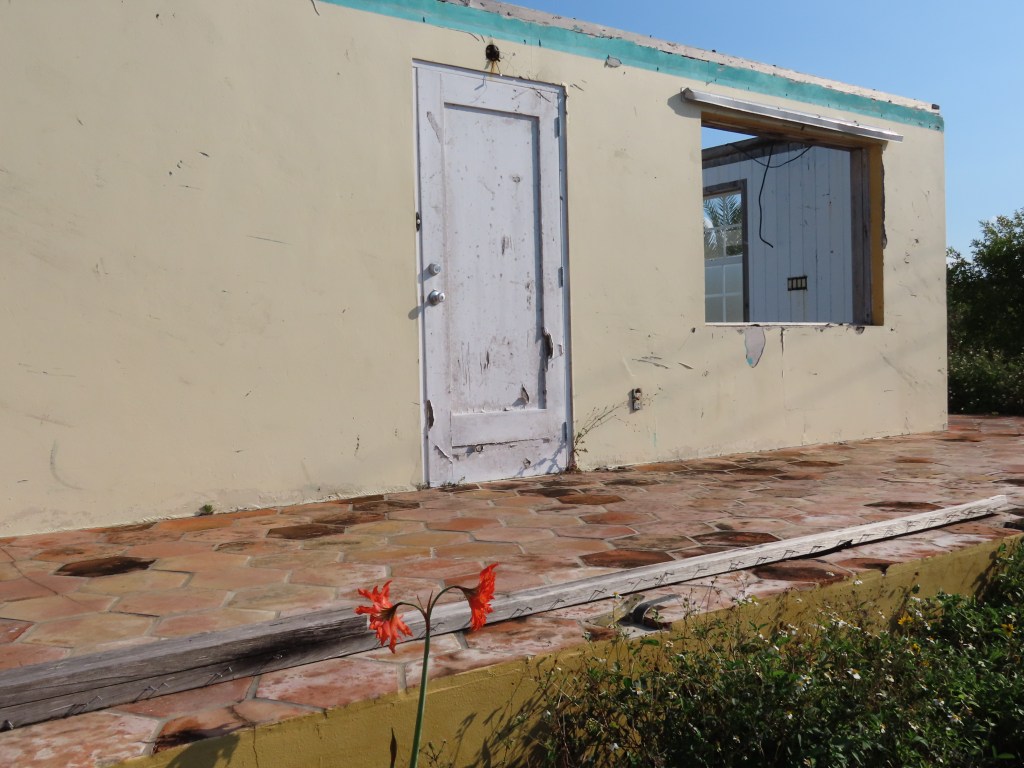
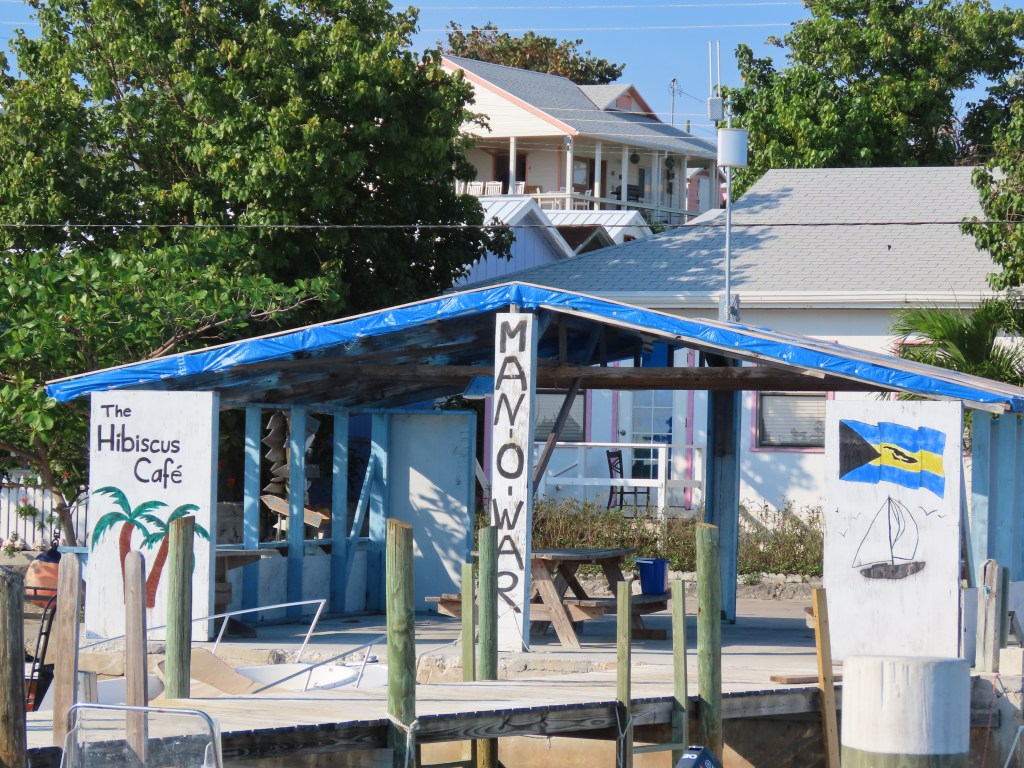
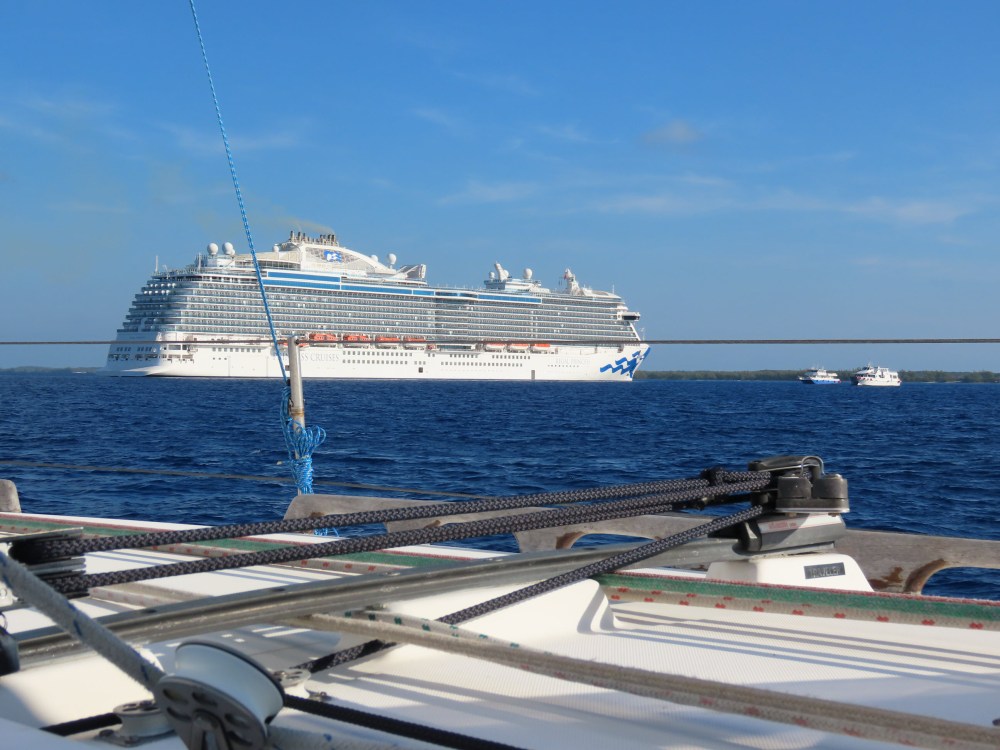
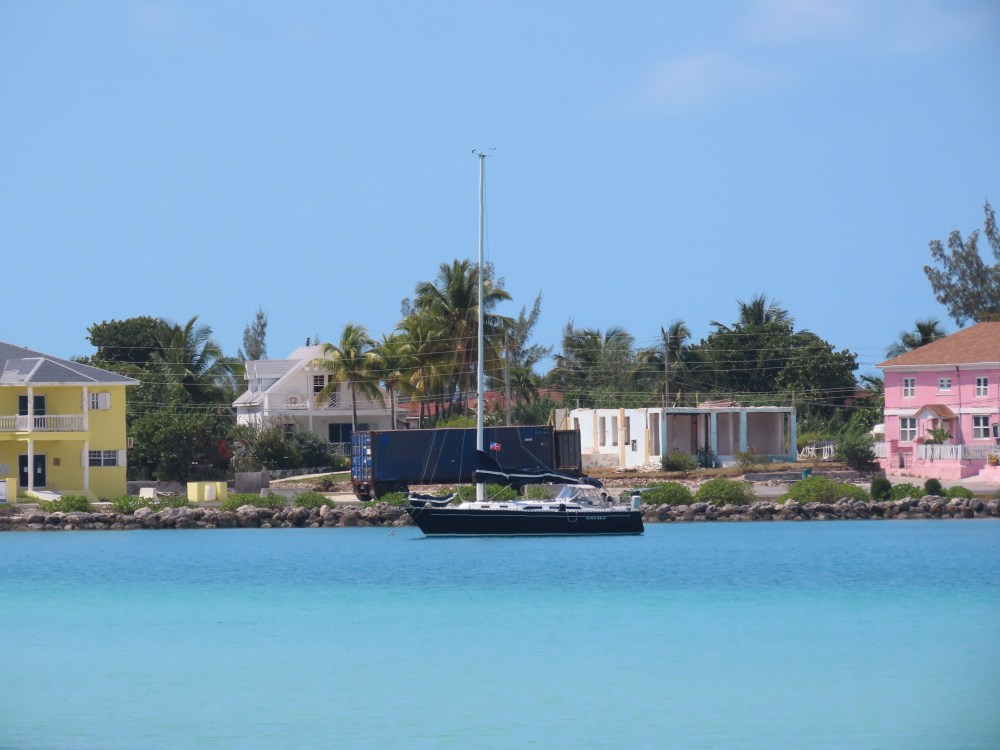
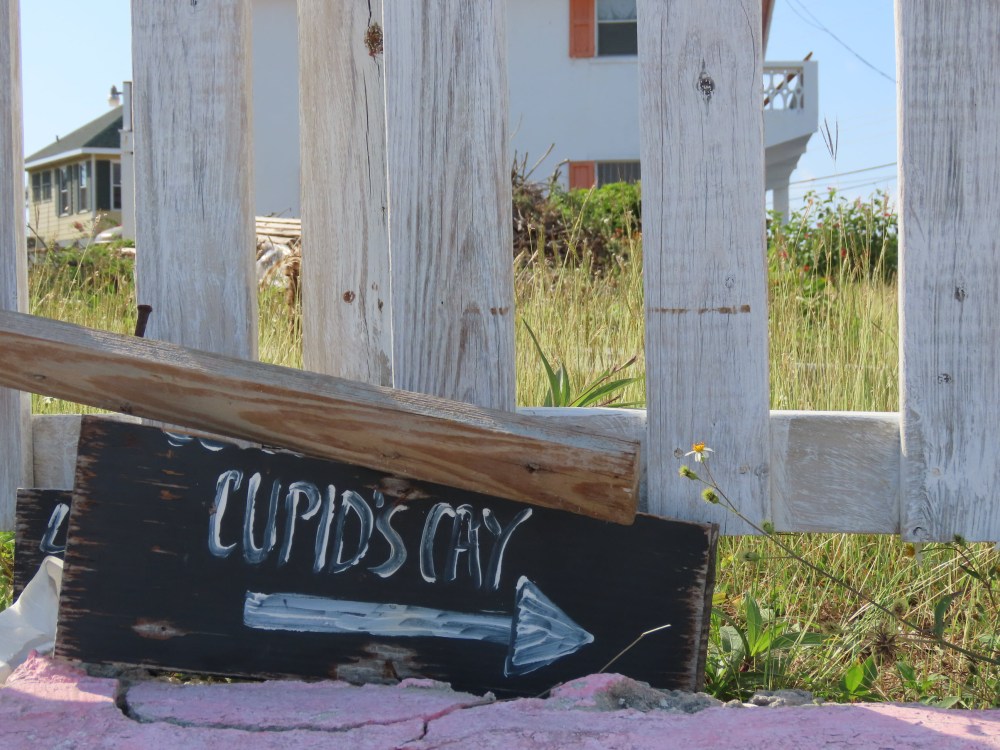
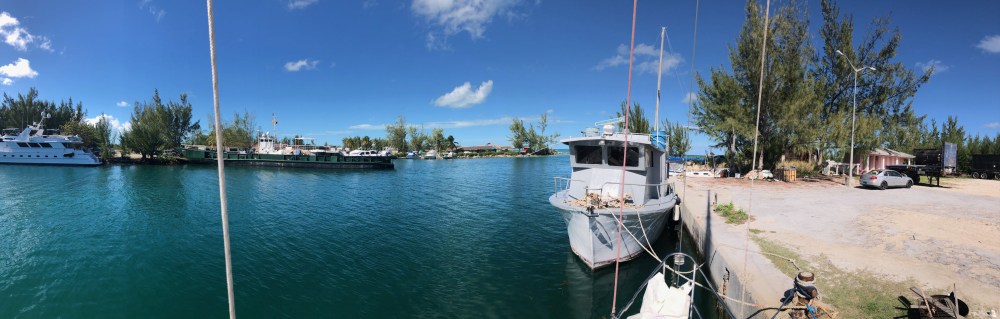
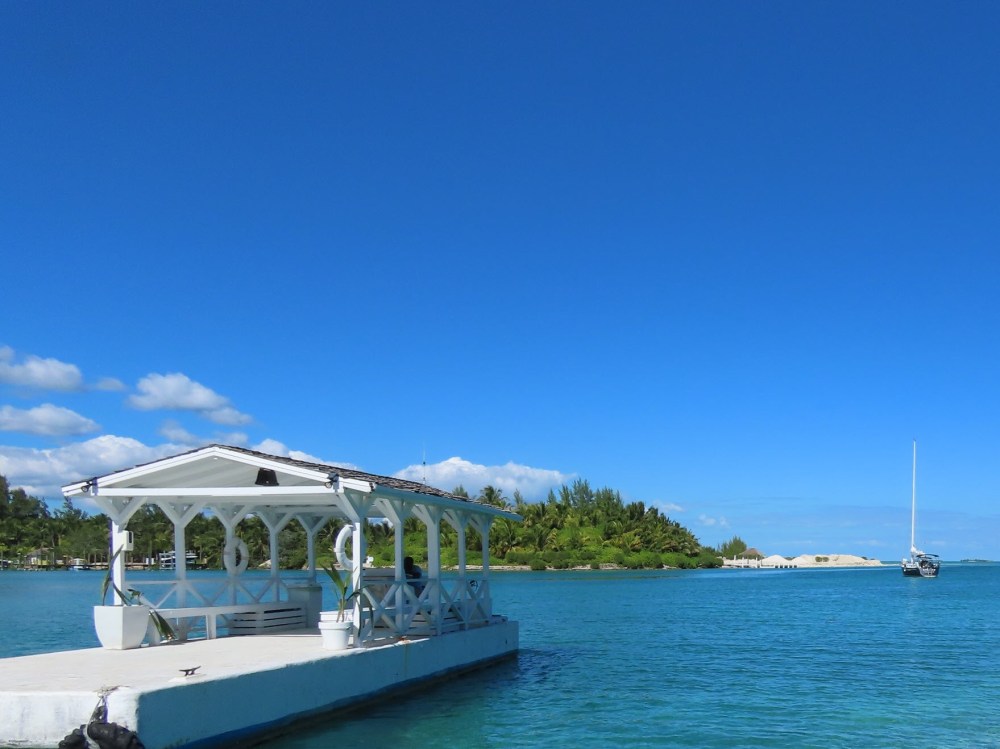
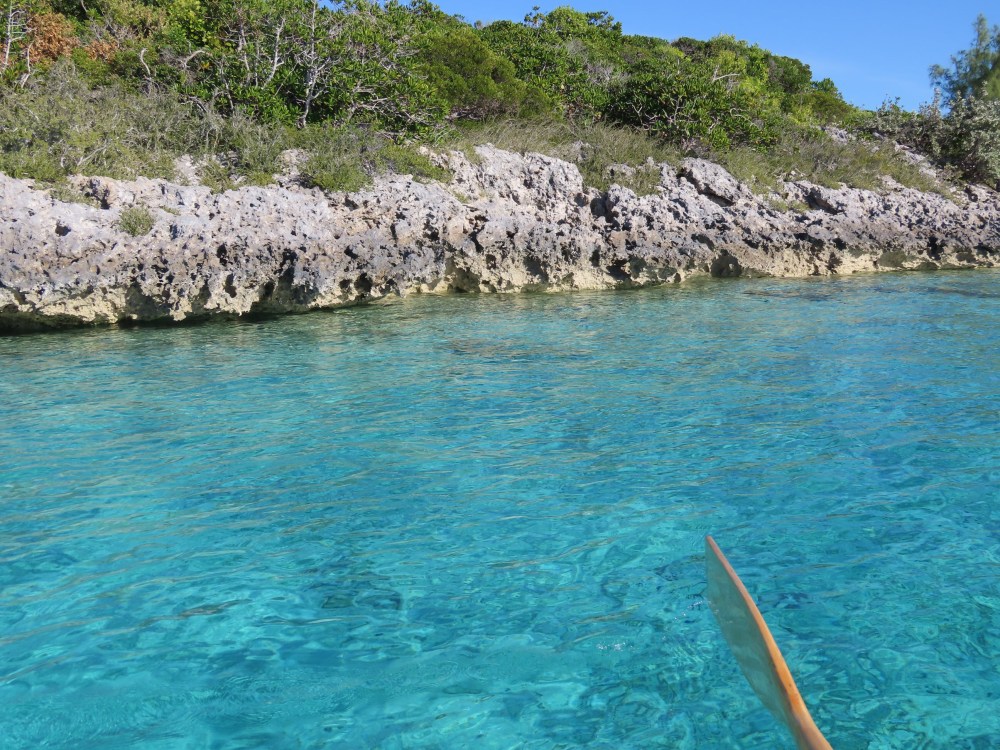
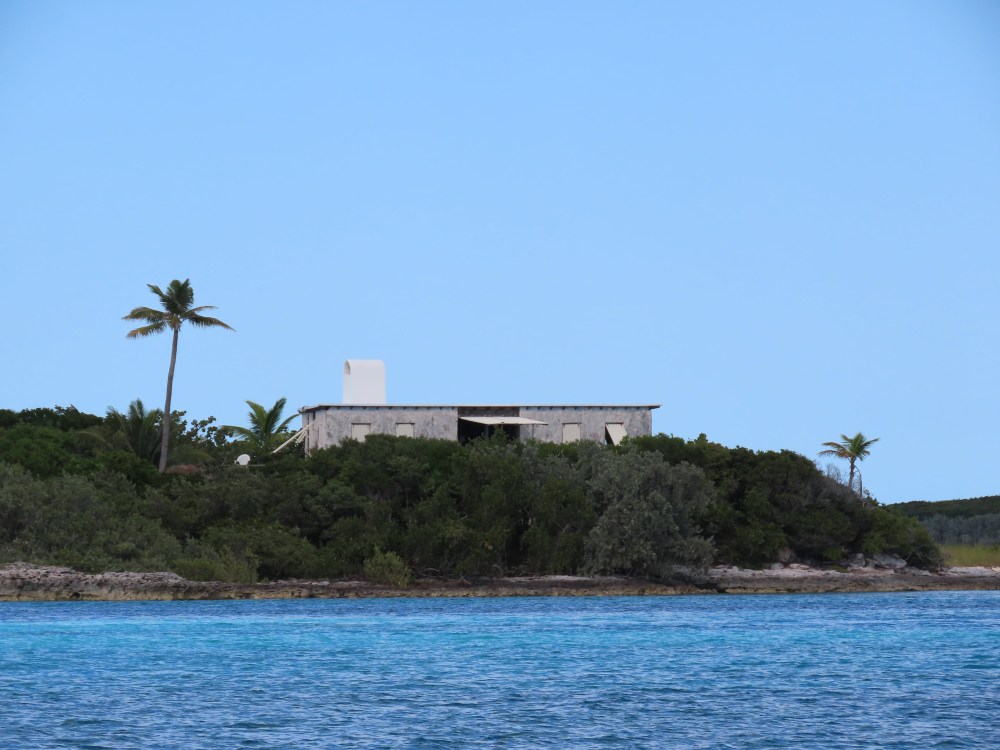
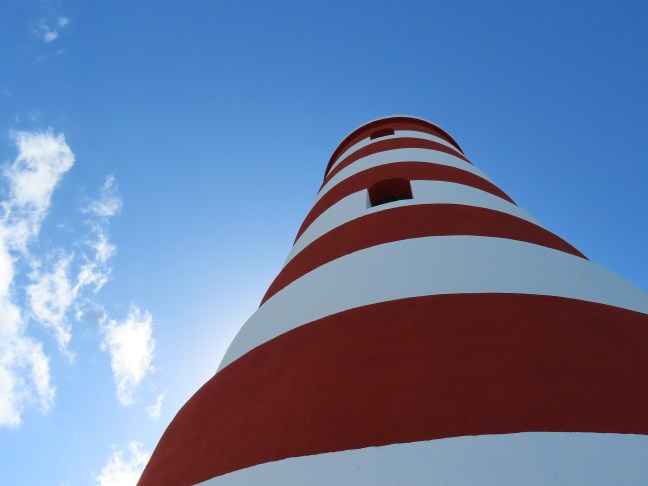
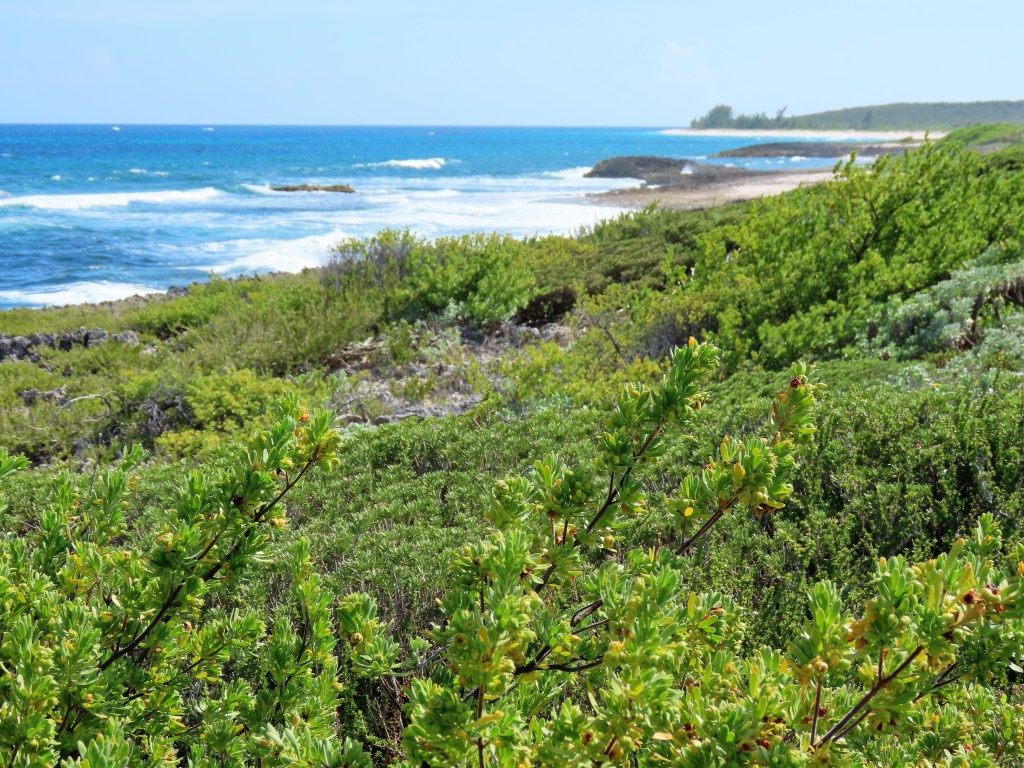
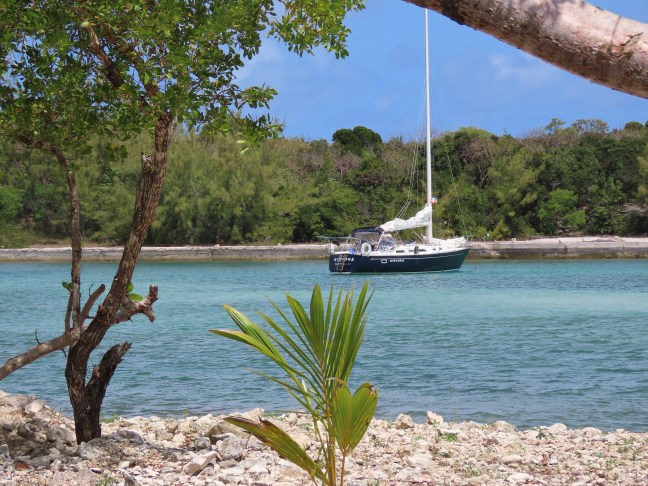
Will and I finished our three months of cruising in the Bahamas with two weeks in the Abacos, which included Little Harbor, Hope Town, Man-o-War Cay, and Green Turtle Cay. These were delightful islands but with a very different flavor, namely primarily white Bahamian islands that feel way more privileged and insular than most of the islands we visited. It’s astonishing how race, privilege, and class are so intertwined no matter where you go. That said, there is some fascinating history, most especially the rich boat building history on Man-o-War Cay, which has sadly almost disappeared. Also the presence of Hurricane Dorian, which devastated the Abacos in 2019, is still palpable.

Little Harbor
Hope Town

Man-o-War Cay

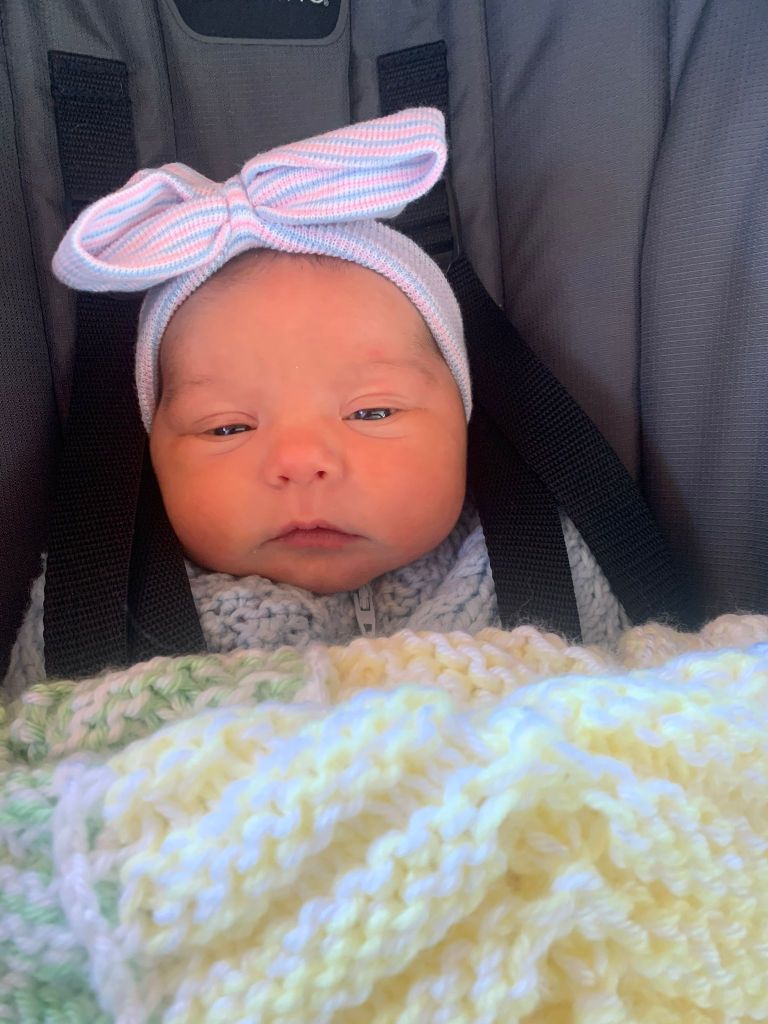
Mariah Maeve

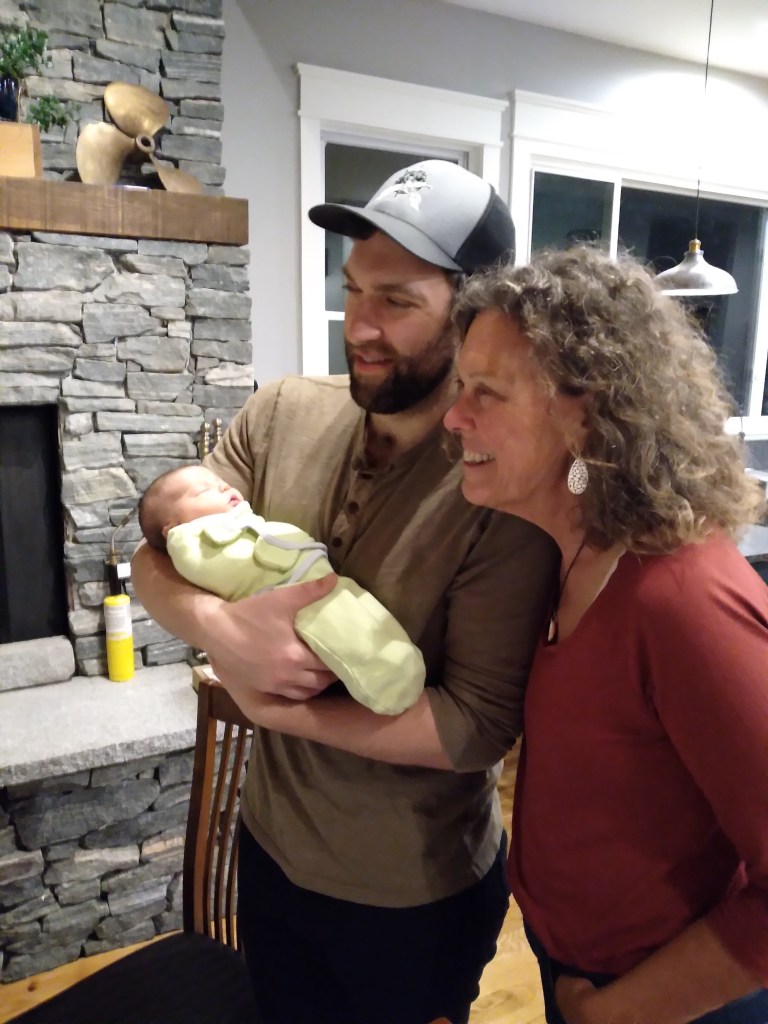
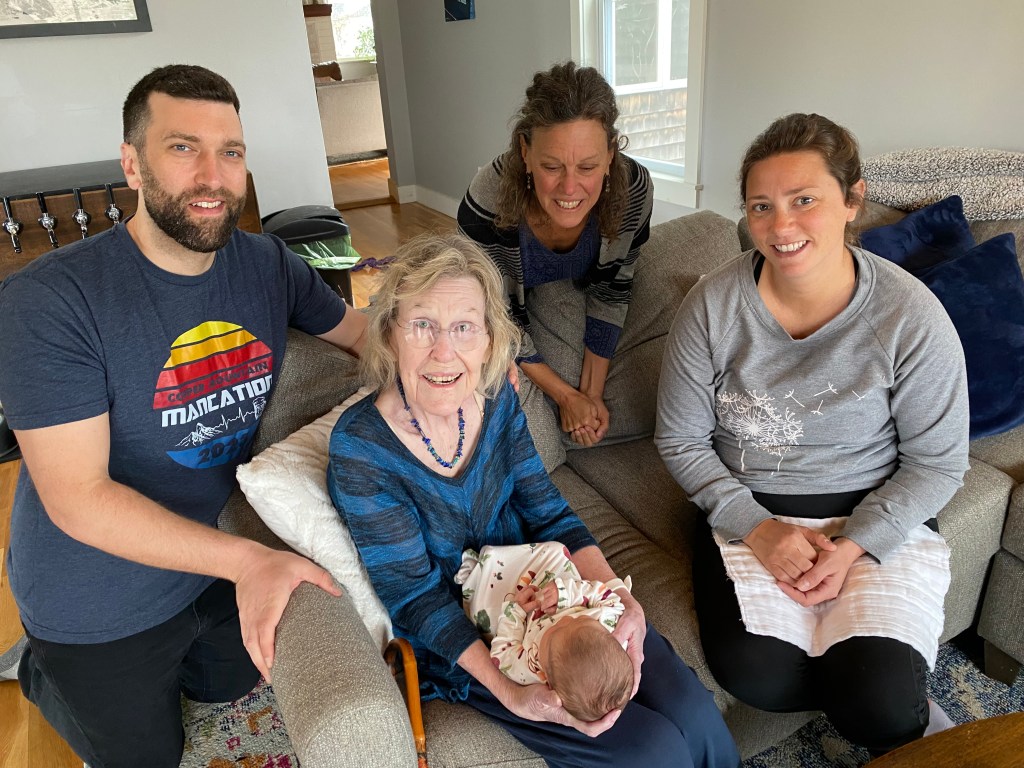
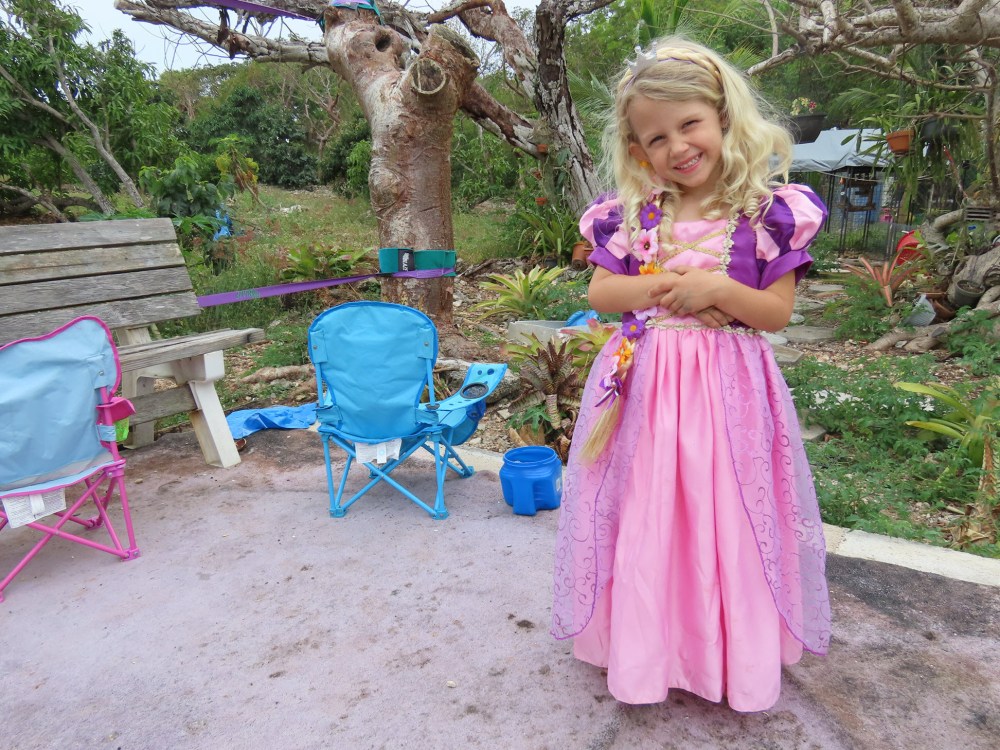
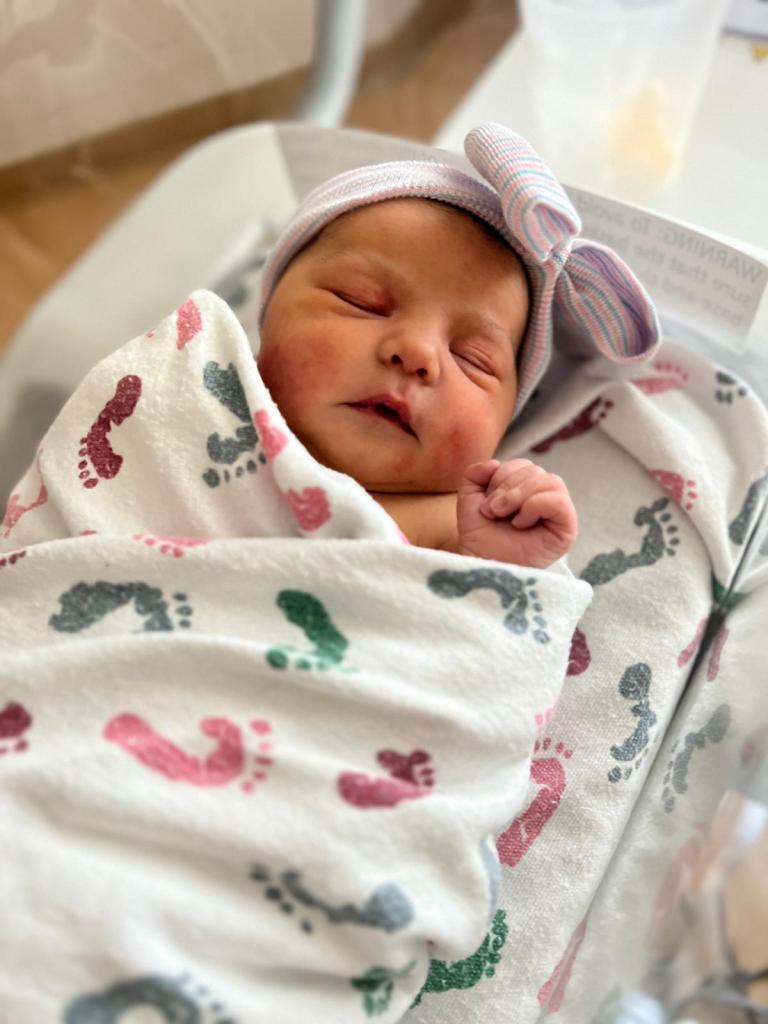
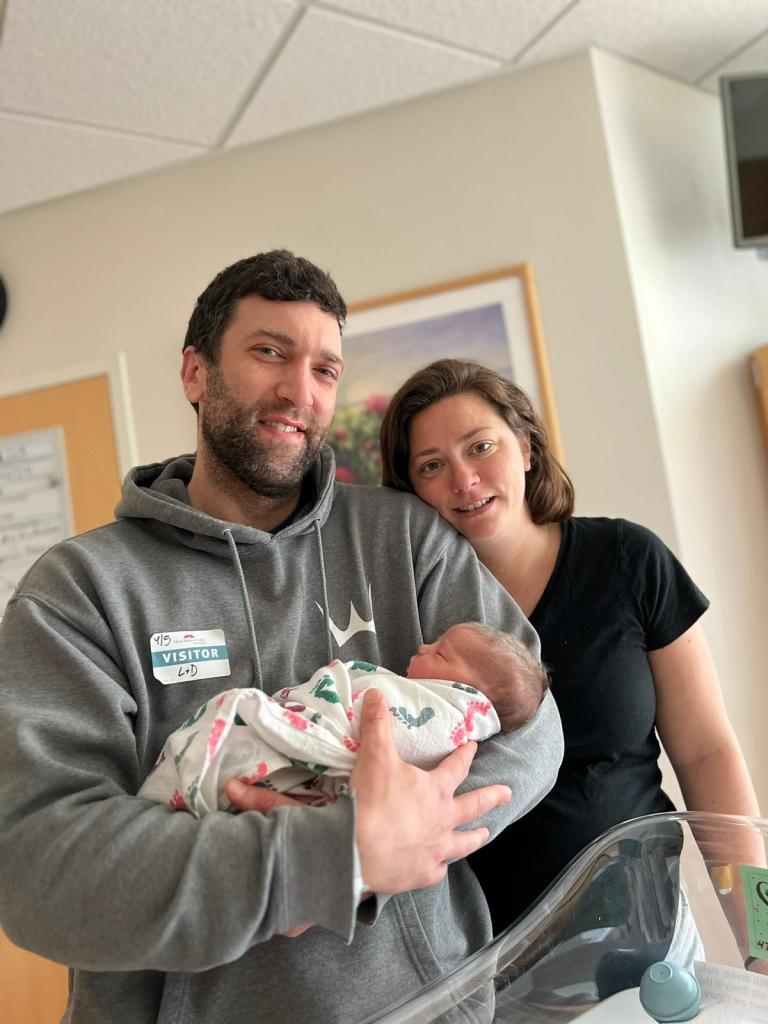
We picked up our friend Sandy in Marsh Harbor for the last bit of cruising and the crossing to Florida. Thankfully, just before we left cell phone range, I learned about the birth of my granddaughter Mariah Maeve on April 6! At which point a pair of dolphins jumped across our bow welcoming her into the world. So suddenly I’m a grandmother as well.
The Crossing

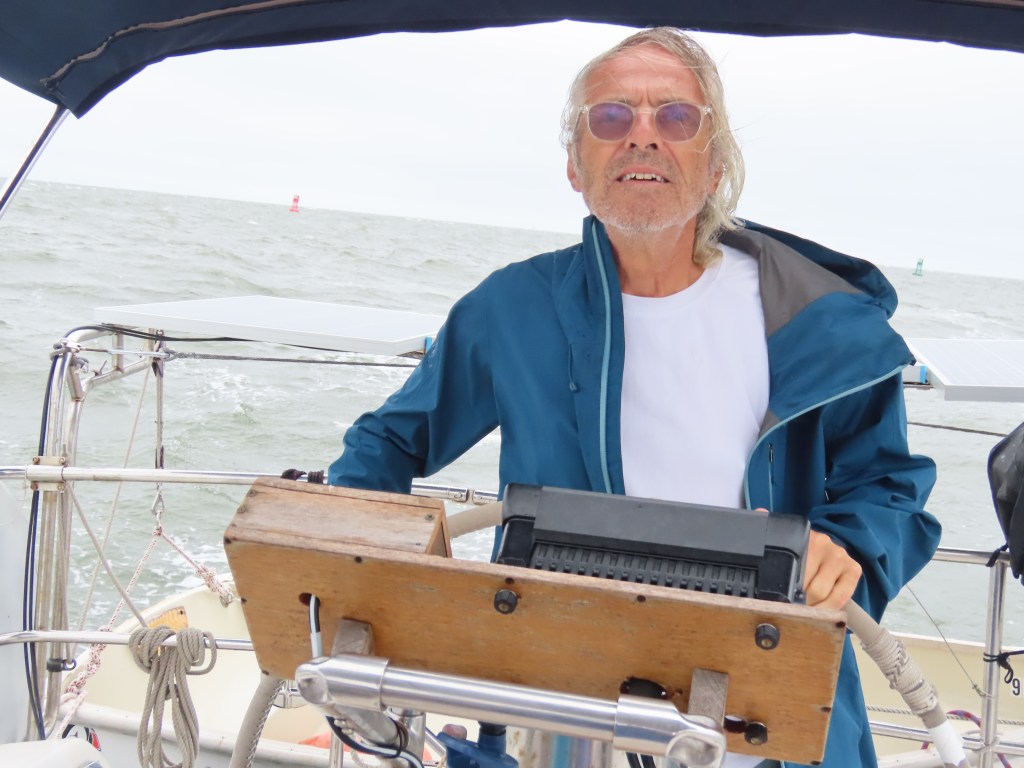
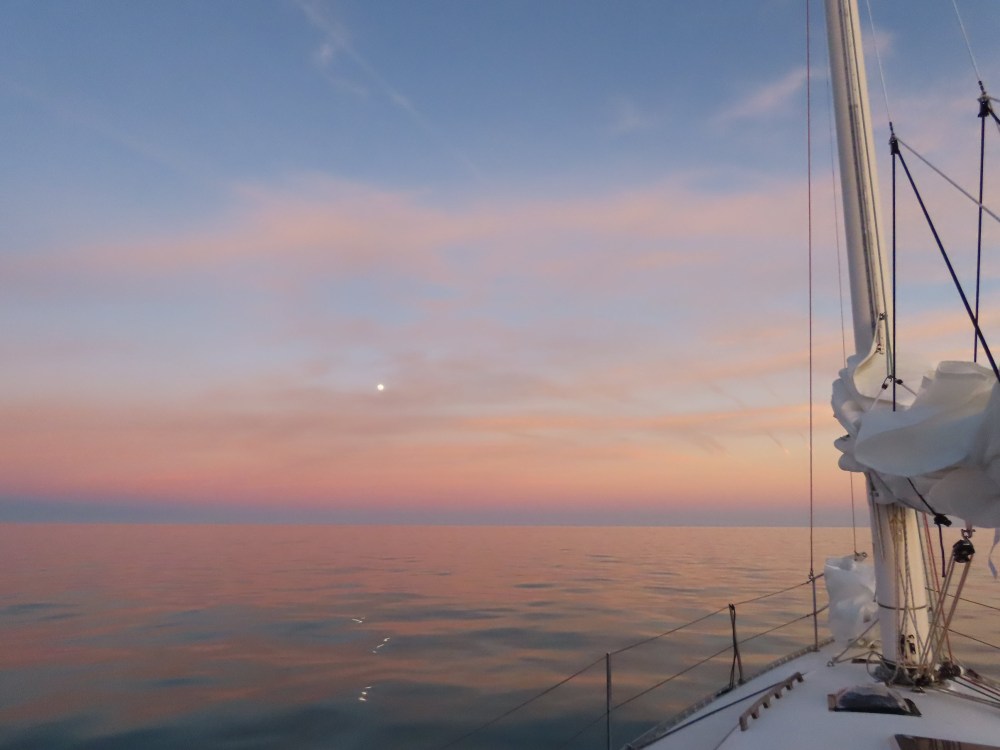
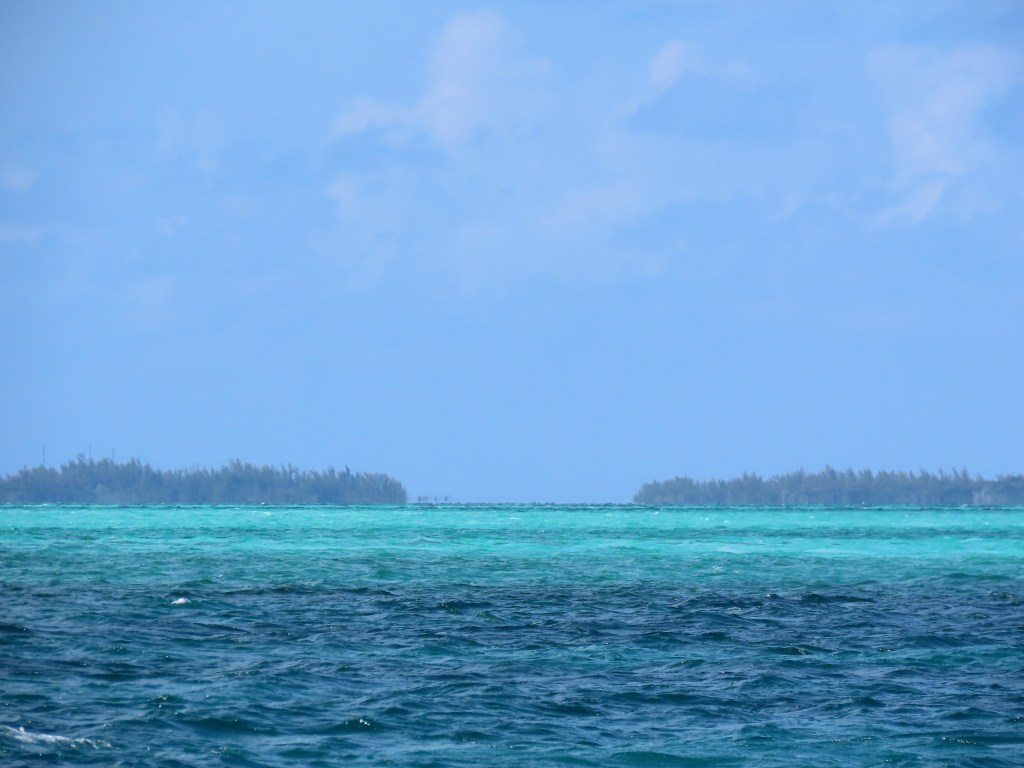
The passage from Pensacola Cay to Fernandina Beach at the Florida-Georgia border was a whopping 330 miles and 53 hours: 70 miles across the Little Bahama Bank in relatively calm waters and 260 miles in open ocean. While the conditions were generally favorable, we experienced a little of everything—delightful sailing in fair winds and following seas with a full moon, demanding sailing in heavier winds and rolling seas, motoring in light wind and seriously rolling seas, a broken boom vang (again), and in the last two hours, wind and seas on the nose as the storm we planned to avoid approached. By all accounts, it was blissful, challenging, exhilarating, exhausting, and uncomfortable, in different measure, at different times, according to each of our experiences.

Transition Time

After our crossing, Sandy and I spent four nights ashore in a hotel while Will weathered a gale on a mooring as we awaited our flight back to Portland. Scrubbing off months of grime in a long, hot shower and sleeping in a large rectangular bed with crisp white sheets was nothing short of a miracle for this sailor. And time ashore in between the end of our trip and the return home was just what I needed to reflect, process, and write about our adventure together, which I do in more detail below.

Sadly, I returned to a house that was nothing like the way I left it when I rented it last fall. It took more than a week to clean, as well as to repair or replace what was damaged or missing. After two years of living mostly on the boat and renting my house, I am very happy to be home, where I’m reconnecting with my family, friends, and dance community and enjoying my own space.

Meanwhile, Will flew back to Florida and began his trip sailing back to Maine with various crew joining him along the way, as well as doing some solo legs. Despite ongoing issues with the boat that have slowed him down, he continues to love everything about the sailing life, including sailing offshore in open ocean.

With time apart, we’ve both been doing some serious introspection about what our future holds. As such, I just returned from a quick two-day visit with Will in North Carolina. After much deep and rich communication, we’ve decided to close this chapter of our journey together living and sailing on Nirvana. While we have deep feelings for each other, we both acknowledge that our lives are moving in different directions. Will’s home is on the water, and my home is on the land. We are ready to open a new chapter with blank pages yet to be written—together and apart.

Reflection

And now for some deeper reflection on the overall adventure, which I wrote a month ago in Fernandina Beach.

I’m someone who likes to reflect on transitions. It helps me to understand the significance of my experiences: thus, this blog. While there does feel like a distinct before we left for Bahamas and an after we’ve arrived back “home,” in another sense, I know that life is one continuous journey.

My uncle Roland Barth, who passed away a year and a half ago and was a lifelong sailor, used to ask, “On a scale of one to ten, how was it?” I believe this self-inquiry can be a useful tool to help uncover a bit to what I’m talking about. But there’s also a danger in doing so in that it has the potential of flattening the experience, shaving the highs and lows into flat peaks and valleys. To honor my dear uncle, I still choose to answer the question I know he would have asked. My answer is a 7.5, which, given the range of feelings I’ve had over these months, is higher than I would have imagined.

Roland was also an educator, steeped in the world of experiential learning who, among other things, served for many years on the board of Hurricane Island Outward Bound. As such, the other question he would also ask is, “What were the lessons learned from your experience?” The answer to this question provides more meaning in helping move forward during these transitions. But here too a danger lurks in drawing too many conclusions about the future based on the past, for in reality, we are always in transition and the only real time is the present. So perhaps, as Rainer Maria Rilke suggests, it’s more about asking the questions and swimming around in the soup of what comes up that insight comes.

Finding Home

What’s it all about, this life aboard a floating home? I’ve been asking myself this question for going on two years now. Since June, 2021, we’ve been living aboard sv Nirvana or sv Cascade in Italy, with only a few months’ break on land last spring when we house-sat for a friend and traveled out west. It’s what my grandmother would call a “peripatetic” life—one of her favorite words—which means moving from place to place.

So what does this say about “home?” Will, the architect, often paraphrases Gaston Bachelard from The Poetics of Space about the significance of the word home: “Home is a place that shelters daydreaming.” In other words, home is a safe place from which to explore…and presumably return. Yet when you’re living and traveling on a boat, you’re constantly exploring and, thus, daydreaming is not about dreaming at all but about living in constant flow. As for returning, there is instead a continual exploration from what is essentially home, so it’s both the safe haven and the journey all rolled into one.

Living on a boat is truly a different way of moving in the world.

The contrast between the stability of life on land—a house, say—and the motion at sea is profound. Literally, the boat is constantly moving, whether sailing at six knots or drifting around at anchor as the wind changes direction. The seas are rarely flat, so there’s an ongoing forward-and-back or side-to-side motion, or both. Sometimes the movement is gentle like being rocked in a cradle; other times it’s like being on a combination mini-roller coaster/tilt-o-whirl perpetual motion machine. And everything in between. On the rare occasion that you’re anchored in a totally protected harbor and there’s no motion at all, you notice it: “Oh right, this is what it feels like to be on land.”

To assemble meals, you pull food from a deep refrigerator or from behind cushions that serve as a couch, both of which can involve an archaeological dig. To use the toilet, you step into a space that doubles as a shower. The water is only hot when you’ve run the engine, or barring that, you hang a solar bag or use a hose in the cockpit. The water supply is limited to 60 gallons, plus what you can make with the water-maker, so you use it sparingly. And you constantly monitor your batteries to ensure the solar panels are feeding enough power to keep up with your electrical use, which is generally minimal.

It’s micro-house, off-the-grid living on the water.

What this way of life affords is the ability to experience and explore in ways that are simply not possible on land. As such, contact with the human-made land world has a much greater impact as it’s no longer the norm but more the exception. While the boat is, to be sure, a human-made object that requires constant care and attention, the sea and sky are just outside the companionway, laid out before you in a splendid expanse, meeting at the horizon. From this perspective, land is as close or as distant as you choose to make it.

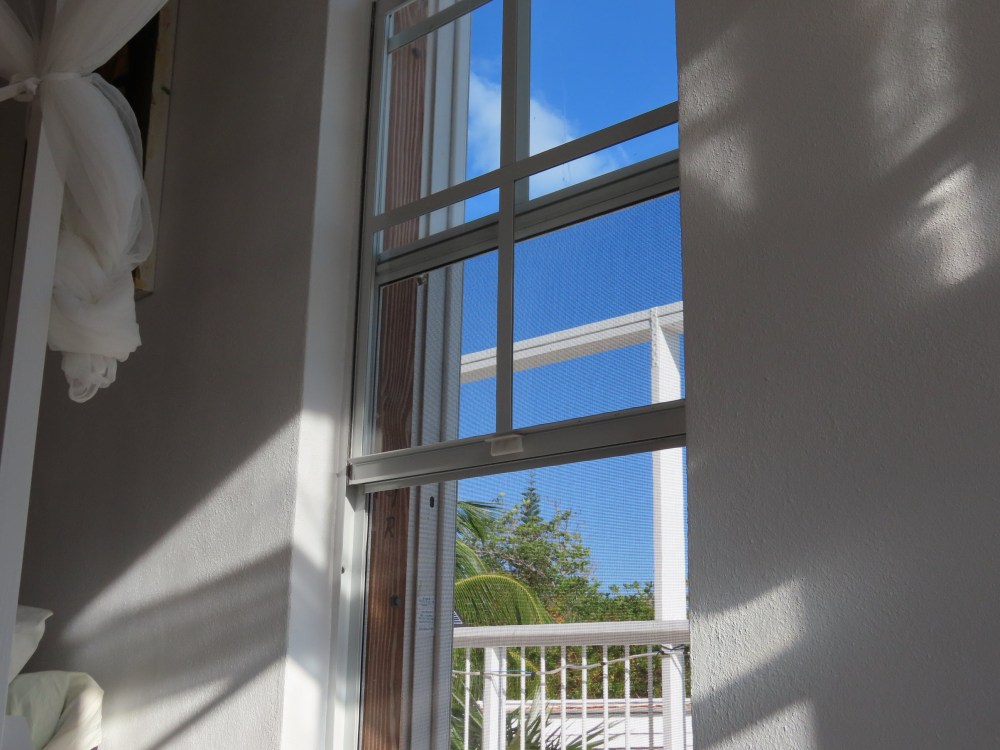
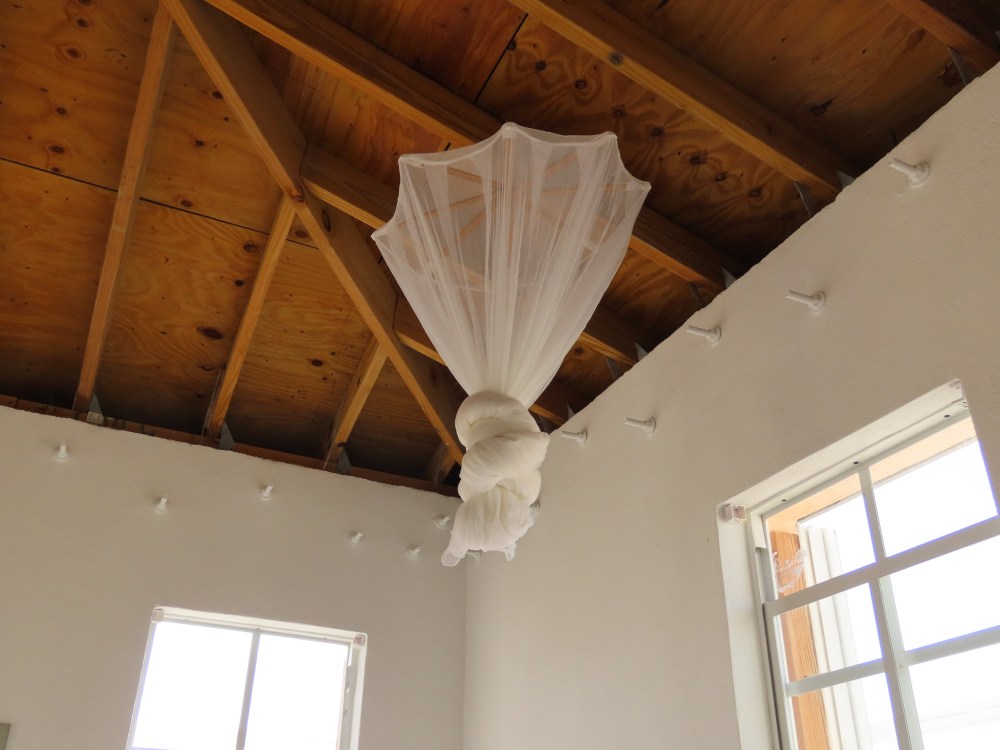
There is something truly elegant and appealing about the efficient living space, small carbon footprint, and preservation of precious resources that boat life provides. And yet, after these many months, I’ve discovered I need more time on land to counteract time on the boat: walks ashore in the greenery of nature; buildings that shelter the elements; a soft, cozy chair in a room with a tall ceiling; a rectangular bed; a shower where the hot water washes over you in a constant flow; a flushing toilet. Call it the creature comforts, stability, and spaciousness of a land-based existence, which are fleeting on a boat where the only buffer between you and the elements is a fiberglass hull and a canvas dodger.

Still, when the sun penetrates your bare skin, continual breezes caress your body, warm water buoys your entire being, and wind fills your sails on a perfect reach, you feel held in the embrace of both your boat and nature in a state of true bliss that simply cannot be replicated on land.

Lesson Learned: Take some time in life to push the edges of your comfort zone and adventure out from the safe harbor of home. Only then will you discover the true meaning of home for you.

Responsibility

Here’s a different take on the word “responsibility”: the ability to respond to what’s happening in the moment.

Life on a boat is an exercise in constant responsiveness to the environment, which begins with the weather and sea conditions and extends to every other aspect of life that exists. The universe is constantly changing; so is the weather, your surroundings, the people you come in contact with, and your feelings. Just when you think you’ve found the perfect settled anchorage, a new weather pattern develops. At the intersection of the high- and low-pressure systems is weather instability, higher winds, bigger seas, perhaps rain.

At a calm anchorage, when the sun is shining down and a gentle breeze is blowing, you can become lulled into a sense of complacency as if it could go on forever. But this is simply not so. The weather is a complex, dynamic system that is only predictable to an extent. For what in the universe is fully predictable? At the sub-atomic particle level, Heisenberg introduced the Uncertainty Principle in 1927, which states that you can know when a particle will be at a certain location with 100% certainty or you can know where it is right now with 100% certainty, but you cannot know both at the same time. This is the current state of our knowledge about the time and space: despite our best efforts, it’s not entirely knowable or predictable by humans. That goes for subatomic particles, stars and planets, evolution, the weather, the economy, the fickle minds and hearts of humans—indeed, the universe.

As just one example, given the state of today’s technology and how it has infiltrated the world of sailing, it’s sometimes hard to remember this simple fact. As we devote ourselves to weather apps, plot courses on electronic charts that we believe to be accurate, and focus on wind, speed, and GPS signals as the boat bounds through the waves, we are seduced into thinking we can—or at least should be able to know or predict what’s next. This is a far cry from sailors of the past who determined their location using celestial navigation and “knots” tied onto ropes that they tossed over the bow and then counted at the stern to determine boat speed. Not to mention sailing in uncharted waters!

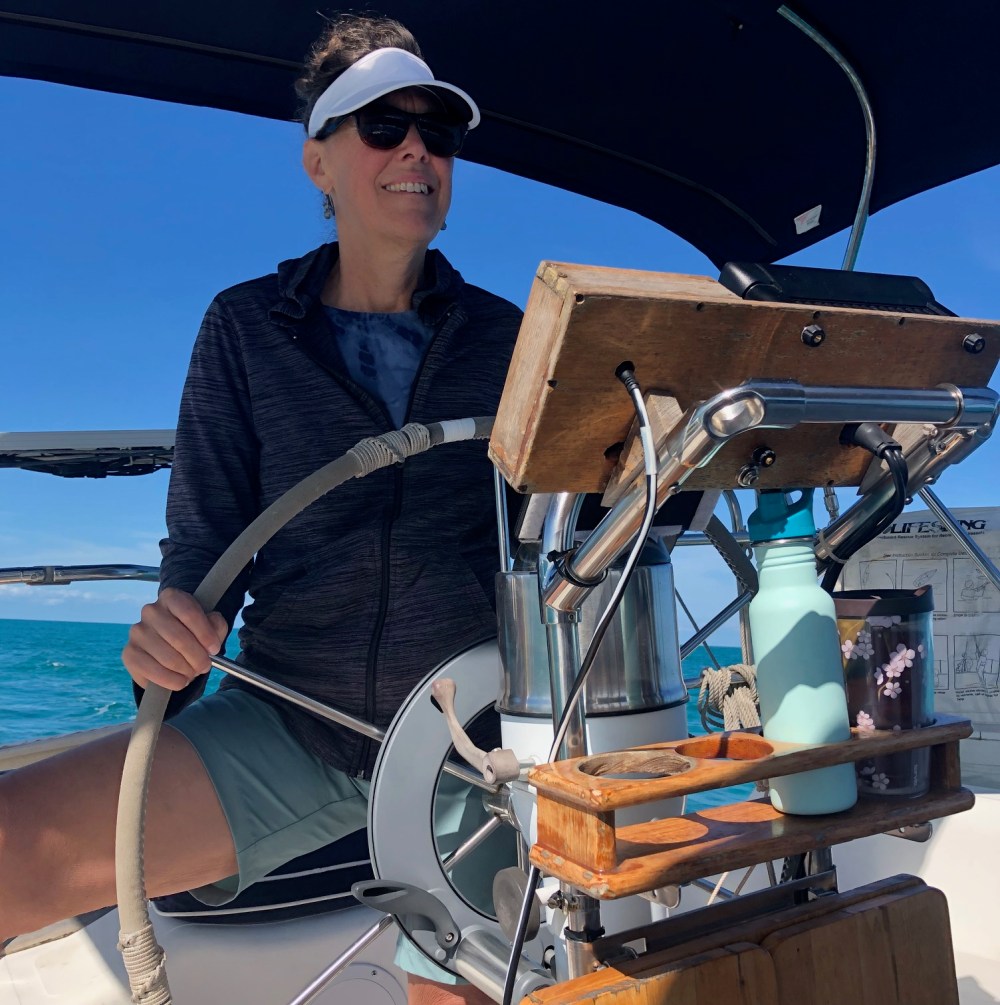
Part of sailing is not only accepting but embracing that despite our best efforts at control, we are in fact always in the flow. The crossing from the Bahamas to Fernandina Beach is a case in point—a true practice in response-ability. For me, sailing is and has always been a practice of dancing between surrender and control, with my comfort zone being more toward the control end of the spectrum. While I’m quite nimble at the helm and have excellent instincts when it comes to all things related to sailing, the unpredictability of the environment has been stressful for me. Will, on the other hand, has fully embraced living in flow on the boat, loving every minute of it, no matter what arises.

Lesson Learned: Accept that life is fundamentally unknown, try not to project too much into the future, and respond to what arises in each moment with grace, agility, intelligence, and heart. Plan when planning is required, but try not to have too many expectations for how it will turn out.

Relationship

For the past almost two years, we’ve been together in a small space virtually 24/7. So at the same time that we’re navigating the wind and waters, we’re navigating our relationship.

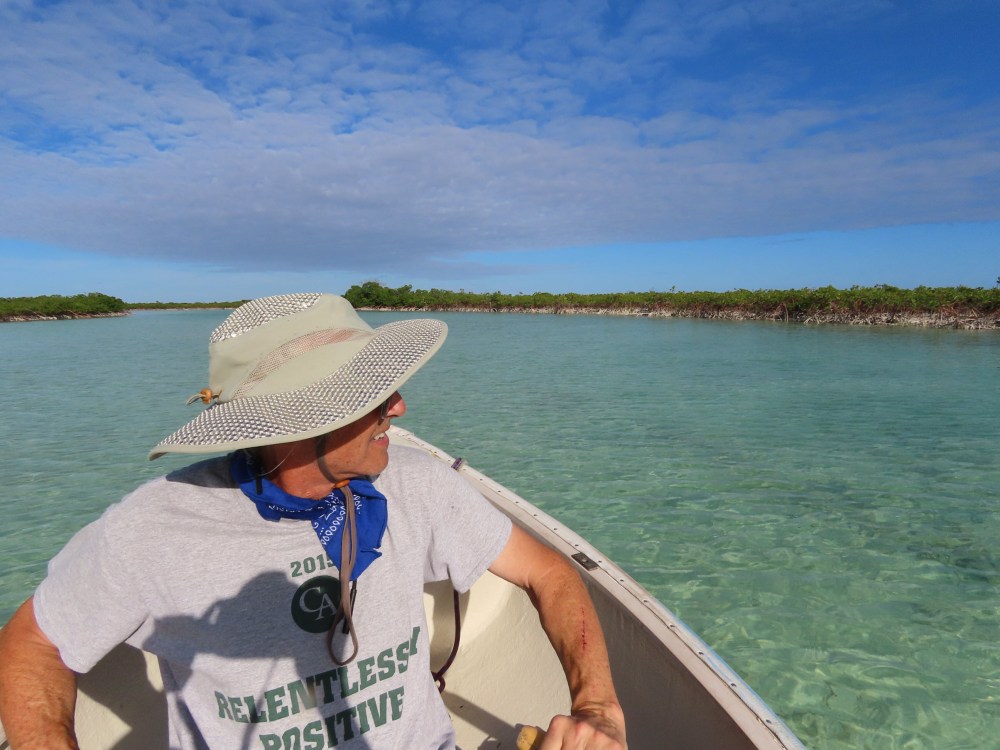
Life aboard a sailboat with a partner is an example of what my uncle used to call “relentless intimacy.” To address this, he wrote a book called Cruising Rules, a tongue-in-cheek account of how to navigate human relationships aboard a boat. The only cruising rule Will and I adhered to is that we “share the helm,” which means whomever is at the wheel gets to decide how we sail. We can and often do bounce ideas or suggestions off each other, which the captain-of-the-moment can choose whether or not to accept. That said, over time, we’ve become quite specialized in our roles. For the most part, we make a good team, although we definitely have our differences in sailing style. Accepting and appreciating those differences has been an ongoing practice.

While I tend toward planning, organization, and broad awareness, Will tends toward being in the moment, sensing the feel of the boat, and doing what needs to be done when the need arises. These differences are often complementary and can have a balancing effect on each of us. I notice when things need attention on the boat, and he’s happy to fix them. He notices when I spend too much time plotting courses, and I let go of some control. I organize and stow things in logical places, and he is coming to appreciate that this approach is helpful for finding things.

Over these many months, my emotional barometer has fluctuated between steady and rising slowly (appreciation), steady and rising rapidly (enthusiasm), steady and falling slowly (apprehension), and steady and falling rapidly (depression). A high can linger without a cloud in the sky, while at other times, lows float in unexpectedly on the wind. Will’s barometer, on the other hand, is steady and high most of the time, regardless of wind, waves, weather, or the state of various pieces of equipment on the boat that need attention.

Lesson Learned: In any relationship, accept the differences between you, be honest about your thoughts and feelings, and navigate the level of intimacy according to your own needs and desires.

*     *     *

I’ve come to many of these realizations late in life and not without some serious intention. Thus, the title of this blog—surrender to the abundance—is a practice and aspiration for me.

And yet, I’ve noticed that when I’m truly honest with myself and others, and when I let go of control and expectations, that’s when the universe provides in unexpected ways. Like stating out loud that I needed a break from the boat and being invited to stay with Sylvia and Elza on Cat Island. I hope that by the time I lay my head to rest at the end of the day, literally and figuratively, I will have surrendered fully to the abundance that surrounds us all at every moment.
NIRVANA S4:E6

March 23, 2023

Little San Salvador

There’s a small island ten miles off the tip of northern Cat Island, a convenient stop on the way to Eleuthera, our next destination heading north. It’s been renamed Half Moon Cay by the owners, Carnival Cruises, but the charts still 6 it by its original name, Little San Salvador. Reading the comments from other cruisers about the place, we were encouraged to stay the night in the wide, open bay after the cruise ship has left for the day and to leave the next morning before the cruise ship arrives. Some rated it highly as a “beautiful anchorage,” and another cruiser said they stopped for a week and went ashore to enjoy the free food offered during the day.

Pulling into the bay, we encountered a “pirate ship” on the beach and numerous beach huts and multi-story buildings. The place was deserted but for a large machine dragging over the long half-moon beach to smooth the sands for the next day’s arrivals. Sure enough, at 7AM a ten-story cruise ship made its appearance and began shuttling staff and then passengers ashore for the land-based activities: water sports, snorkeling, volleyball, basketball, horseshoes, shuffleboard, horse-back riding, hiking, glass bottom boat excursions, and of course, eating. Over the course of the next hour, we watched this spectacle unfold, thinking we might try going ashore and “blending in” to see what the cruise ship experience was all about. By 8AM, we thought the better of it, weighed anchor, and continued on to South Eleuthera, happy to have escaped.

Little San Salvador is 2400 acres, of which the cruise company has developed 50 for its activities, with the stated goal of “maintaining as much habitat as possible for wildlife.” The company purchased the island in 1996 for $6 million and employs hundreds of Bahamians, as is required when foreigners create businesses in this country. From the many conversations we’ve had with Bahamians, most agree that working in a resort means a good, steady income that they would not otherwise have, although some project this sentiment with more enthusiasm than others. From my eyes, I see an army of people of color serving white foreigners and wonder if this might be part of what I’m feeling—a sense of passive resignation.

And there are dozens and dozens of examples of this model across the Bahamas—white, foreign investors creating resorts of one description or another in a country where over 70% of the economy is from tourists, 70% of whom visit by cruise ship. The next largest sector, 15% of the economy, is banking and offshore international financial services, accounting for the most offshore entities in the world!

Needless to say, the cruise ship industry is a BIG DEAL in the Bahamas. So far, this is the first sighting we’ve had of these monster ships, which we saw stacked up like dominoes in Fort Lauderdale and Miami ready to make the crossing. Little did we know that the second cruise ship we saw in the distance that morning was heading for our next stop in South Eleuthera.

Lighthouse Point and Rock Sound, South Eleuthera

We pulled into the very exposed anchorage at the southern tip of Eleuthera, Lighthouse Point, but with winds from the north, we were protected, and much to our amazement, we were the only boat in the little bay—only the second time so far in the Bahamas. The water was crystal clear, the beach was beautiful, the rocky point was dramatic, and the path up to the light house and beach on the Atlantic side was lovely. With such privacy, we stripped down to our skin and enjoyed a great swim, extolling our good fortune at having found such an off-the-beaten-path anchorage.

The next morning, as we rounded the point, there was the cruise ship from the day before, offloading people in small boats ashore.

We assumed the long pier labeled “Under Construction” on the chart was being built for the cruise ship and confirmed our suspicion online—Light House Point, Eleuthera is Disney Cruise Lines’ latest development in the Bahamas. Since its purchase in 2019 of the 700-acre property, they’ve created a detailed environmental impact study—which apparently passed muster with the government—hired two well-known Bahamian artists to work with Disney “imagineers” to create an “authentic local feel” to the site (I’m imagining Junkanoo on steroids), and will hire 80% Bahamians, thereby creating 120 sustainable jobs for locals. As part of the deal, they will also donate 190 acres at the tip of the island to the Bahamian government for a national park.

It sounds good on paper, but how could developing yet another waterfront cruise village not hurt the environment, at least visually, if not in percentage of the island begin developed. These ships dump hundreds of thousands of gallons of treated sewage three miles offshore, apparently legally, but regularly dump plastic and food waste overboard, which is illegal. Their response is to receive the fines and simply pay them as part of the expense of operation.

And yet, we too are foreigners who come here on our sailboats for the pristine beauty of these islands and for the local culture. There are no regulations for dumping raw sewage overboard and everyone does it, as there are no pumpout stations like in the US. Who’s to say the Bahamians don’t have it right that creating another resort isn’t the best use of the land for the people?

Anchoring in Rock Sound further north, we asked the woman who worked at the well-stocked grocery store and gave us a ride back to our boat what she thought about Disney coming to South Eleuthera. “It’s terrible,” she said. “I don’t want them here.”

Later, as we wandered around the settlement and stumbled upon the Ocean Blue Hole, we met a youthful, middle-aged woman selling a variety of wares under the gazebo, including a book of fiction that she’d self-published, which we bought and have been reading. Like many people we’ve talked to in the Bahamas—who face the same outrageous prices in the grocery stores that we do. Like many people weve encountered in the Bahamas, she works hard piecing together several jobs to make a living.

“Follow the money” we heard about the One Eleuthera Foundation, a collective for sustainable development that would nix overscale development like Disney’s on the Although this organization has done some good, it seems that they are white people who came in as “saviors” and probably have no more on their mind than developing those same lands for themselves. It would be tricky for any group to look totally clean to locals but, on the face of it, OEF seems a better bet than Disney, given the two track records.

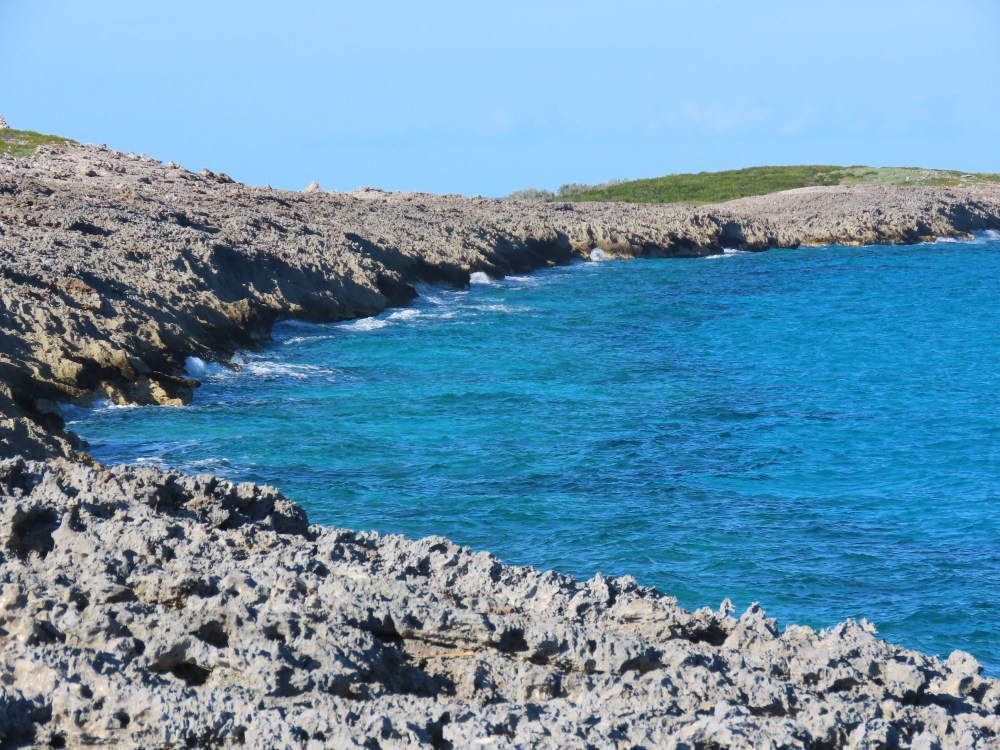
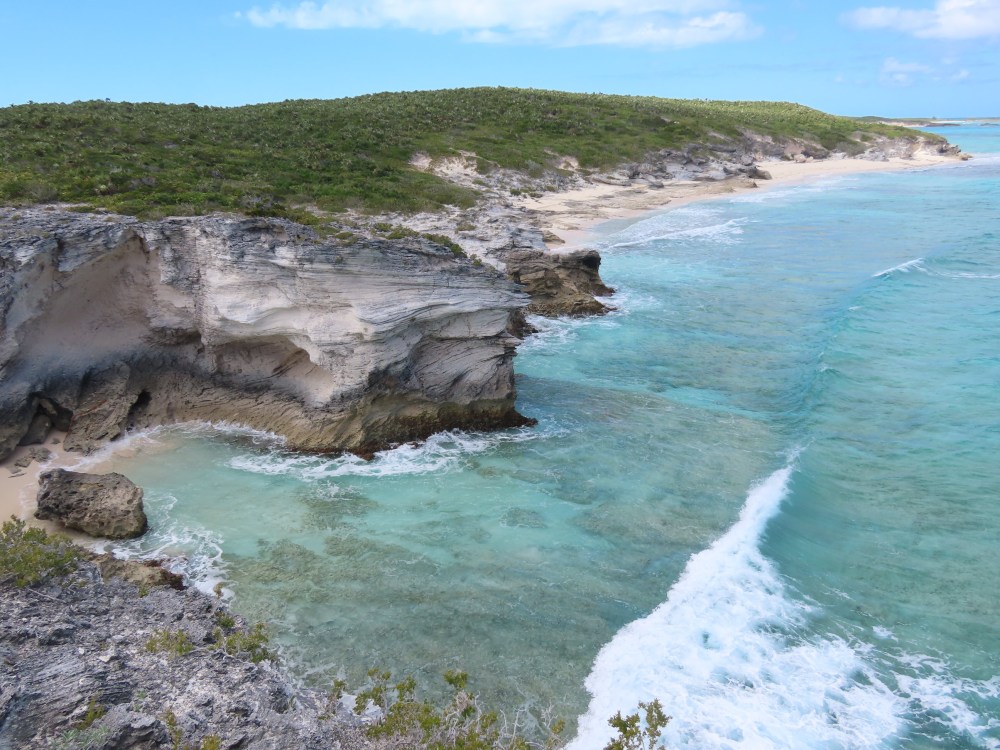
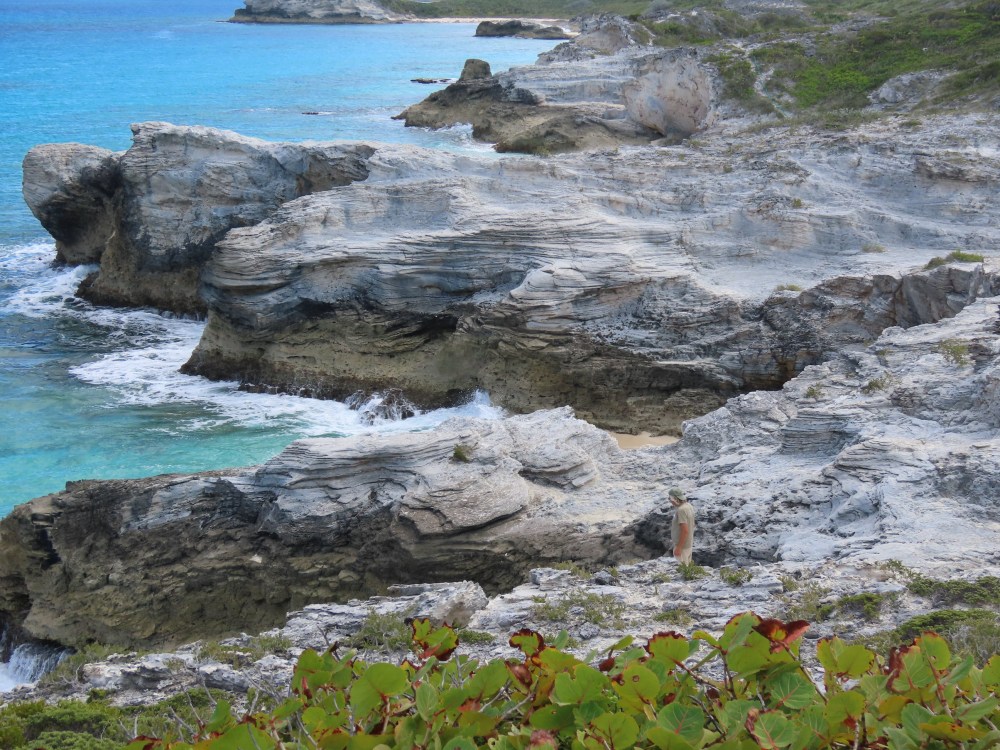
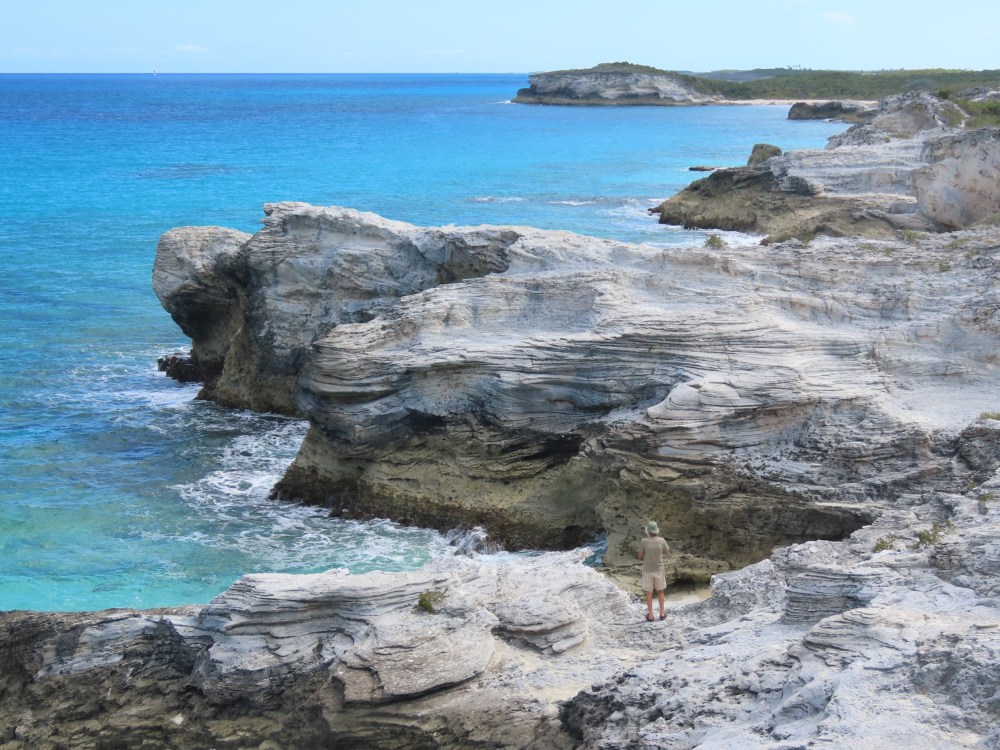
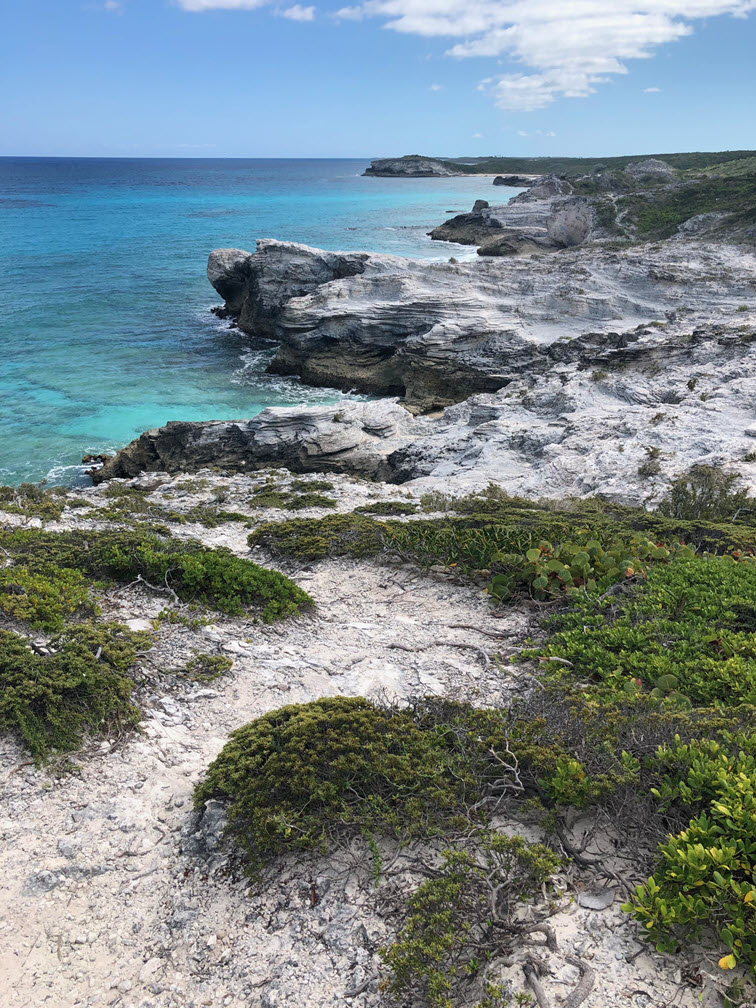
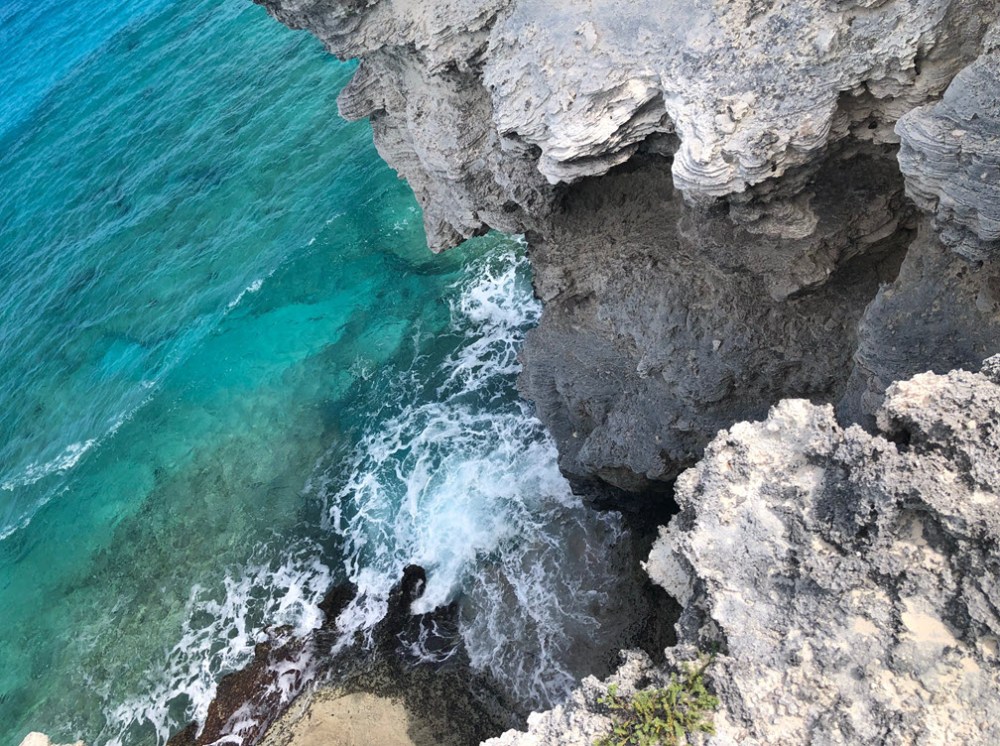
After several days, we sailed north stopping in yet another off-the-beaten-path, and very exposed, anchorage where we were the only boat. The bold rocky cliffs were reminiscent of Maine, and we enjoyed a quiet day in calm waters…until the wind shifted 180 degrees, the waves started rolling in, and a sleepless night ensued for this princess. Motoring up the coast the next morning gave us little respite until the next day when, after a good night’s sleep, I was able to see the world once again with clear, open eyes.

Governor’s Harbor and Hatchet Bay, Eleuthera

On Sunday, singing wafted high from the Methodist church at the head of Governor’s Harbor, where I stopped in to take in the sights and sounds. Later in the afternoon, an outdoor service took over a community gathering spot with a fervor that lasted hours. Each morning, an industrious man and his wheel-chair-bound father boarded their small fishing boat for full days of fishing, even on Sunday. We had spoken just a few words to each other, across bows, when we picked up a mooring the first day, and we were touched when the fisherman gave us a hale wave as we left a few days later.

Walking up the hill we noticed a distinct difference to this place: many of the houses were from the mid-1800s, of more stature, and the environment more manicured than we’ve seen anywhere in the islands. It had a distinctly colonial, upscale feel, which was confirmed by Catherine, the Swiss-educated, Bahamian owner of the Buccaneer Club with its Sunday afternoon live music and attached ice cream and gift shop selling fancy women’s attire and coffee table books of Cat Island and Eleuthera. According to her, the visitors to this part of the island are mostly New Yorkers, along with, among others, the Royal Family and Lenny Kravitz, who lives part of the year in the modest home where his grandfather grew up.

As we’ve heard countless times, the Bahamas is home to the rich and famous, as well as the poor and underserved. The writer we met writes succinctly about this slice of the Bahamian culture in her stories that relate problems of obesity, diabetes, teen pregnancy, unemployment, drug abuse, HIV/AIDS, single motherhood, and marital rape. These problems are especially acute in the outer islands where community resources are minimal compared to the urban centers: think health care and social services. That said, her stories all have an upbeat turnaround, which she uses to inspire personal responsibility for making better choices.

To a lesser extent, the Bahamas is also home to a growing middle-class of hard-working people who find steady work and/or create self-sustaining businesses. We’ve also heard many stories of people leaving for Nassau at a young age where the urban lifestyle provides plentiful work, as well as all that goes along with it—traffic, over-congestion, and crime—then return to the “family islands” where their people were born.

Andros:

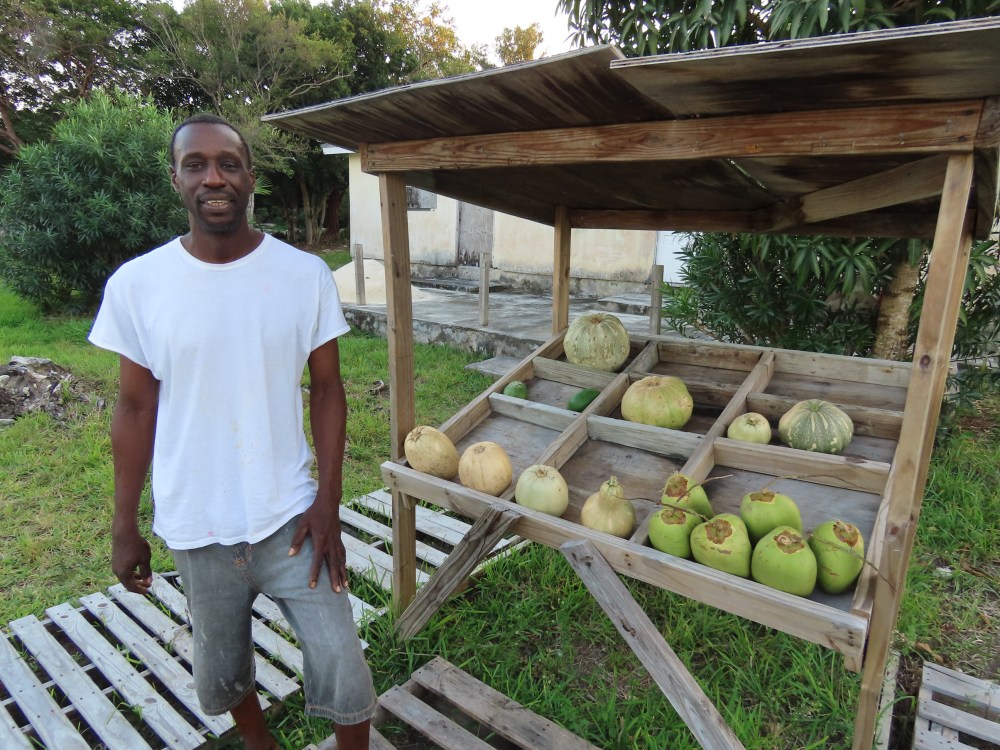
“I was a cab driver in Nassau for thirty years. Now I live in my mother’s old house and sell coconuts and vegetables on the roadside to make ends meet.”

“I worked for the Bahamian Government in Nassau for thirty years and when I learned that a position as head of the Labor Department opened up on my home island, I jumped at the chance. I wanted to give back to the community where I was born. Oh, and I have cars to rent if you need one.”

Exuma:

“We live on Warderick Wells for a few weeks at a time, then we go back to Nassau. Here we enforce the regulations in the Exuma Land and Sea Park, which mostly means driving around to boats collecting payments for moorings. In Nassau, as security police, we’re in the line of fire, fighting crime. Who wouldn’t want to come here?”

Cat Island:

“My father started this grocery store, and now we own a small shopping plaza. I’ve never been off the island, and I like it that way.”

“My husband used to work at a restaurant in Nassau, but we came back home to start a small take-out restaurant. It does well enough.”

Eleuthera:

“I worked for Paradise Island resorts for 38 years and came back to Eleuthera to start a small business selling clothing. I should have done it years ago.”

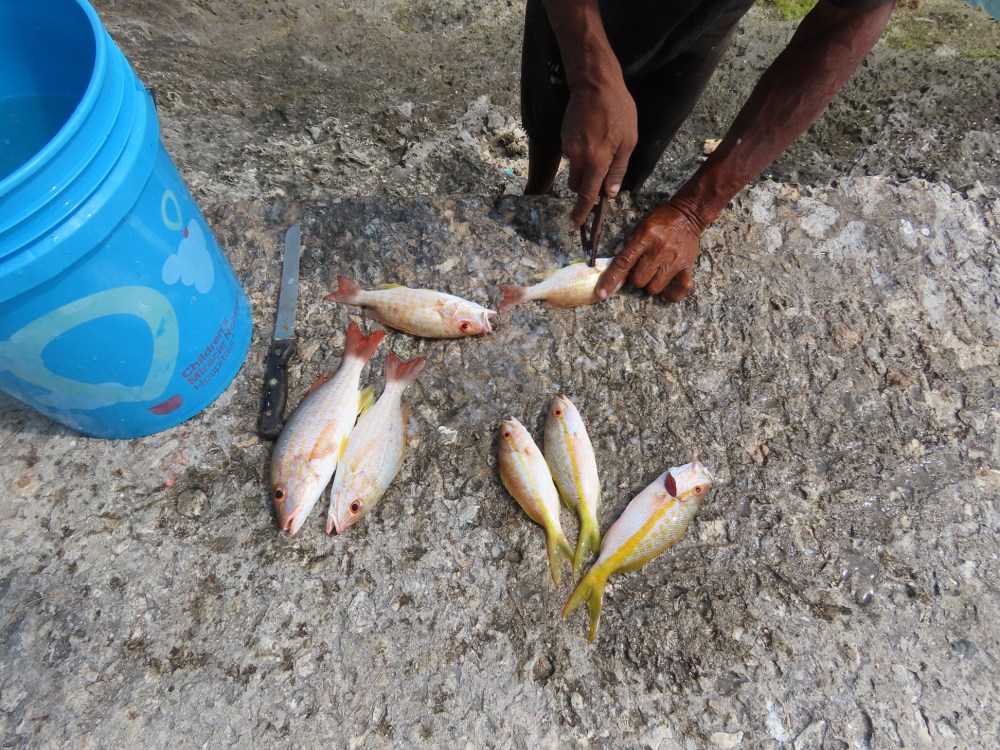
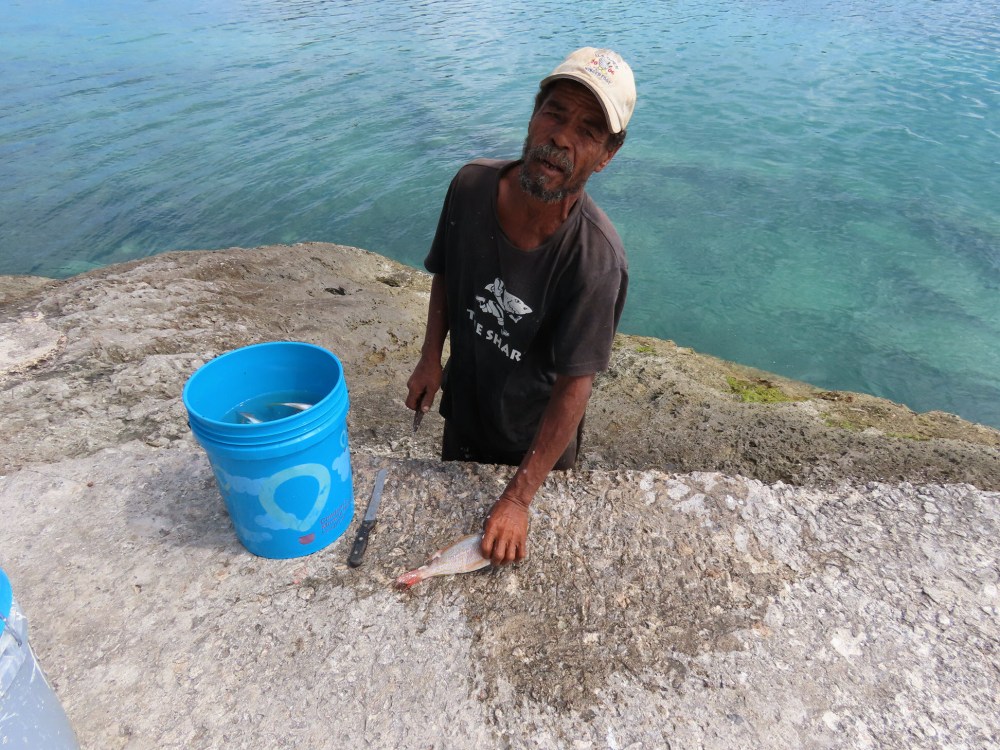
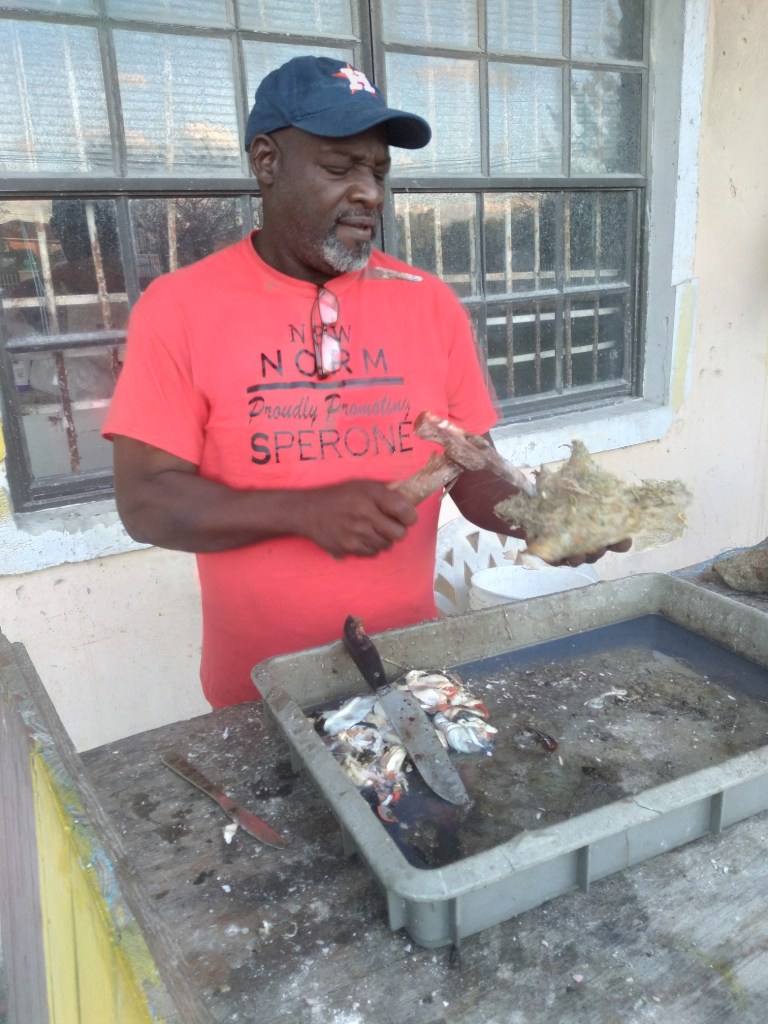
“I’m cleaning these fish for a guy on that sailboat. You can have these four snappers he gave me for ten bucks.”

If nothing else, Bahamians are extremely resourceful, and yet they are deeply dependent on the American economy, one might even say enmeshed—the two currencies are, in fact, interchangeable. For many years, the enmeshment took the form of drug smuggling. Now, legal offshore banking has legitimized all financial exchanges. Americans own much of the property and many of the businesses, and the American government has a large military base as well. Why? The Bahamas has no income tax, corporate tax, capital gains tax, or wealth tax. It does, however, have a 10% Value Added Tax on all goods coming into the country, and as almost everything on the outer islands comes by container ship or plane from Nassau, and almost everything in Nassau has to be imported, the cost of goods is extremely high, often two to three times the cost in the US. It’s a wonder the Bahamians prosper as much as they do, albeit largely on rice and peas, fried fish, and Bahamian mac ‘n cheese; thus, the obesity and diabetes.

A commonwealth of the United Kingdom since 1648, the Bahamas gained governmental independence in 1973, yet it has been deeply interconnected with America and Europe for centuries. Unlike the original inhabitants, of the 400,000 Bahamians who live on the islands today, most are descendants of freed slaves from American Loyalists, who were resettled by the Crown after the American Revolutionary War. When slavery was abolished in the Bahamas in 1834, the country became a haven for freed African slaves from North America and British slave ships. And what of the native people from these islands? The Lucayans, who inhabited these islands for centuries prior to their “discovery” by Columbus, were removed, enslaved, and extinguished by diseases brought by Europeans. And so, the history of these islands is much like that of our own country, except that here, the descendants of slaves actually rule the government, if not the economy, which largely remains in the hands of rich Americans.

Glass Window

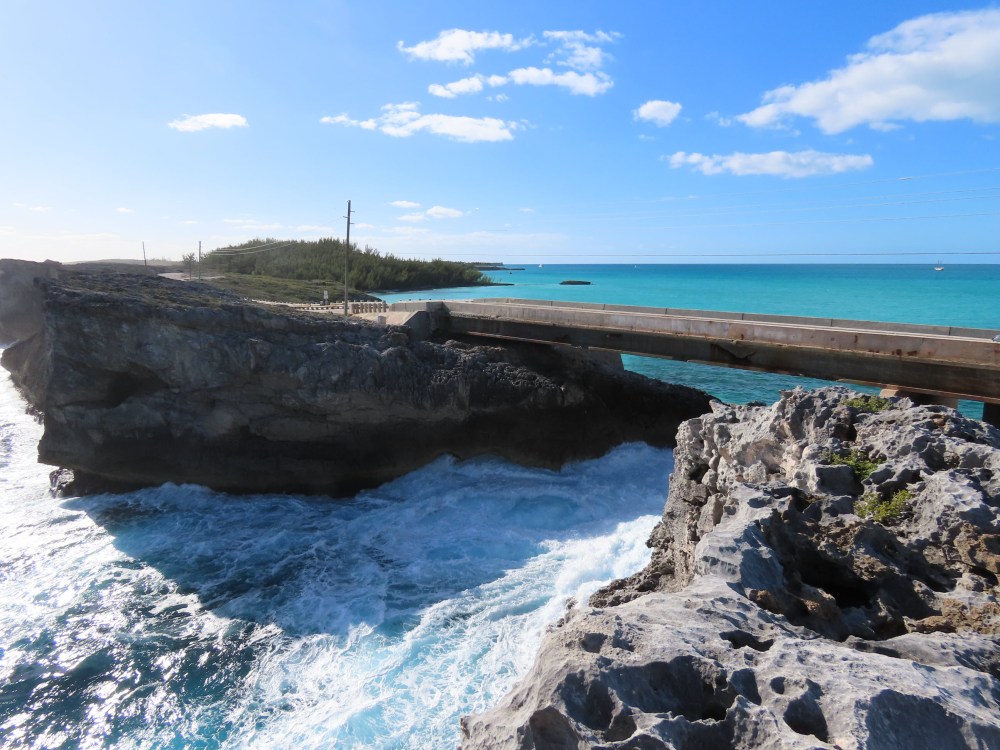
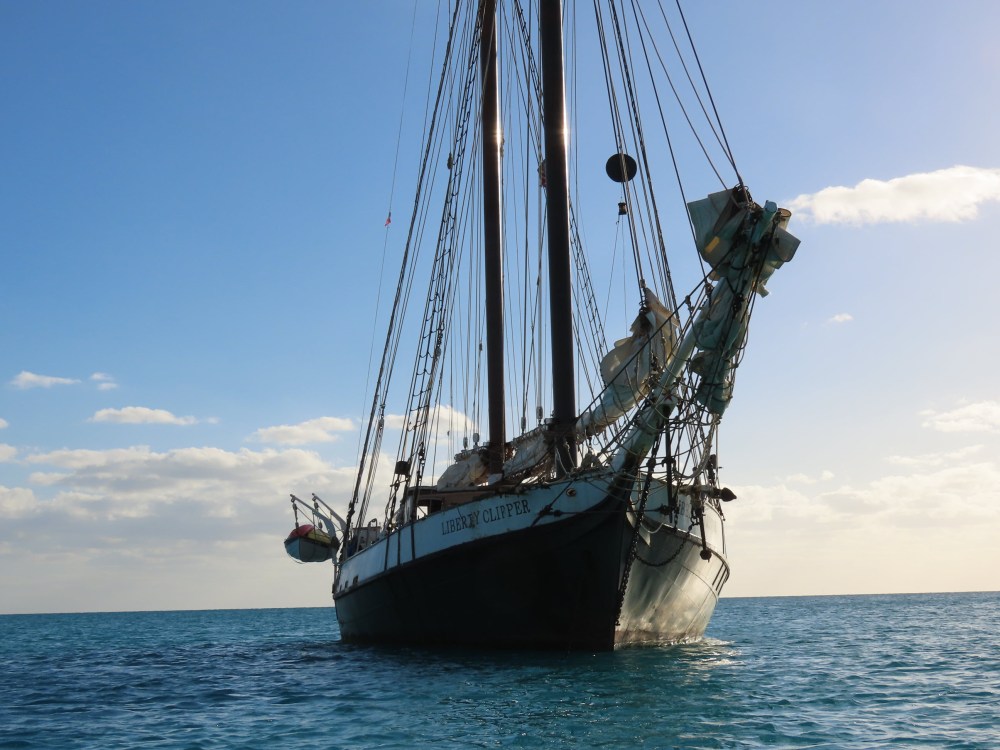
Leaving Hatchet Bay, we anchored off Glass Window, where a very narrow strip of land divides the ocean from the sound, but  with the change in tide, the water gushes in and out connecting the two. Much to our surprise, the Liberty Clipper, a 120’ schooner hailing from Boston, was anchored off during one of its Bahamian cruises. Two of the crew were driving around in their large tender and said they were headed over to see the window. As I sometimes do, I asked if we could catch a ride, thereby saving us a long row. With their captain’s agreement, we got up close and personal with the spectacle as the Atlantic Ocean trickled and splashed over the land into the sound at low tide. We also got a tour of the schooner, which is always a thrill and made me nostalgic for Maine, which is swarming with schooners. We also saw the glass window opening from the bridge above, as well as the Queen’s Baths, where the water splashes into high pools above the ocean swells.

Spanish Wells, Eleuthera

We’ve now visited Eleuthera from bottom to top, landing in the strange, foreign land known as Spanish Wells, where 90% of the inhabitants are white Bahamians and the blacks are mostly from Haiti. These Bahamians have an unusual British-Aussie-Irish-Bahamian accent unlike anything we’ve heard. St. George’s Cay, which makes up one half of the community of Spanish Wells, feels like Coconut Grove in the 50’s with its mostly one-story colorful cement-block house and manicured lawns where everyone drives around in golf carts. While engaging when you speak to them, people don’t say “Good afternoon” in the friendly manner we’ve heard from black Bahamians in the settlements, and they don’t look you in the eye when they walk past. The large grocery store is off-the-charts compared with all the other stores we’ve been in with tons of fresh produce and meats, and a pharmacy department complete with fluorescent lights like in the states. It feels like another planet!

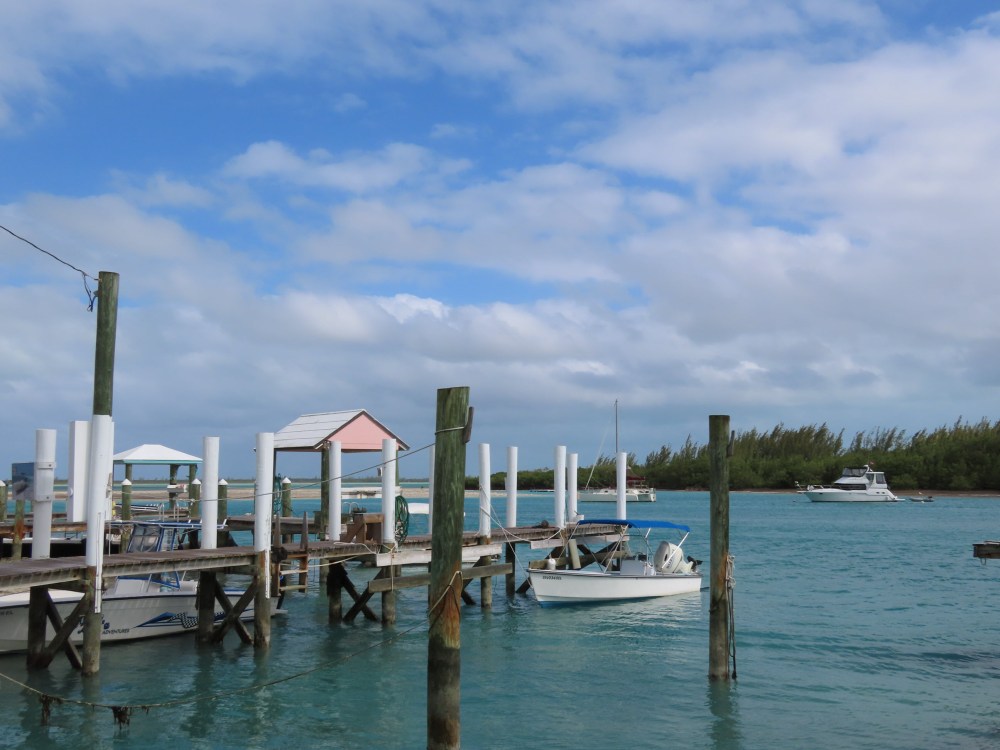
Arriving to seek shelter from the upcoming winds and seas, we learned that all the moorings and slips were full, but someone recommended Kyle Pinder’s dock in Muddy Hole on Russell Island, the other island making up the “harbor” (called the creek) of Spanish Wells. Turns out the main road in town is named after his grandfather, Leo Pinder, one of the grocery stores is called Pinders, and the school is the Samuel Guy Pinder All-Age School. Kyle and his cousin couldn’t have been nicer helping us tie up our boat and giving us the lay of the land. He directed us where to land our dinghy on the other side of the creek, but when we got there, we had to ask someone which dock was his. The guy said, “Kyle Pinder owns half the docks in Spanish Wells, so that doesn’t help!”

Investigating further at the Spanish Wells museum, we learned that white Bahamians arrived here in 1648 after leaving Bermuda seeking religious freedom and were shipwrecked on the Devil’s Backbone, a coral-reef-strewn shoreline at the northern most tip of Eleuthera. One group of freedom-seekers went to New Providence, aka Nassau, and the other settled in Spanish Wells. The inhabitants of the island are largely descendants of these early Puritans—Pinders, Higgs, and Sawyers—along with some later Crown loyalists who left the United States after the American Revolution. In fact, these early settlers called themselves the “Eleutherian Settlers,” which is Greek for freedom. The island has remained largely self-sufficient, community minded, God worshiping, and white ever since.

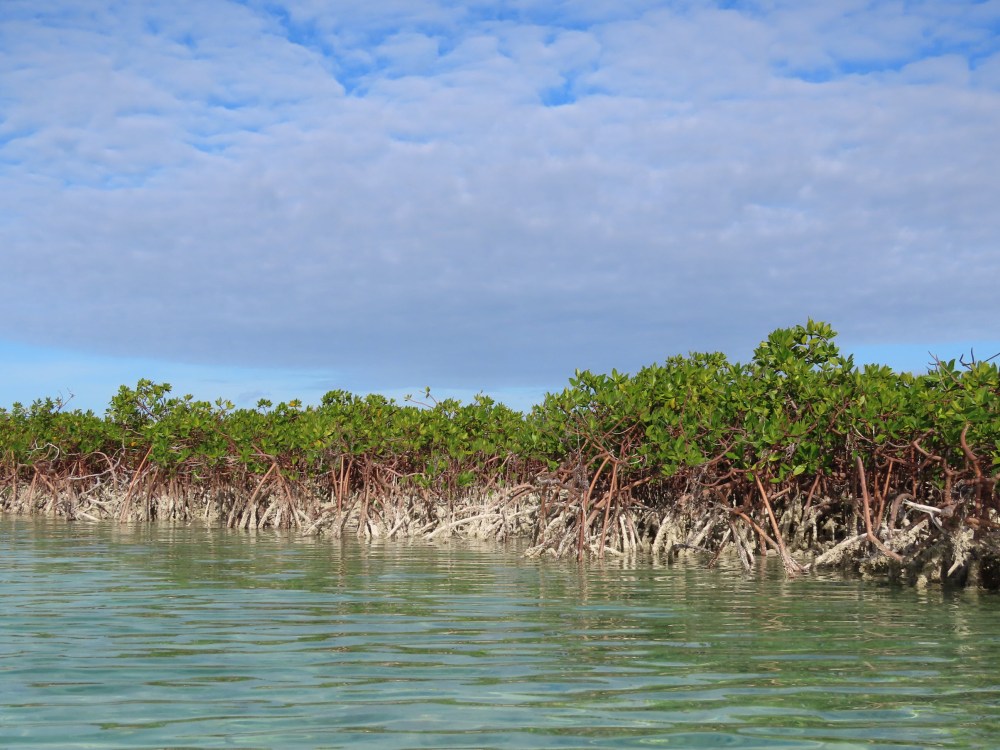
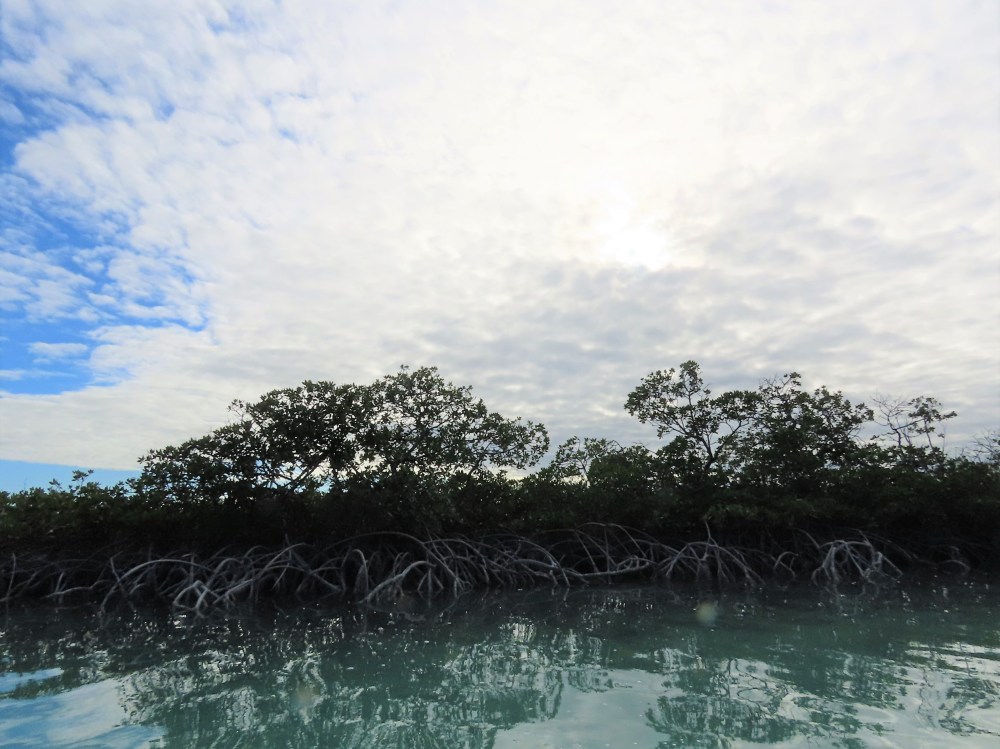
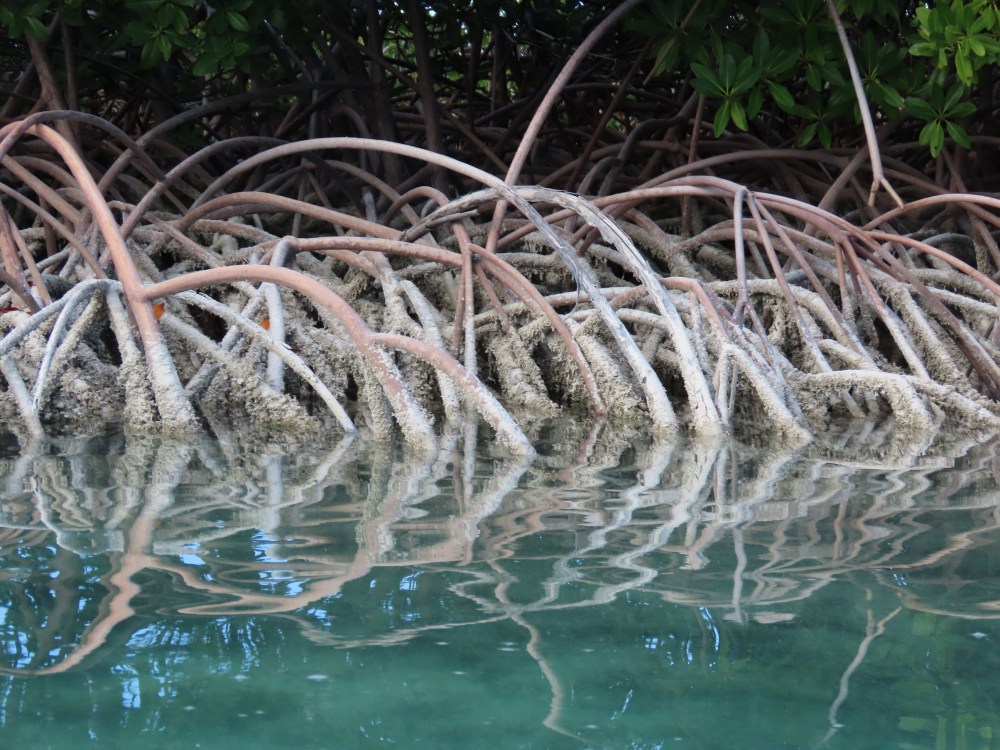
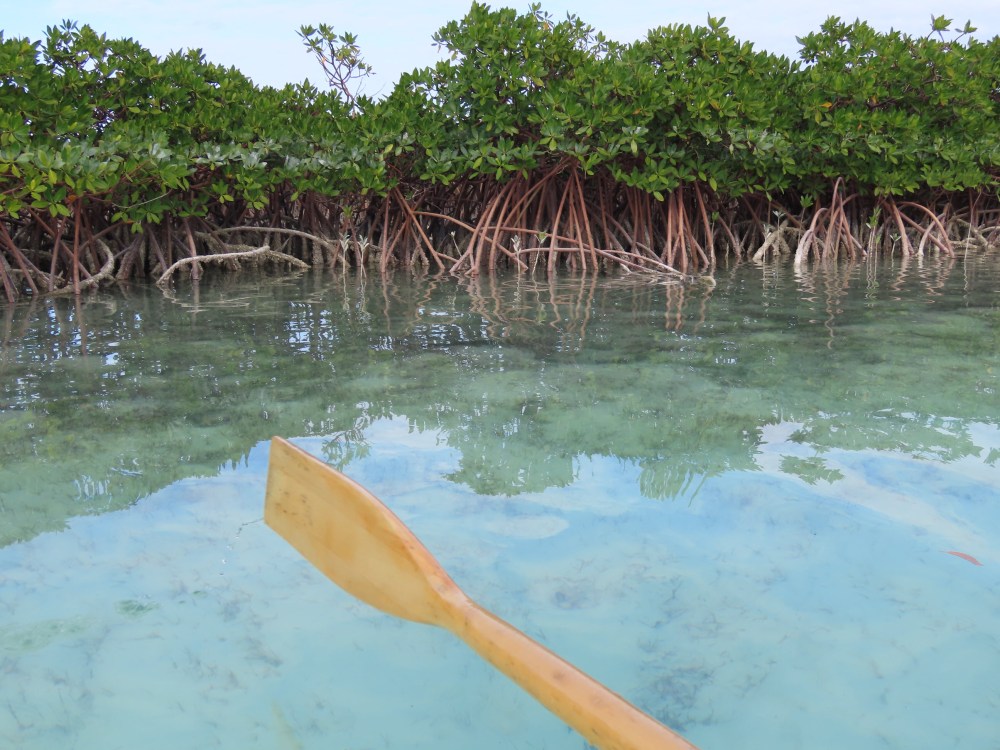
After a night at the dock, we anchored out in Muddy Hole, which is a little hidden gem—a super-protected opening in the mangroves, as tranquil as a land-locked pond. Despite days of significant wind and rain, many very welcome calm nights and good sleep ensued. Exploring Russell Island by foot, we were offered a ride in a golf cart by a white Bahamian from Nassau who has recently been investing in land on the island; since COVID, the prices have been exploding and he wants in. In fact, it appears that half of Russell Island is for sale and the other half has recently been developed, including a man-made canal reminiscent of Florida to create “waterfront” property for the rich.

In the course of our tour, he told us that Spanish Wells is known as the “white, racists” island, which indeed he was, although he claimed otherwise. I cannot even repeat some of the things he said because they were so offensive. And yet, every once in a while, it’s good to come face to face with people with such extreme beliefs to remind yourself of your own values. Why he chose to reveal his extreme racism to us we don’t know, except that Will especially is extremely good at asking probing questions that get people talking about themselves and their lives. In Hatchet Bay, for example, we chatted with the owner of a small clothing store for an hour about his return home from 30 years working at a resort in Nassau. With each revelation, he chuckled and said, “I don’t know why I’m telling you this, but…” And it’s happened countless times throughout the Bahamas. I guess we are open and curious, and take the time not only to ask questions but to listen to the answers. We’ve found that people love to share their stories as much as we love to hear them; it’s how we get to know a place—by its people.

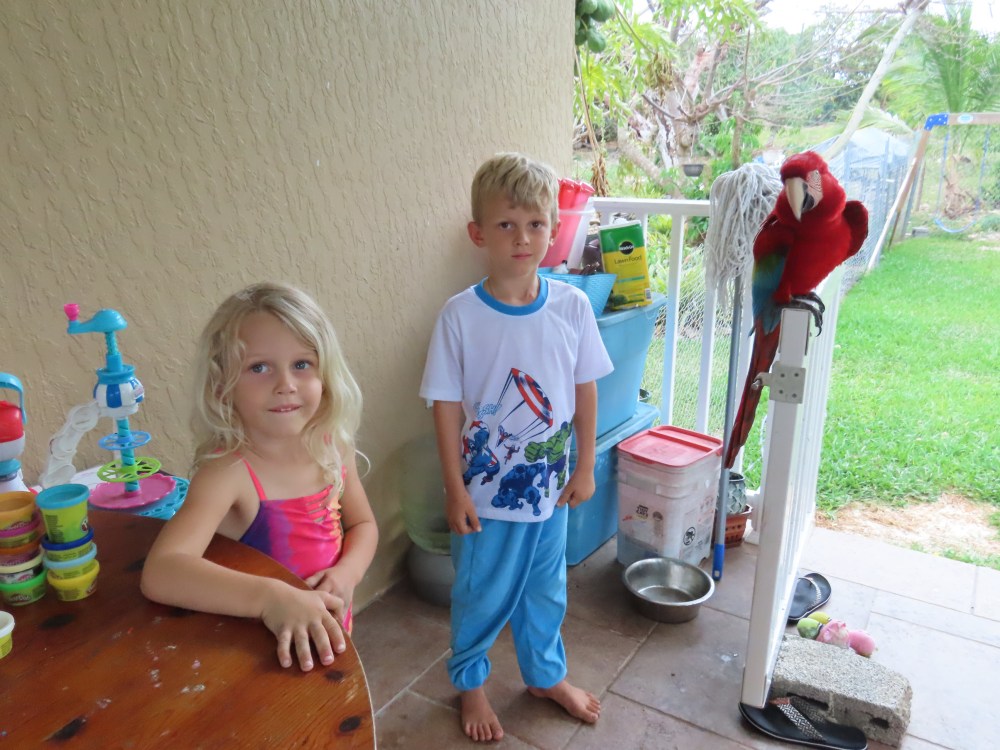
As we continued on our walk around Russell Island, we saw a sign for a Lutra Sails. Curious about what kind of business a sailmaker has on Spanish Wells with so many motor boats, we called the phone number on the sign. When Lorin arrived back from his run, he invited us into his shop, sweat still pouring off his face. Turns out he mostly does canvas and vinyl work, but not only that, he is the Bahamian National Champion in time-trial bike racing and road racing, and recently won both titles in the same Championship, which has never been done before as riders feel too spent after just one of these. Soon Deann and her two adorable children took me upstairs to meet Skittles, their macaw, a beautiful bird she’d owned for nine years.

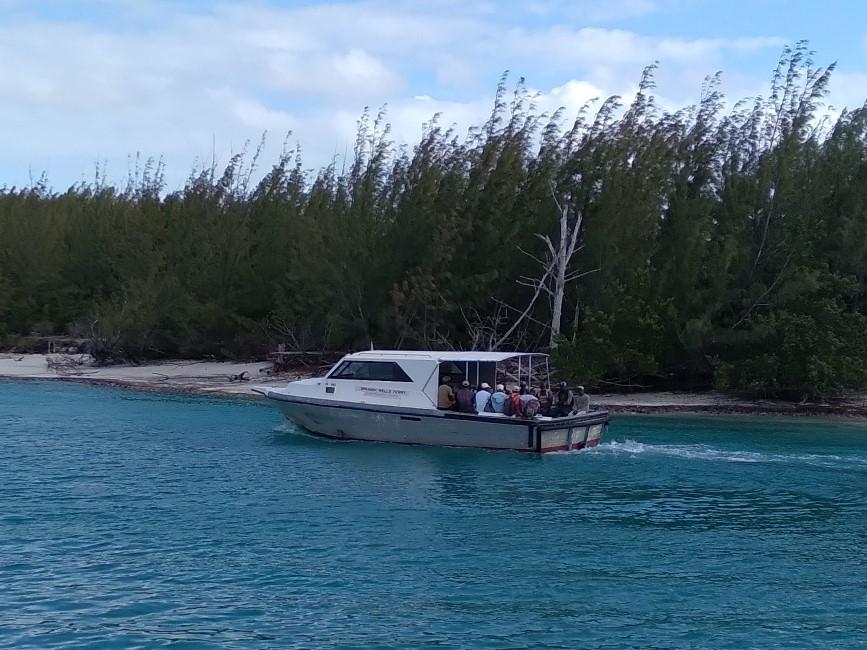
While Leann, the kids, and I picked tomatoes, played marbles, and painted rocks, Will learned about the canvas trade, as well as lobster fishing, which Lorin did for many years. In the 1980s, the fishermen of Spanish Wells devised a form of lobster trap that they call “condos,” which the spiny lobsters crawl under for protection. These “traps” are simply pressure-treated 2x4s with a corrugated tin roof but no bottom. Diving for them using hookahs—hoses attached to air compressors on the surface—fishermen can often bag up to 40 at a time. In fact, Spanish Wells is the largest processor of lobster in the Bahamas, exporting 70% of its catch to Red Lobster in the US. We also learned that fishermen own their boats and earn their pay cooperatively, whereby everyone gets an equal share of the profits—a holdover from the early settlers. Because of the abundance of lobsters and other fish, fishermen can earn up to $30k in three months in this trade, which combined with a booming construction trade means that unlike many of the family islands, few people ever leave. Well, except for the black Bahamians, who are ferried by the boatload back and forth each day from the mainland to work on the island for the locals.

After more than a couple of hours with this delightful family, we returned to the boat with two paw-paws (papayas), a jar of home-made salsa, and a much warmer feeling about the place, especially after our earlier encounter.

From Lighthouse Point to Rock Sound to Governor’s Harbor to Hatchet Bay to Spanish Wells, we’ve covered a lot of Eleuthera, which is the most diverse Bahamian island we’ve encountered so far. Although we are among the racial majority here in Spanish Wells, we feel less “at home” here than in other parts of Eleuthera and the family islands. Perhaps it’s the feeling of insularity and isolation from the rest of the Bahamas that feels so uncomfortable. Or perhaps it’s a sense of racist undertones; it’s clear that the Haitian workers are invisible and only speak when spoken to. Or it could be that affluence has brought about more social “cliques,” evidenced by the relative unfriendliness of passersby that appears to be another striking import in their spiral toward Americianization, which, thankfully, is so much slower in the other family islands.

NIRVANA S4:E5

March 7, 2023

And the adventure continues…(I hope you read to the end so you know it’s not all paradise here in paradise.)

Stocking Island

After two most-welcome days at a marina where I sat for hours in a rocking chair on land getting some time on solid ground, alas the swell started rolling the boat at the dock. As the winds were reported to be increasing and the entrance to the marina can be impassible in heavy seas, we decided to book it out of there and head back to George Town, where at least we didn’t have to pay for rockin’ and rollin’.

As predicted, the winds blew steady and hard for a week, with large seas reported outside the relatively protected harbor. For me, it was a long seven days of relentless wind and choppy seas such that we rarely left the boat as rowing against all that wind and chop was hard. And as the wind was out of the east, we couldn’t sail in any direction but back from where we’d come, and so we waited…

One day, I rowed the short distance alone to the social gathering spot, Chat ‘n Chill, for a respite, but the wind on land was stronger than on the boat, which at least has a dodger and cabin to protect us, so I came back disheartened to endure the wind and seas for several more days. Needing to do something to lively things up, I organized a dance at Chat ‘n Chill, which a number of people attended. It was great to feel the spaciousness of movement on land, as for me, the boat can feel very confining after days on end.

Mid-week, one of our two bottles of propane ran out, so the never-daunted Will decided to row the one mile across Elizabeth Harbor to drop off the tank and pick up some groceries. With many engine-powered dinghies going back and forth, he caught a tow back, getting soaked in the process from all the chop. Another day, he got a ride from our Canadian friends to pick up the tank. This time he put on a large rain poncho to save himself from getting drenched. Having been soaked on another occasion transiting the harbor with this couple, I gave that outing a miss.

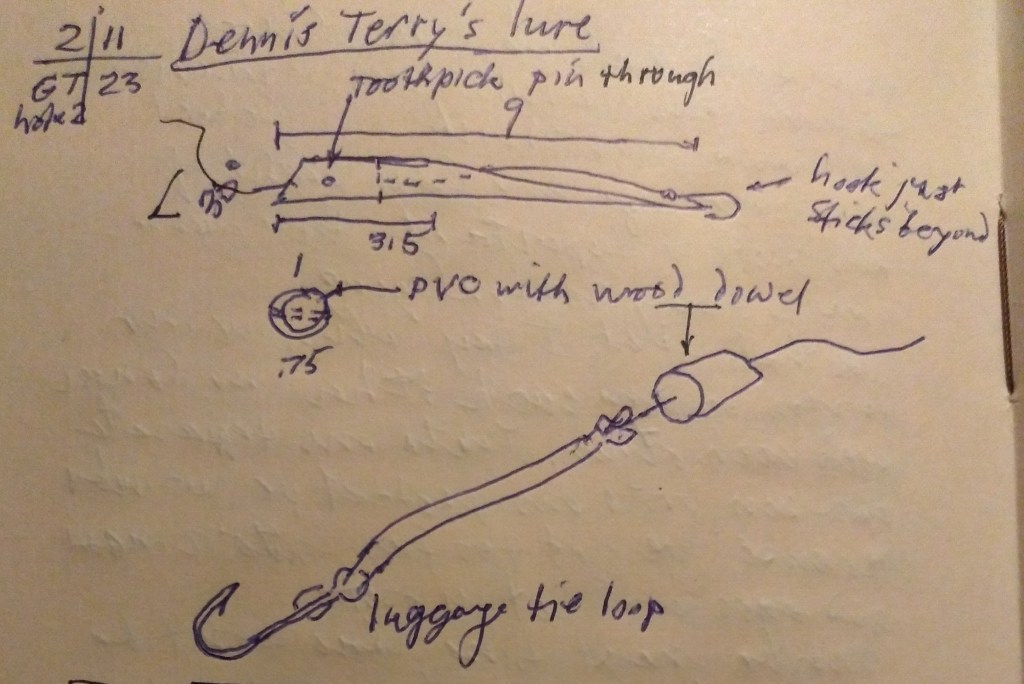
Finally, the wind let up somewhat and we ventured out in the dinghy to explore one of the extremely protected “holes.” There we encountered Dennis, whom I’d met a number of years ago when he was a launch driver at Handy Boat in Falmouth where I kept my boat. Now in his 80s, he has no fixed address and has been coming to this spot in the Bahamas for decades. He offered Will a neat home-made fishing lure made of PVC, which he learned about in Fiji from a solo around-the-world sailor in an engineless boat. The stories you hear of and from sailors are endless! Alas, Will lost the lure the first time he used it when a fish actually took a bite, but he’s since made several himself (see design below). We continued on a long hike to the top of monument hill overlooking the harbor, where sailors have spelled out their boat names in stones on the flat landscape below. It was great to finally stretch our legs, muscles, and energies in an outward direction on land.

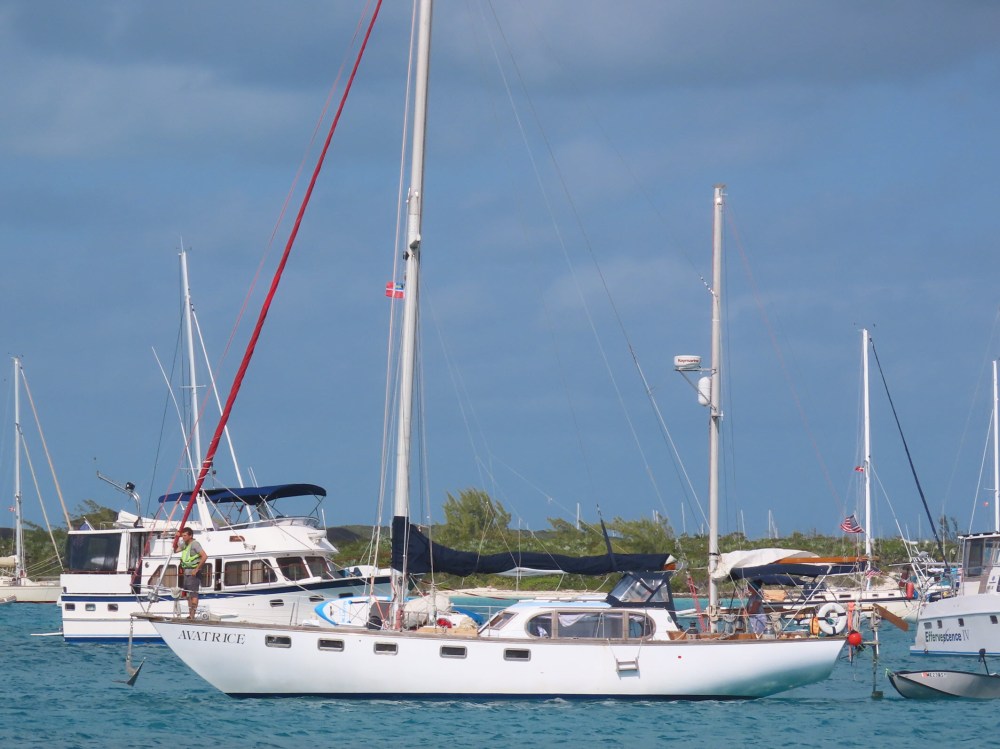
We met up with a number of people from Maine during our week waiting out the winds. The first was a family who bought sv Avatrice, which I recognized as the boat that was owned by a woman in Maine who, for more than twenty years, ran Women Under Sail, a sailing school for women. After texting since Florida with another family who sails in Maine, we finally met up with them as they sailed over to greet us in their small dinghy.

So the week was not without its entertainment and diversion, but for me, it was a week of feeling stuck on the boat. From Will’s perspective, it was another week in not-undesirable weather, tackling boat projects, reading, and enjoying the warm air and cool breezes, despite his partner’s distress.

Long Island

Although the wind was still up, it finally changed to a favorable direction such that we could head east to Long Island, one of the so-called Out Islands of the Bahamas. To get there, we had to navigate one of the infamous “cuts” that took us out of the relatively protected harbor into open ocean. To do this, you try to plan to go through at slack/”no” tide to avoid the wind-against-tide phenomenon that causes rough seas and breakers. We heard later that some friends got an early start and a wave crashed into their cockpit from abeam and scared them pretty badly. We, on the other hand, got a later start and had medium choppy seas for only a short bit before things calmed down. The cut behind us, we had a great sail behind the reefs toward Thompson Bay. Ever the cautious one, it is often the case that for me, the anticipation of the impending threats are more difficult than the thing itself.

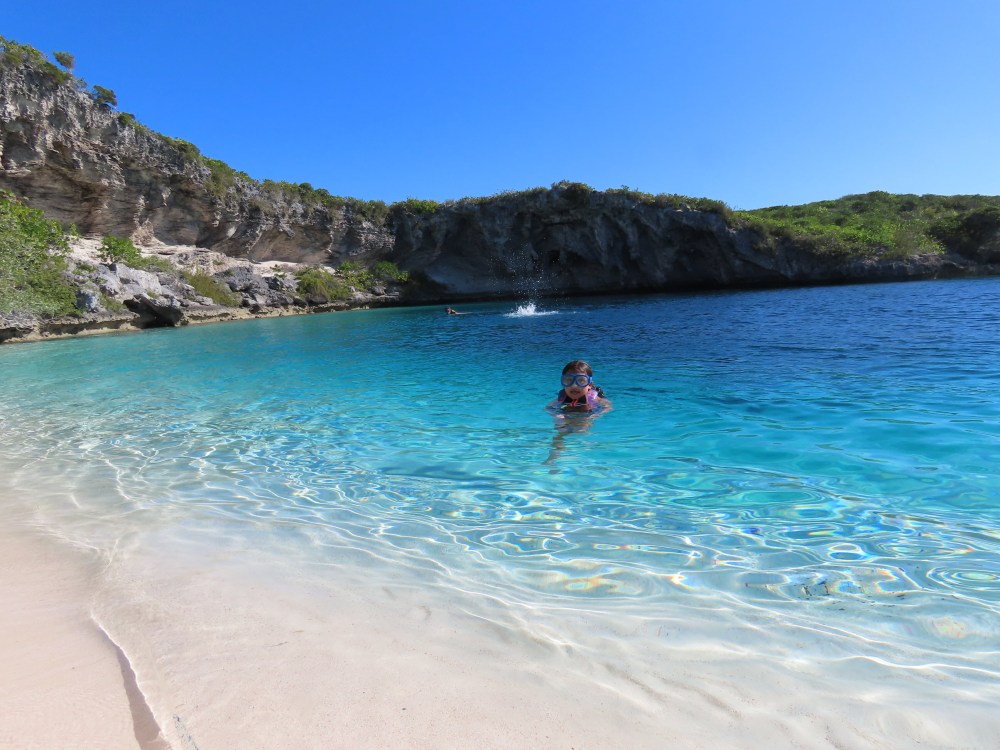
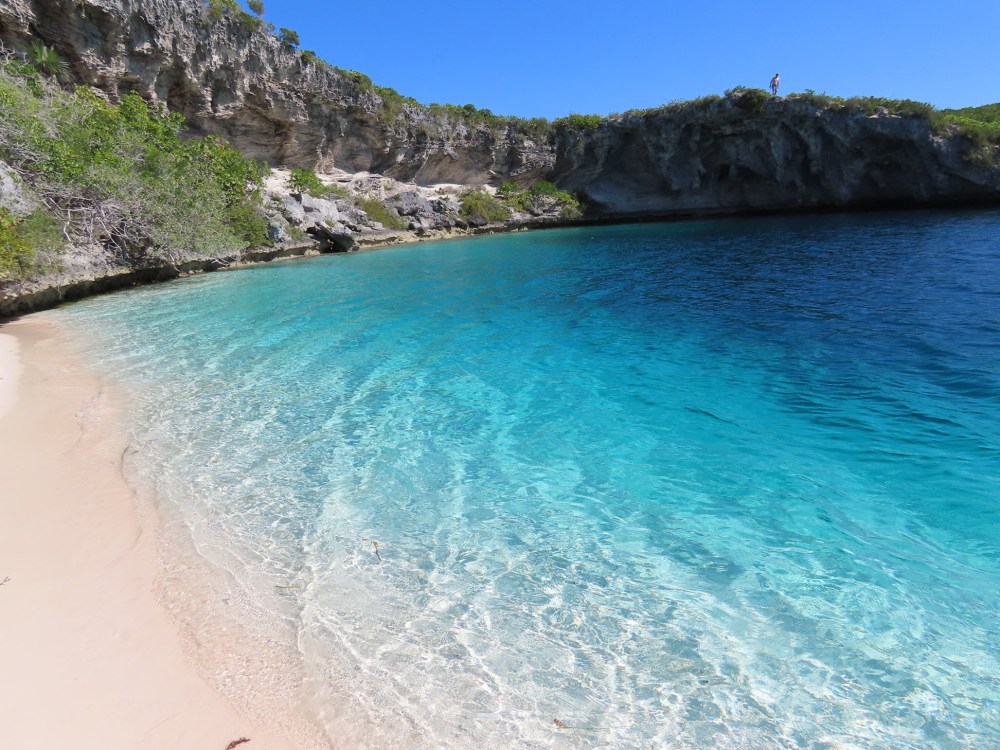
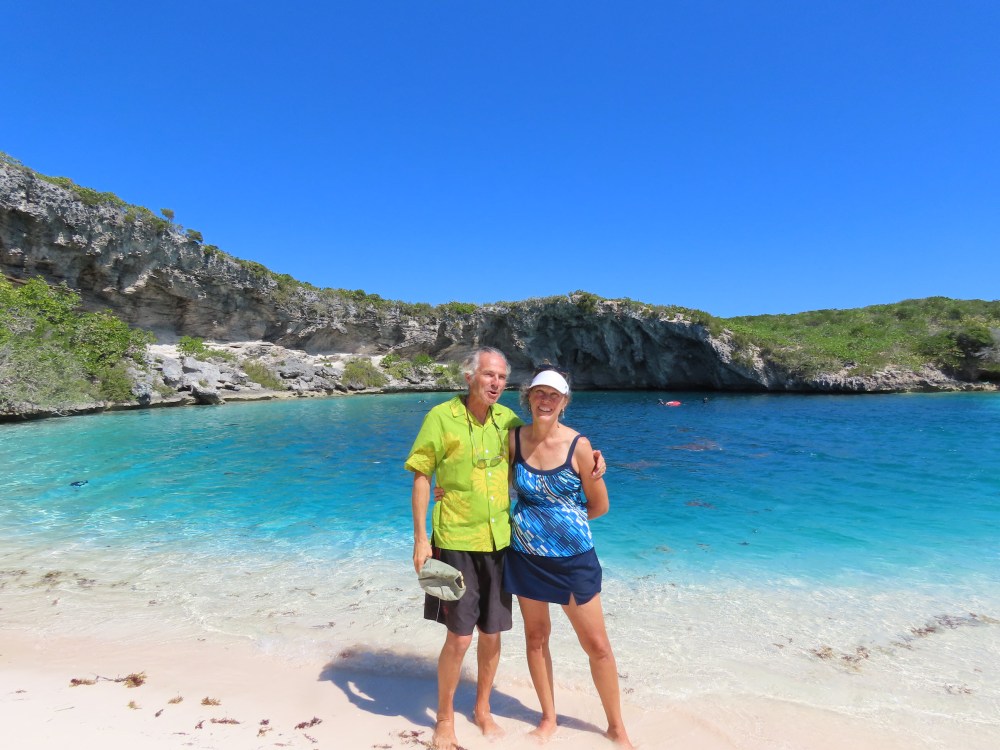
When we arrived in Long Island, wouldn’t you know it, there were our friends on Avatrice, as well as a couple dozen other boats who had the same idea of fleeing the wall-to-wall boats in George Town. Our friends offered to share their car rental, so we happily spent the day touring most of the island with them. First stop was Dean’s Blue Hole, which is known to be the deepest blue hole on the planet and is in fact where they have the annual freediving (no scuba tank) competition where the world record was recently set at 393 feet! We snorkeled and saw some cool fish, and our six-year-old friend found a sea biscuit, which looks like a puffy loaf of bread with a star on top.

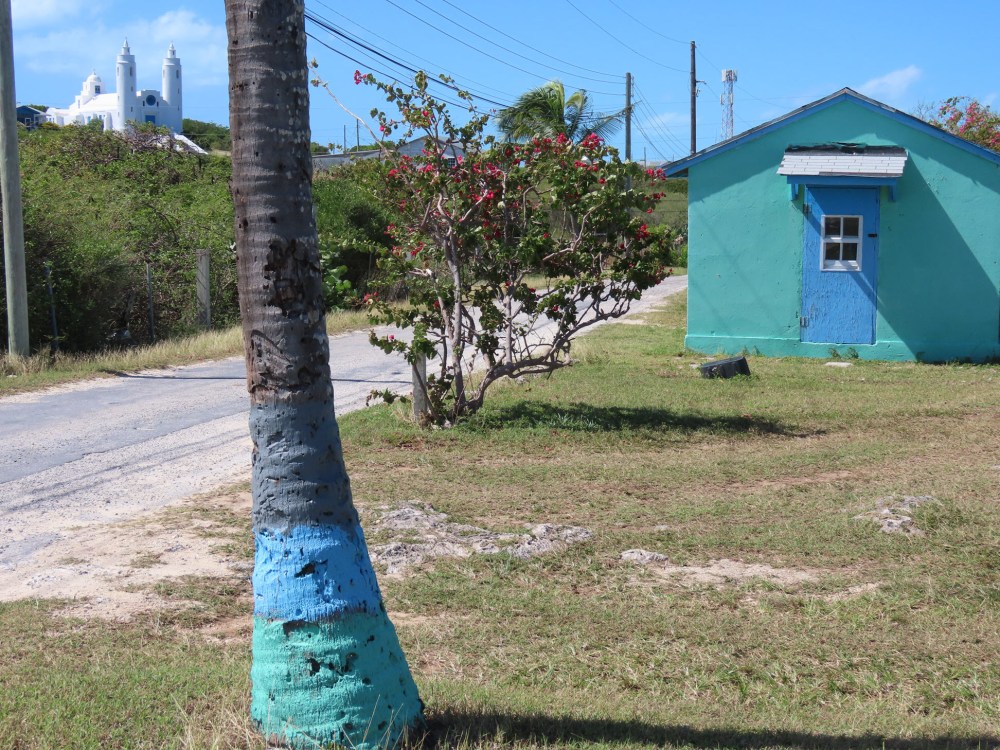
Next stop was Clarence Town, which was modest and quiet but for a bakery, a church, and a marina. Last stop, at the complete other end of the island, was Cape Santa Maria, with its monument to “the gentle, peaceful, and happy aboriginal people of Long Island, the Lucayans and to the arrival of Christopher Columbus on Oct 17, 1492,” (!) superb wording since Mr. C slaughtered the entire population within 20 years. It’s a brand-new monument created at some expense on the high cliffs above the bluff—very impressive and very strange at the same time.

From Thompson Bay, we sailed up the coast to Calabash Bay, just south of Cape Santa Maria, where we spent four days awaiting the arrival of my Polish delivery skipper friend on her trans-Atlantic crossing in a brand-new catamaran. What a thrill to finally meet up with her and her crew and share a meal. After showing off our boat and telling them about another Freedom for sale in the Abacos, they diverted on their way to Florida to see it, and it turns out her partner/first mate bought it! So we may be seeing more of them next season in the Bahamas in between deliveries.

Conception Island

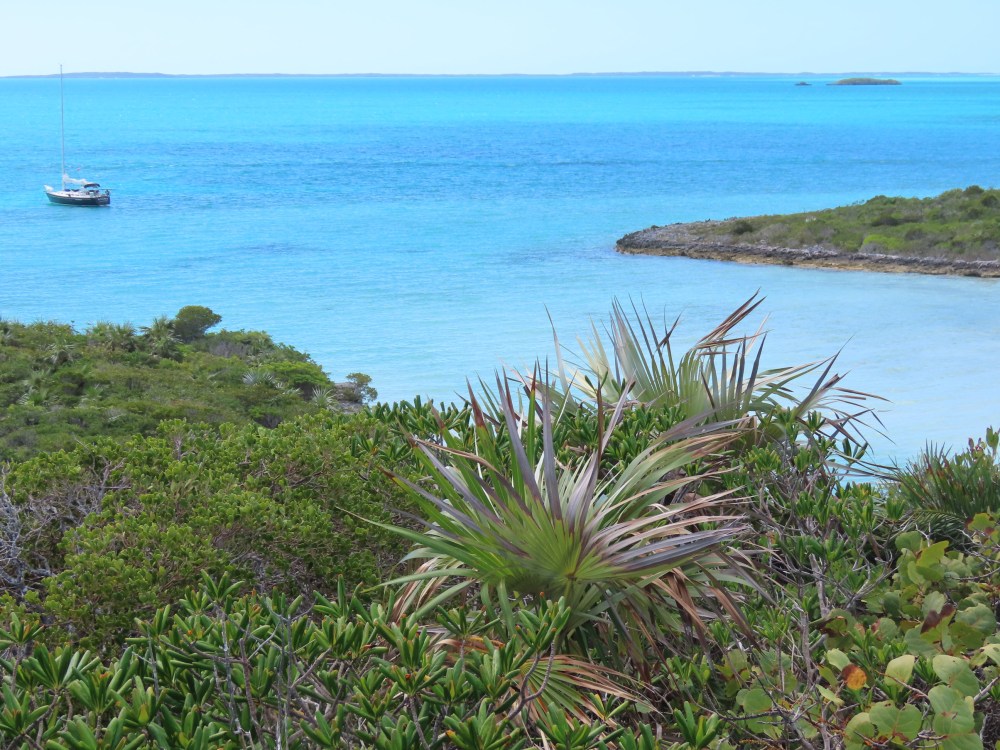
The winds and seas having calmed down a bit, we had a great sail to Conception Island, further east and out to sea. Like the Exumas National Land and Sea Park, this island is administered by the Bahamian National Trust and was stunningly beautiful in its pristine, uninhabited state. Although there were plenty of boats anchored off the long beach, including a number of large motor yachts, it was big enough that everyone was spread out so it didn’t feel over-crowded like George Town. We walked across the island and had a small beach to ourselves where we played like teenagers.

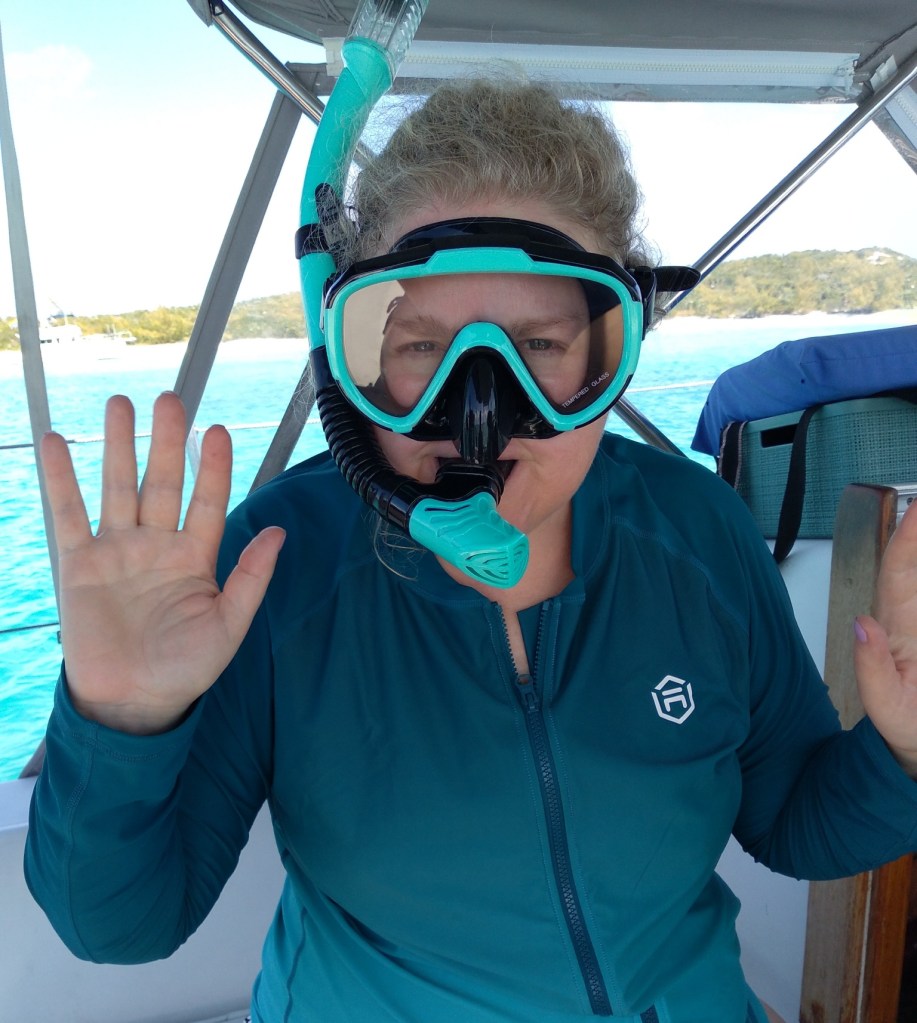
Next day we motored down to the creek entrance and rowed into the huge mangrove creek in search of turtles, which we heard were plentiful but alas eluded us. A modest-sized cruise ship was anchored off the creek, which we discovered was a National Geographic explorer vessel. Their next excursion was snorkeling the reef where we reset our anchor, so we snorkeled alongside them and saw the best underwater coral reef and fish yet. It’s a whole other world down there, although we understand that the fish are nowhere near as plentiful as in years past before so much of the coral died due to global warming, acidification, pollution, and other evils that man has wrought.

Cat Island

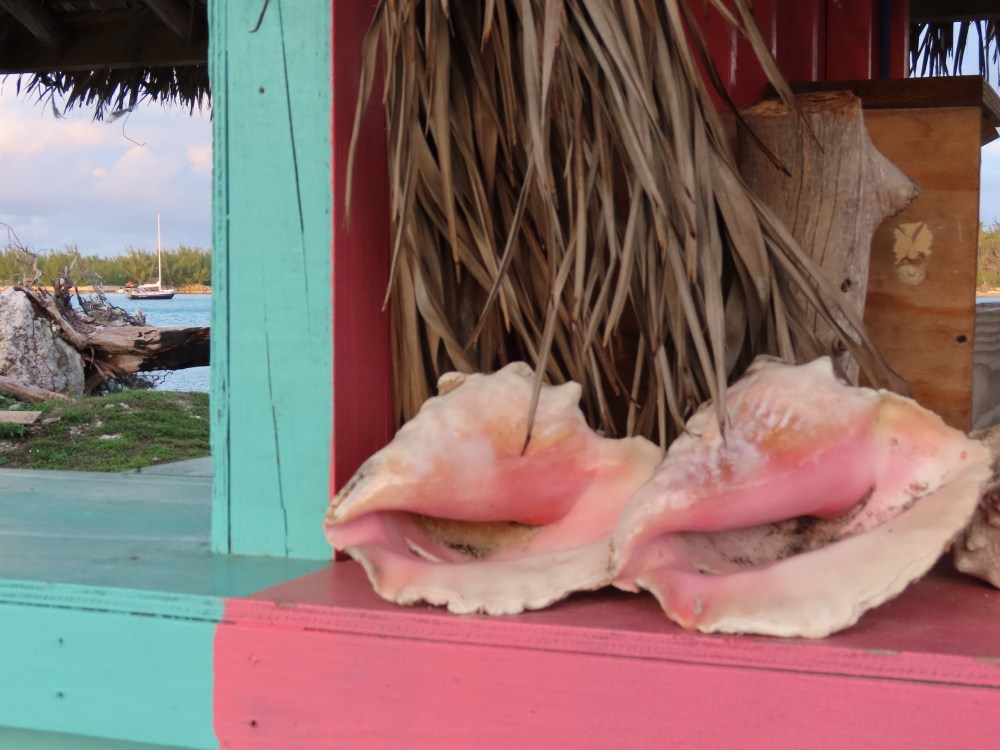
From Conception, we had another delightful 40-mile sail to Cat Island, which is my favorite island so far—a large open harbor protected from the prevailing winds; numerous small beachfront food shacks locally known as the “Fish Fry” where we had the best conch salad yet with mango and pineapple and fish stew for Saturday breakfast, a Bahamian thing; a great grocery store with fresh veggies unloaded that morning from the mail boat; a wonderful meal of fresh lobster; and a brand-new laundromat so we had clean sheets once again! We hauled out the bikes and enjoyed stretching our legs in a circular motion as well.

At the grocery store, Will started chatting up a woman who lives on the island in an entirely off-the-grid house that she built. As it happened, someone had just shown her an upsetting picture of a dog and she was fuming. Will picked up on her agony and asked if she was from OK, and pretty soon, she was sharing some of her life story, which took her from Nassau, to France, Germany, San Francisco, North Carolina, and then to Cat Island, the land of her father’s people.

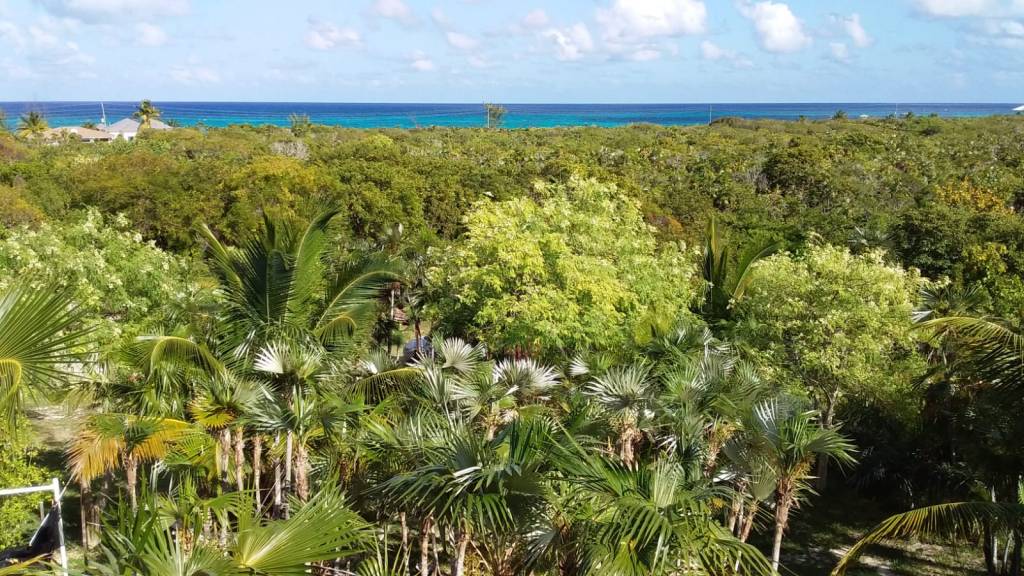
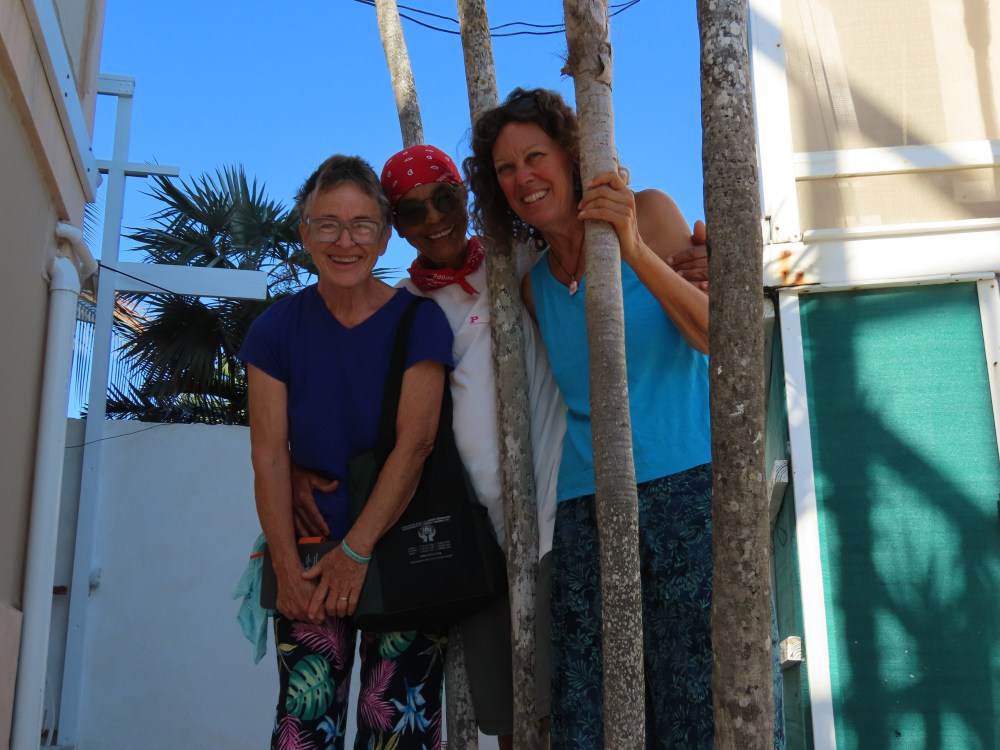
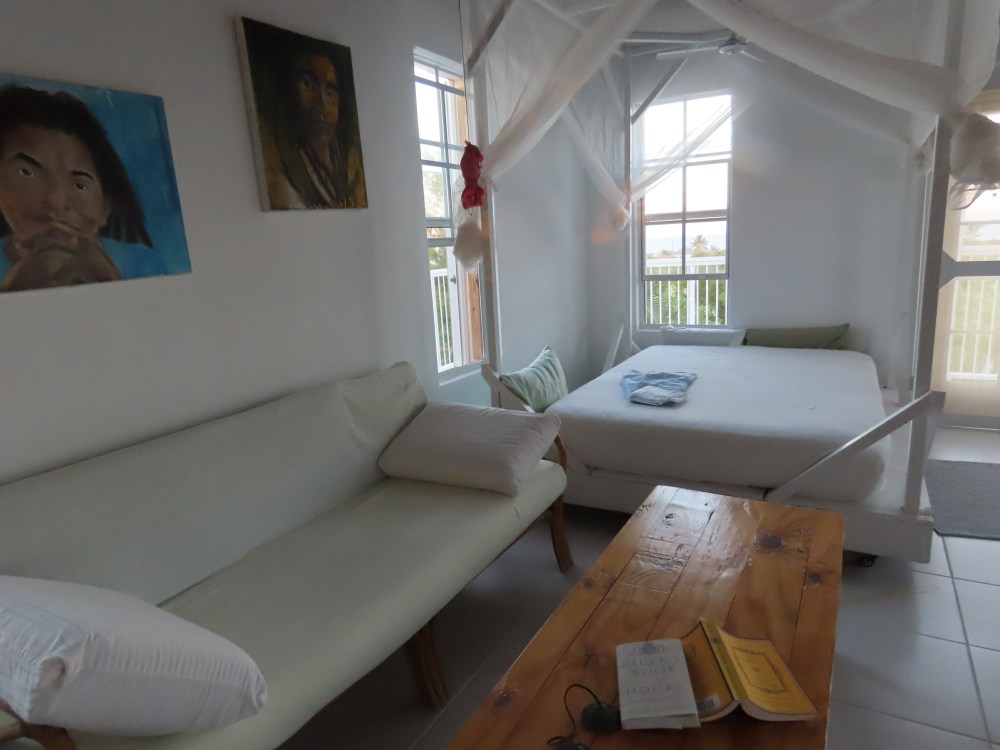
Forever the gregarious one, Will suggested that we would enjoy a visit to see her solar oven and solar everything, and she said sure. So the next day we set out hitchhiking to the other end of the island to find her. Two hours and several rides later, we managed to track her down with the help of a neighbor since everyone seems to know everyone on this island, and Sylvia came to meet us in her car. We rode on a bumpy road through the bush to an area known as Greenwood with a dozen or so houses, mostly owned by foreigners. Entering the property, we weaved through palm and fruit trees to meet Elza, her partner of twenty years, and a compound of structures that they built over more than a decade, including lots of solar panels and lots of batteries. The newest concrete house had one room and a huge wrap-around porch, which was breezy and cool. The crowning jewel was the upper floor with its ocean view, queen-sized canopy bed, inviting couch, simple table, and breezes flowing in from all sides. I admired it longingly…

We sat down on the porch for sliced oranges and the loaf of my fresh bread we’d brought to learn more about each other. Sylvia is fluent in French and German, having moved to France in her twenties to learn the language because of one inspirational song. When they first moved to Cat Island, she taught French in the island school, and Elza was the island nurse. Before that, Elza was a nurse and healer in the states; she’s seen it all. Among many other things, Sylvia is a builder, and Elza is a writer and painter. Together they started the Cat Island humane society and at one time had many dogs, each of which is now buried on their land. While they now live a simple, quiet life away from most people, they had a lot to say about the underbelly of Cat Island, including the fact that much generation land—untitled land that has been in families for generations—has been essentially stolen from locals in order to be sold to the highest bidder, and this includes land that was Sylvia’s grandmother’s.

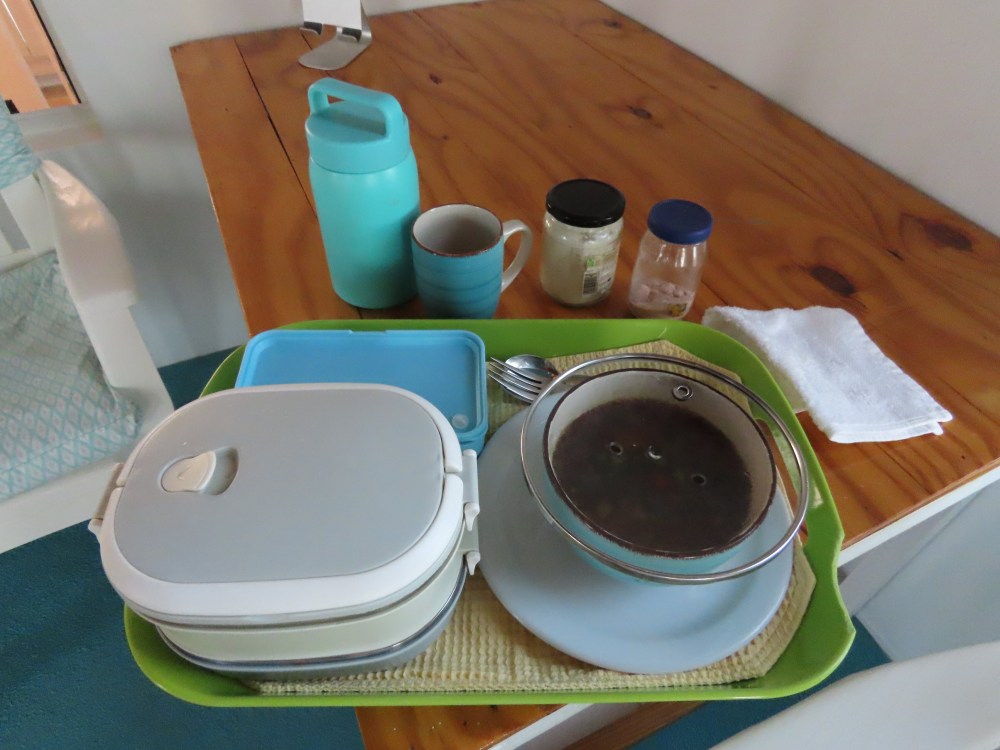
The conversation turned to boat life, and it soon came out that I’ve been longing for some time on land. Sensing my not-well-disguised distress from earlier and Will’s hints that I needed some time ashore, within minutes I had an invitation to stay in the heavenly upstairs room whenever I wanted! At Will’s encouragement, I accepted their incredibly generous offer, we went back to the boat to collect some things and leave Will off, and Sylvia brought me back to Shangri-la. I sat on the upstairs porch in tears at my incredibly good fortune and was told dinner would be brought up on a tray. Soon a thermos of lemon grass tea and several bento boxes appeared outside my door, each dish more sumptuous and nutritious than the next. I sighed out loud with every bite, surrendering to the abundance. In between bites I read Hafiz and Rilke, wrote in my journal until my pen ran out of ink, and then collapsed into bed where I stayed until late the next morning, the sounds of surf and birds lulling me to sleep and awake. The bed was rectangular and spacious, the room was clean and white, and the ground was still and quiet. I melted with gratitude into what the universe had provided.

And so, for a few days, I recharged my batteries on land, both in solitude and in the company of two wonderful women, whose stories they shared freely along with their home. I am deeply grateful and humbled by their generosity and spirits.

After three nights, I invited Will to join us, and we spend an equally restorative time—together and apart—in the room overlooking the sea in Greenwood. Here’s what he has to say about the experience:

Yes, I appreciate how much this sounds like “prayer answered.” But I believe there is a difference when I say, “Get out of your own way and the universe provides.” More than a week prior, I had contemplated what a local might be like to stay with, given that Tasha had done much research and there were simply no affordable, decent places for her to stay to get some strongly desired (and needed) land time. Then, not only does it happen, but it happens with a place in our style, and from interesting people—a well-traveled Bahamian, and a giving American-turned Bahamian— and a marvelous ascetic and aesthetic “retreat,” complete with gorgeous food. Then, the lovely experience of daily talking and nightly reading of Elza’s intimate memoir—quite a combination—as well as a look behind the veil.

Their place was a compound built of just two rooms but so many interconnecting passages/breezeways and other ephemeral/screened-in transition zones. We had the top floor/room admitting of light, air, birdsong, and ocean lapping. Sitting on the wrap-around deck you could see the ocean over the treetops—a monastic room but a resort’s sort of amenities.

I did not know how long Tasha would stay but the thought of a week was always in my mind. That she invited me to join her after two nights for the final four nights tells you what a generous person she is, as she needed the land time, not me, though I had no complaints about how idyllic it was. It is my belief that treasures like this are to be found everywhere but only time will tell if we admit them. In the meantime, I’m happy that Tasha got her groove back.

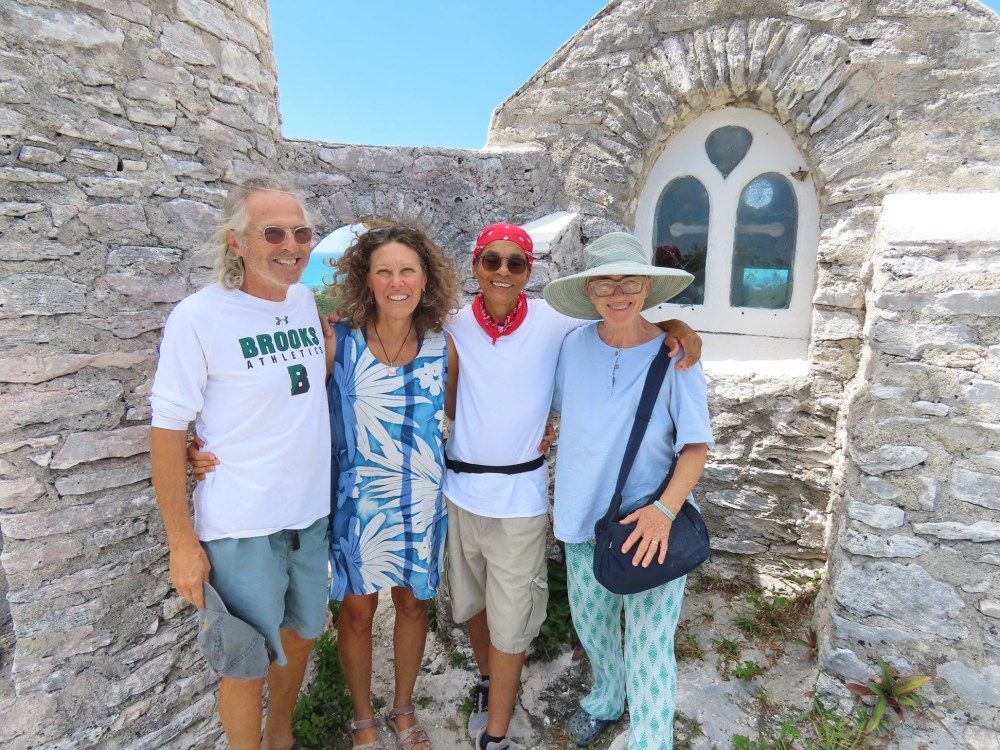
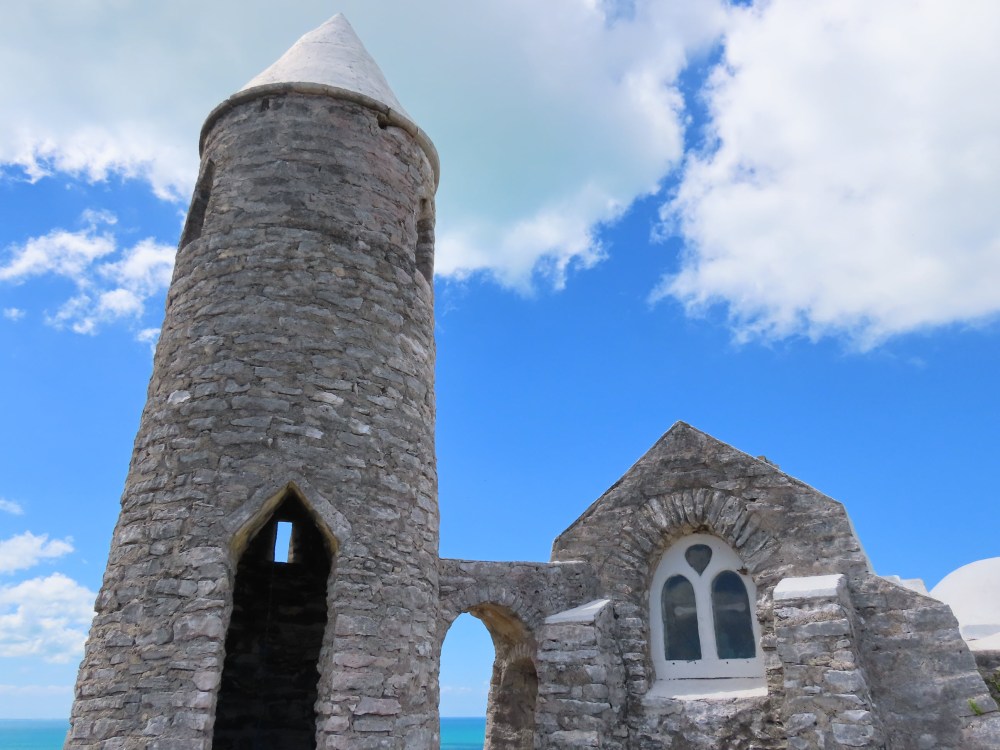
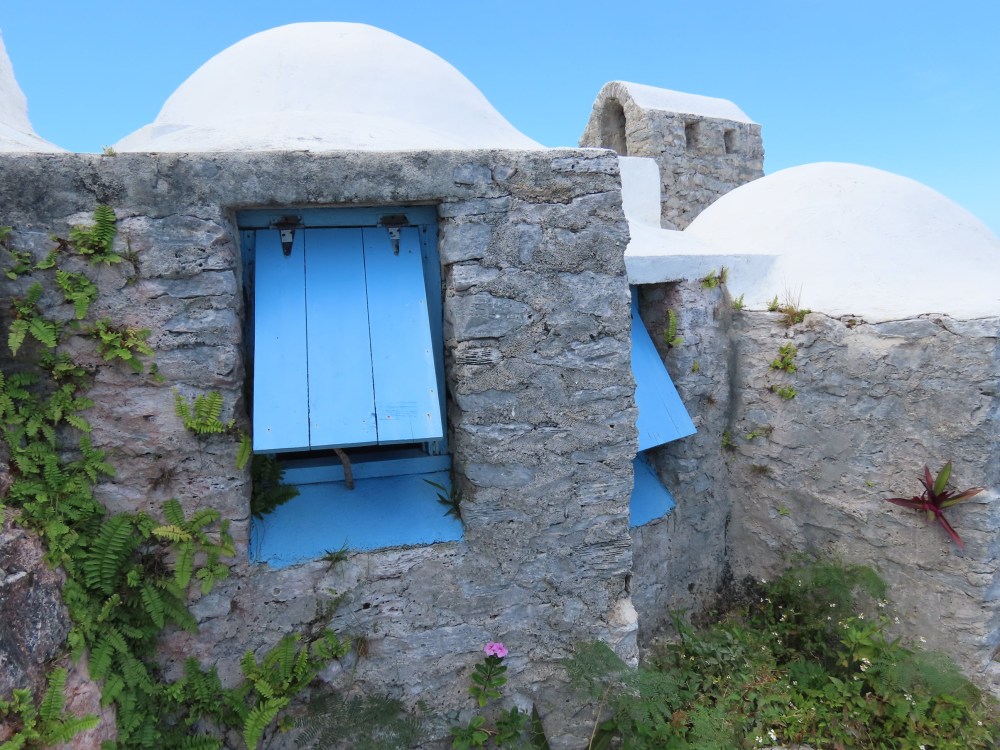
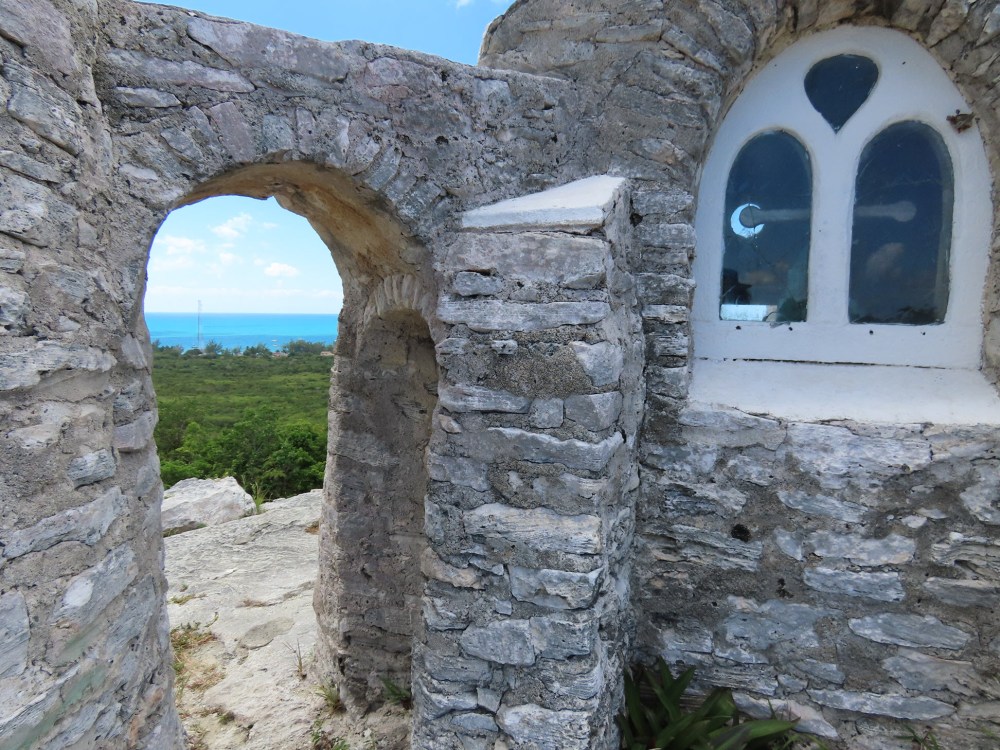
We ended our visit at the highest point in the Bahamas, Mt Alvernia, where in 1939 the architect/priest Father Jerome built a scale replica of a medieval hermitage in honor of St Francis of Assisi, and as it turns out, where Sylvia spent her first nights on Cat Island in a tent when she returned to the Bahamas twenty years ago. It was nothing short of adorable, with is tiny rooms and passageways. This was one hermitage for a priest; the off-the-grid hermitage in Greenwood, which they call Sylwood Shalom, is another—for Sylvia and Elza, and now for Will and me.

*   *   *

I end with another story (this one is for you, Nancy). A couple weeks prior to meeting Sylvia and Elza, I was tasked with getting some provisions and taking ashore the trash in a solo expedition before we left George Town with my cousin during her visit. Part of that involved dumping our “dehydrated” poop into the trash—rather than dumping it overboard as 99% of boaters do in the Bahamas as there are no facilities to do otherwise. Our “composting” toilet being what it is, it takes a little getting used to aiming your pee so it doesn’t mix with said poop so it can in fact dehydrate, more or less, as well as pushing a button to flush as you go. I’ve gotten used to it, but our guest alas was not as pee-direction-pointing-while-simultaneously-flushing savvy, and thus, rather than dehydrating in coffee chaff, on this occasion, our poop was the opposite: super-saturated.

Ever the cautious one, I determined I would take the bag in its bucket ashore separate from the other trash so as not to risk spilling the mess, as happened early on before I became so pee-direction-pointing-while-simultaneously-flushing savvy, so I set it on deck to put into the dinghy. As we pay by the bag, Will saw the bucket and stuffed the poop bag into the other trash bag, which contained among other things a large empty tin of olive oil. I was annoyed but didn’t say anything because I didn’t want my guest to feel like she had contributed to any wrongdoing.

After rowing ashore against wind and chop, I lifted the bag from the dinghy to place it on the dock and, you guessed it, the tin of olive oil broke the bag, exploding the contents all over the dinghy in what I will not attempt to describe but you can surely imagine. It was a stinking mess!!! I hung the bag from a cleat while using a sponge to clean my legs, shoes, and dinghy with salt water, and then carefully carried the bag to the truck, refusing the offer of help from the lovely man on the dock. Needless to say, I was disgusted and disheartened, but on sv Nirvana, we practice the art of no-blame, so I spent the next few hours dissolving the feeling that naturally surfaced. As a bonus, it was yet another occasion for practicing the art of communication: Speak your truth and follow through with your convictions.

We then set out for Lee Stocking Island, which I’d been told was beautiful. Wanting to be spontaneous and respond to wishes from others that we explore other possible anchorages along the way, we tried ducking into a tiny cove to anchor and ran aground, despite the charted depths indicating it was safe. It took a painfully long 15 minutes and agonizing more than effort, but we finally got off just before dead low tide. We then motored to the nearest anchorage, where we were cautioned by two boats that the charts where we were headed were wrong, thus saving us from running aground again.

By that point, I was truly distraught and through tears, uttered out loud what had been building up in me for weeks, “I need a break!” “I need some time on land!” And “I want a rectangular bed that you can climb into on three sides!” It was a huge revelation and relief to admit this to myself and confess it out loud. At the same time, Will sensed that our recently made plan to sail in a Bahamian Sloop Regatta, aboard H2O, at 5F (Farmer’s First Friday in February Festival), was too much to care about at this juncture. Over the course of the next two weeks, I remembered that some friends had been to Cat Island and raved about it. I found myself fantasizing about an airy cabana on a beach swinging in a hammock, drinking pina coladas, imagining what it would be like to leave the boat for a few days, to have a break from living within the confines of 36 x 12.5 feet, and to sleep in a rectangular bed.

Three weeks later, the universe responded. And trust me, it was light years better than a beach cabana! Reconnecting not only with myself but with Will, I felt nourished like I haven’t felt in some time. I think this is what it feels like to live in the flow: Be open and everything you need and desire will come to you.

NIRVANA S4:E4

February 10, 2023

Here we are in the Bahamas, where we’ve been for just over a month, in what feels like a world apart from the two plus months of travel to get here. “Where are you headed?” people asked along the way. “The Bahamas,” we replied instinctively, not really knowing much about what that means in reality, just that it’s our destination. We have been all too destination driven, and now we feel like we have “arrived.” For more than the place—the Bahamas—it’s about the experiences unfolding as we follow what’s in front of us moment-by-moment, hour-by-hour, and day-by-day. Needless to say, it’s a very different mode of travel.

Key Biscayne

While this mode feels more low-key and enjoyable than the mode we were in, the passage from Florida required some serious planning. First you need to decide where you’re going to check into customs and immigration. That dictates where you leave from, taking into account the effects of the Gulf Stream pushing you north at 2.5 knots as you sail east. Then you need to wait for the right wind conditions to cross the stream, some 50 miles, depending on how far north it pushes you. And finally, you need to ensure reasonable conditions for crossing the Great Bahama Bank—another 90-some miles—to get to the islands.

And in our case, before all that happened, we had to wait for some important stuff to arrive—a new pump for our head, two new AGM batteries since ours were shot, and two new SIM cards so our phones would work in the Bahamas. This waiting period afforded us some much needed down time in Key Biscayne where we anchored for a week, going ashore most days for a walk in the delightful 400-acre state park—thankfully saved from development by Bill Baggs, editor of the Miami news, in 1967—and taking dips in the ocean along with enjoying the park’s outdoor showers. It also gave us time to take on the installation of our new autopilot, which had been sitting in our aft cabin since North Carolina! Working side-by-side, Will and I installed the pilot together, which was very satisfying as it went swimmingly well, yet we thanked ourselves at every step of the way that we weren’t paying someone to do it as it took us close to two full days! And still, we needed two additional cables that we didn’t have…

Coconut Grove

We lucked out and spent a night on a mooring at the Coconut Grove Sailing Club, which had agreed to accept some of our packages. What a delightful place it was too, with dozens of small racing dinghies, a mooring field full of only sailboats, and hints of how Miami might have been fifty years ago. Everything went like clockwork as we Uber-ed to Home Depot to collect the batteries and dispose of the old ones and on to West Marine for the cables, and then to stock up on what we feared might be our last fresh vegetables. However, late in the day we learned the SIM cards we’d been waiting for had been shipped to Maine (!), so we took yet another Uber to collect them at a local store. By then it was dark, and we still needed to fill up our water tank and motor across Biscayne Bay for an early morning departure, which we did with aplomb.

Great Bahama Bank

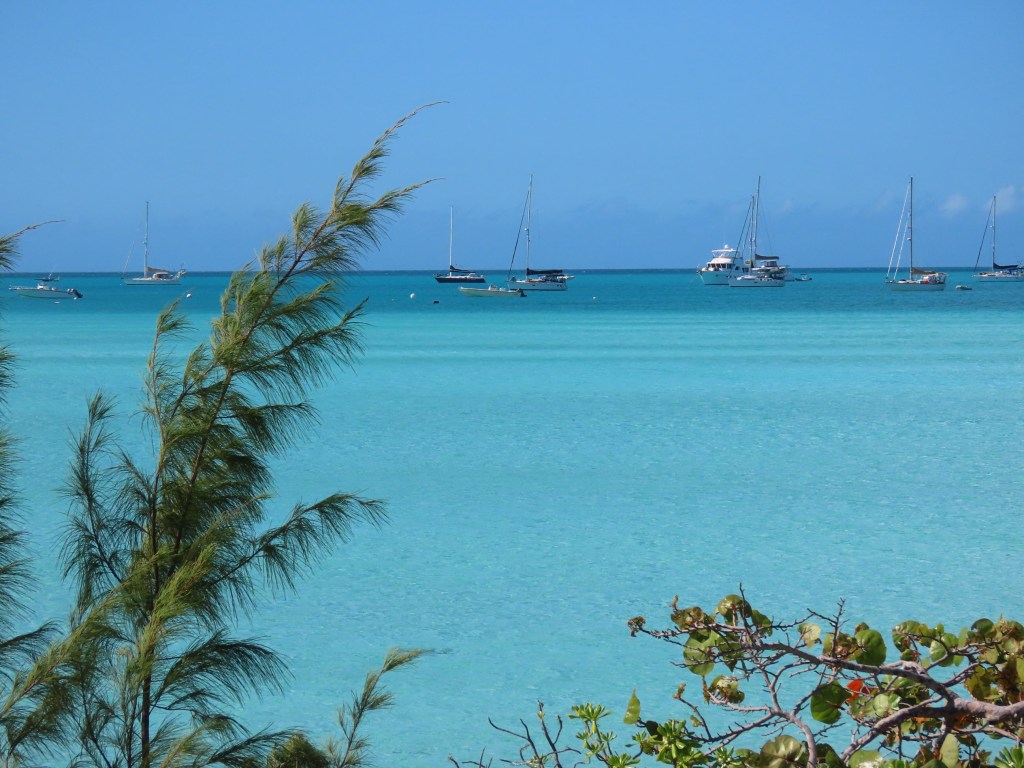
On January 5, we left Key Biscayne at 7 am to cross the Gulf Stream with ESE winds at about 8-10 knots. This meant we were able to sail about a third of the way across—the first time sailing in a month!!—until the stream started pushing us north and the winds diminished, at which point we motor sailed to keep on course. Given extremely calm wind and seas, as well as a full moon, we opted for a really long day and motored most of the way across the bank at night, and then anchored. It’s a strange thing to drop anchor in 13’ in the middle of a huge expanse of open water, but other boats had the same idea, and we saw them off in the distance as we motored past, finally stopping at 11:30pm. Waking up to the brilliant aquamarine water over white sand and not a breath of wind was extraordinary! We immediately stripped down and jumped in with a delight that only we will know—the other-worldly beauty, our accomplishment at having traveled 103 miles in 16 hours, and our first night passage!

Chub Cay

Just as the wind picked up, we raised sails and had a delightful five-hour sail to Chub Cay (pronounced “key”), anchored, and set about attempting to finish filling out our online forms, not entirely successfully. Next morning, we motored into the marina, our yellow Quarantine flag flying, and were driven a short distance to a small landing strip they call an airport to check in with customs and immigration, receive our 90-day cruising permit, and pay our $300 for the privilege. Back at the marina, we raised our Bahamas courtesy flag and were officially checked in, happy it went so smoothly. We were told we had to pay a $100 “landing fee” to check in, but it was only another $50 to stay the night, so we decided to splurge. However, when we went inside the resort lobby, we learned it was another $40 each for a membership to their exclusive club (which we were told was cheap for the Bahamas), so we turned on our heels and booked it out of there…

But not before having a delightful conversation with Malcolm, our driver, who it turns out was from Andros, the largest Bahamian island only 30 miles away. He said if we wanted to see “the real Bahamas,” we should go there. And so, because we were so turned off by the exclusivity of the Texas tycoon-owned Chub Cay and because we met the delightful, down-to-earth Malcolm, we hoisted sails once again and headed west for Morgan’s Bluff at the north tip of Andros, having no idea what to expect.

At which point, the shifting of modes from one focused on boat repair and destination planning to one more focused on following where the boat leads us had officially begun! YAY!!!

Morgan’s Bluff

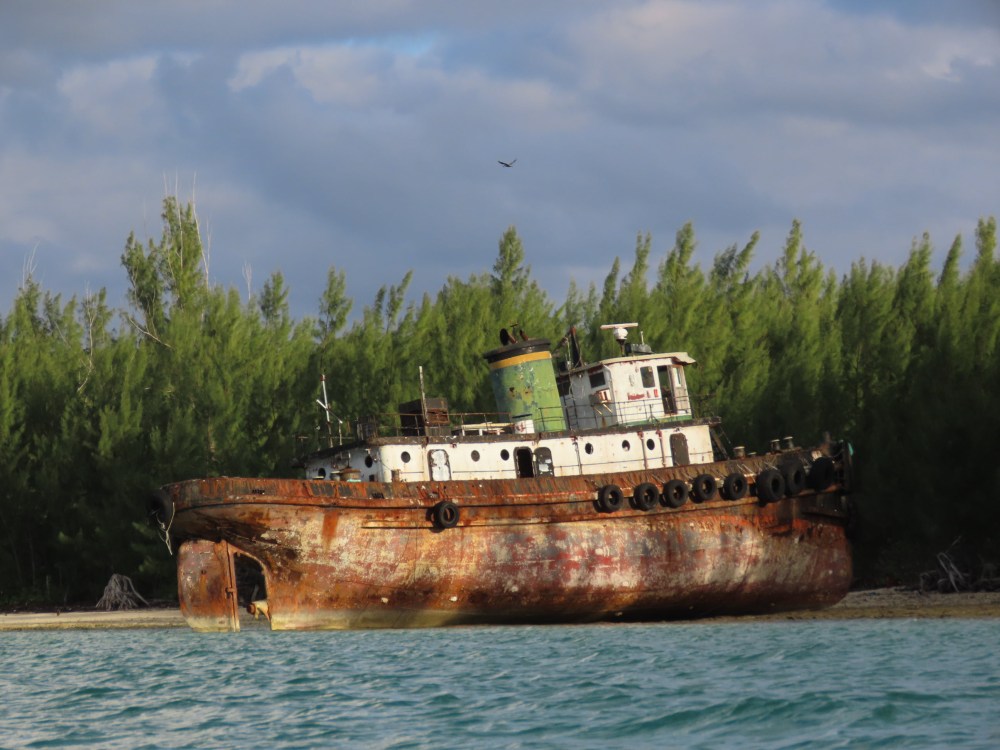
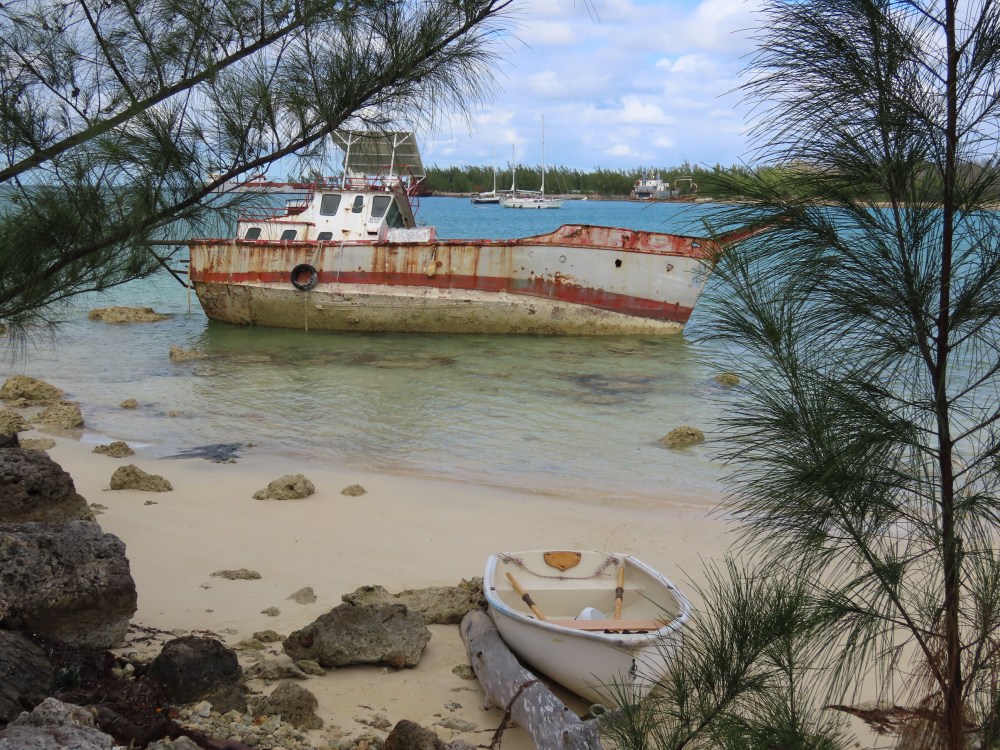
After a delightful four-hour sail across the Tongue of the Ocean where depths get up to 6000’, we anchored in the huge harbor, one of only two anchored boats plus a few rusty wrecks. Rowing ashore to explore, we encountered Gregory and his wife who were preparing for the next day’s gathering in their food stall. We said we’d like to see the island and wondered if they knew someone who might be able to show us around. We assured her we’d be back the next day to try her conch fritters.

Ten minutes later while walking up the hill a car pulled up. It was Michael, their friend, who picked us up and gave us a driving  tour that magically ended at  his wife’s take-out place attached to their home in Nicholls Town. He shared a wealth of information about his native Andros, where he was happy to return after years in Nassau, to serve as head of the labor department. Cynthia served up cracked (fried) lobster, cracked conch, rice and pigeon peas, guava duff, and Kalik beer. Needless to say, after a diet of mostly salad, homemade bread, fish, and vegetables, we were stuffed. Michael then happily drove us back to the harbor. We were incredibly touched by his generosity of spirit.

In the morning I heard the cheerful voices of children coming from the other boat in the harbor, so we hopped in the dinghy and rowed over to say hi. Turns out this family of five has been living aboard in Andros for the past two months, having fled—you’ll never believe—Moldova, which borders Ukraine. Marianna, her American husband, Neil, and their three wonderful daughters ages 5, 8, and 9 live on a 52’ boat that they keep in Florida. Because of the war, they’ll be returning to California until things settle down in their home country. What a delight it was hanging out with this family, especially those three girls who used every handhold as monkeys use branches!

We then hauled out our folding bikes for the first time, rowed them ashore, and took off to explore the nearest settlement, Nicholls Town. There was not much to it except a couple blocks of houses, a few very nondescript stores, and a bar on stilts. We did have a couple of interesting encounters along the way, one with a proselytizing Rastafarian, which raised Will’s heckles, another with a guy who said, “Are you the people on the boat?” Word gets around quick at this end of the island!

Back at the harbor, two stalls were open for business, and the conch fritters and roasted root vegetables were indeed delicious. Even more fun was playing Red Light Green Light and Simon Says with the girls on the beach. I’m so looking forward to having a grandchild, who arrives in April!

Another day of hanging out on the boat saw us dragging anchor for the first time ever. We reset and all was well until after dark when we started dragging again, at which point we motored into the very tiny commercial harbor and tied up to the cement wall, just in front of a sunken boat, once again with great aplomb. Morgan’s Bluff is not your average Bahamian destination with its somewhat run-down looking commercial harbor, several sunken vessels in both the inner and outer harbor, and not much happening most of the time. That said, when you dig a little deeper, we found it to be a delightful place to spend some time.

Kamalame Cay

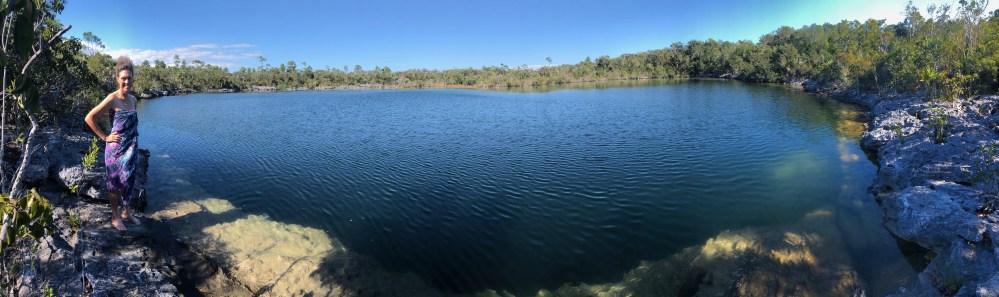
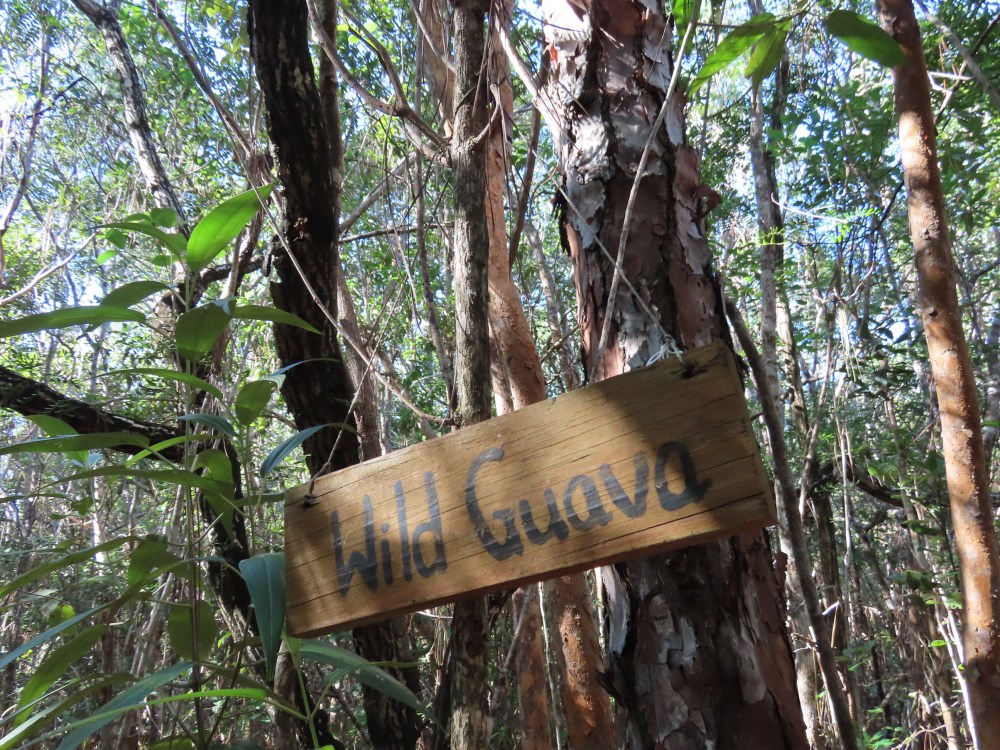
Next stop was Kamalame Cay, 25 miles down the coast, again not your average Bahamian destination as the anchorage has room for about one boat and there’s nothing there except a “ferry” that shuttles dozens of workers back and forth to the exclusive resort, hidden from the harbor. Once there, we discovered we weren’t far from the Blue Holes National Park, so we loaded our bikes into the dinghy once again and set out in search of a blue hole. What are blue holes, you might ask? They’re underwater caves filled with water, which can be 1000’ deep and are home to prehistoric creatures that can survive without oxygen. Turns out Andros has one of the largest number of these blue holes on the planet, along with the third largest barrier reef in the world! We asked person after person as to where we might find a blue hole within biking distance and following their clues came to a small sign on the side of the road that said, Rainbow Blue Hole. We stashed the bikes and started walking on a narrow trail with signs hanging from various trees marking their species, most of which were unknown to us. After a half a mile or so, we came to what looked like a small pond, stripped down, and went for a refreshing dip! We saw no prehistoric creatures however. Apparently, the tiny fish will nibble the callouses from your feet if you hang out in the water, but we didn’t know that yet.

On the bike ride back, we stopped at a hardware store and two very small and not well-stocked grocery stores, chatting with the owners to learn about life on Andros. There’s not much to buy except when the mail boat comes with supplies once a week, and what’s there is very expensive. No wonder rice and beans are a staple here. Many locals here make their living working at Kamalame Cay resort, or they leave, like Malcolm did, and go to work on another island, most commonly in Nassau, the big city on Providence Island. But for those who’ve stayed or come back, there’s a love of place and people that is nothing short of devoted.

Fresh Creek

Next stop was Fresh Creek, once again not your typical Bahamian cruiser’s destination as the anchorage is poor, there’s only room for a couple of boats, and the marina has been closed since Hurricane Matthew in 2016, although it is reopening this year. What is there is a commercial dock where supply boats come twice a week, a government dock where you can tie up for $5.20 per night, and a cadre of colorful and generous people who are delighted to share who they are and what they know. We stayed three days and loved it!

Our first encounter was with David Moxie, a German-speaking, published poet who shared his manuscript in exchange for a beer, which he left with us to read. Returning it several days later, I followed the breadcrumbs to his brother’s compound overlooking the ocean. He was squarely middle class, working part-time as a contractor at AUTEC, a US military base that conducts “research” and testing of “maritime warfare” readiness in the deep ocean off Andros. Even here we have a military presence!

We next asked the lovely woman in the pink harbor office where we might find some conch salad. Next thing you know, the preacher, who was engaged in a rousing game of dominos on the dock, said he’d be happy to make us some in an hour or so. Two hours later, we walked up to his shack and watched him skillfully extract the live conch from its shell and create a delicious fresh salad with green tomatoes, onions, and citrus. Finally, a cracked conch that wasn’t fried!

Getting the bikes ashore here was easy at the government dock, so the next day we had a nice ride to a public beach which we had to ourselves where I had a chance to dance on the beach and Will caught sight of a turtle swimming in close. We stopped at a roadside stand and chatted with another Bahamian who had returned home after years as a taxi driver in Nassau, now making his living selling fresh coconut and other vegetables. Nearby was the Small Hope Bay Lodge, a dive resort that was started by an American in 1960, now being run by his son and grandson, which still had the feel of the old Bahamas. For fun, they feed the sharks with “fish popsicles” so divers can watch the feeding frenzy.

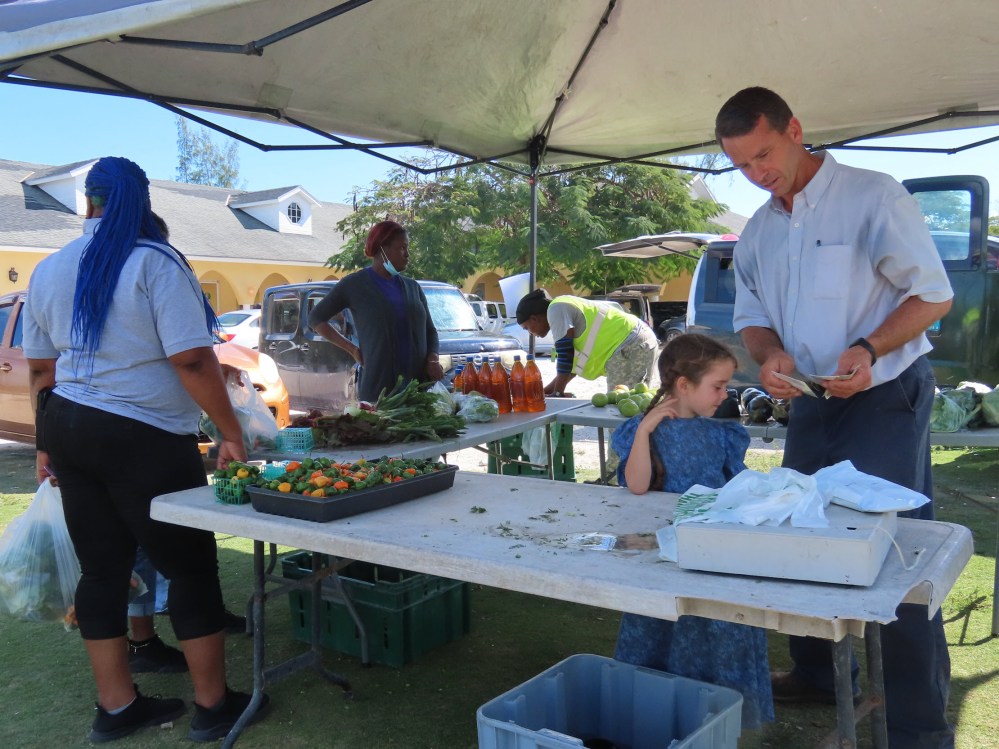
We heard that the Mennonite farmers have a farm stand on Friday mornings at 8:00 am where all the locals go for vegetables and fresh eggs, but get there early or they run out. We were there at 7:15, helped him and his young daughter set up when they arrived, and then bought an abundance of fantastic vegetables for a mere $40. Many Mennonite families moved to the island in the70s and have been there ever since, integrating with the native Bahamians, for the most part…

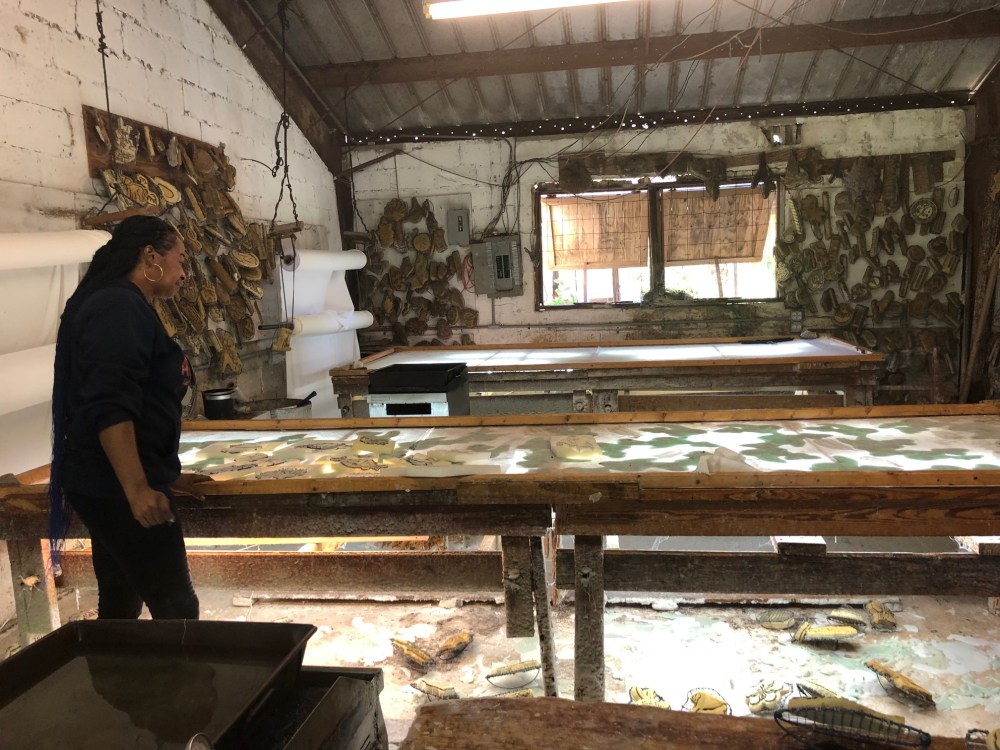
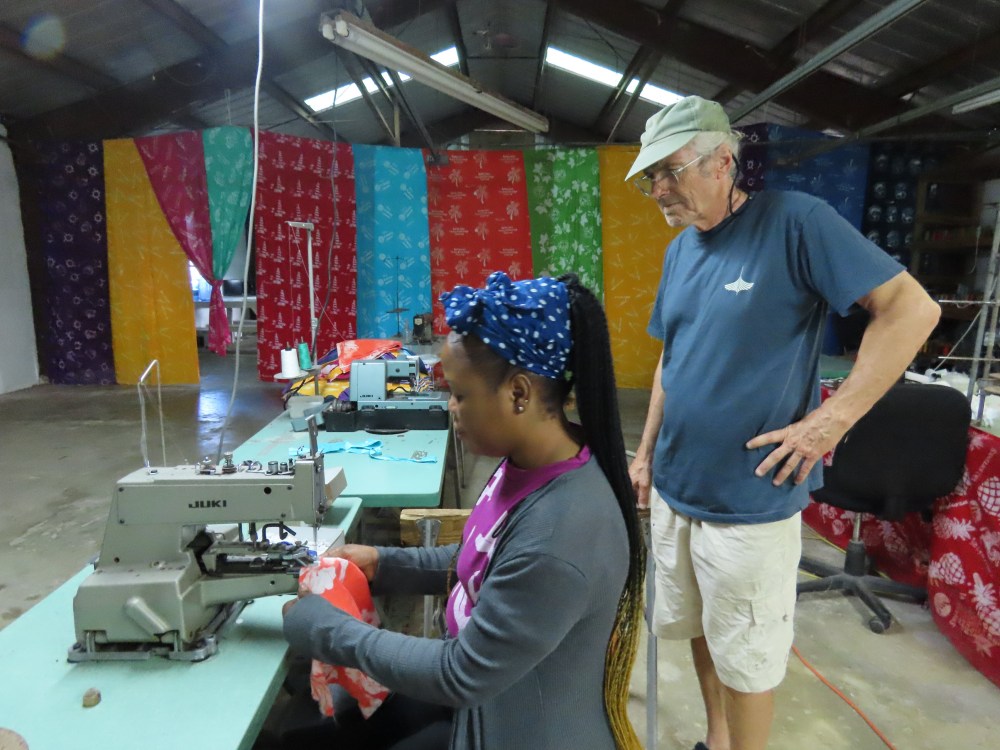
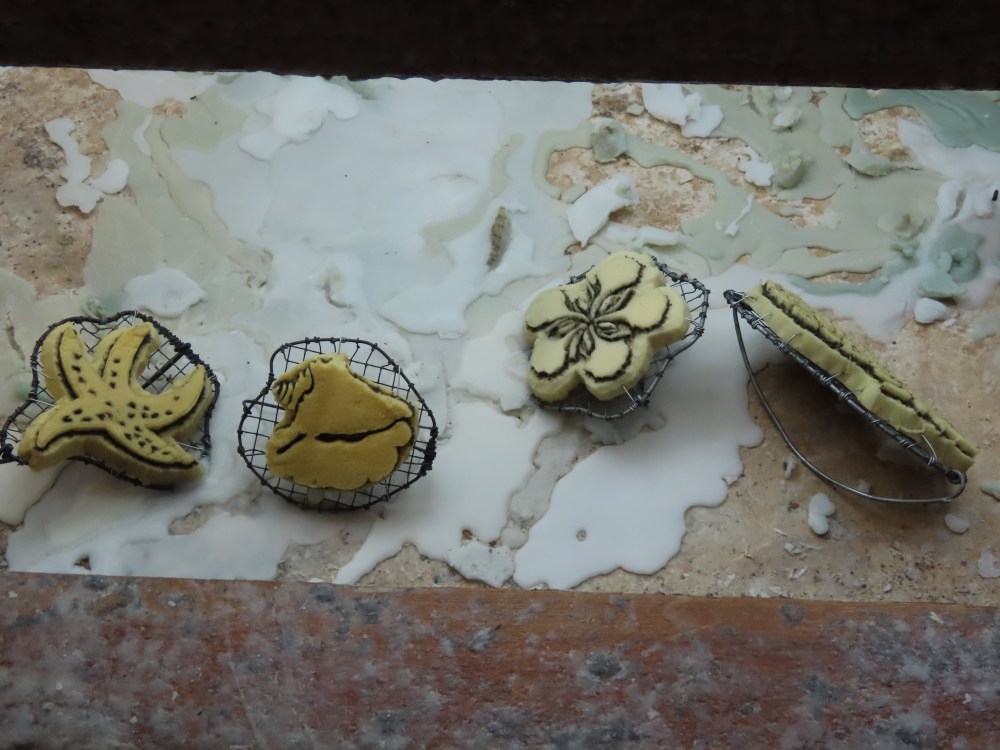
Our next stop was the Adrosia Batik Factory, which was started in the 70s by the same guy who started the diving lodge and is now run by a group of local women. We had a long chat with Shanika, who it turns out had been raised Mennonite when her mother converted twenty years prior, until what she described as a racist preacher came to the island and basically forced all the Bahamians out of their church! Growing up, she had been best friends with David, the farmer’s daughter, David having missed becoming preacher by one vote. While said preacher has since been removed from the position, those who left the church have not returned. It was a sad story indeed from this otherwise very hospitable place.

The high winds and seas having died down, it was time to cross the Tongue of the Ocean once again and head to the Exumas after an unexpectedly delightful week on Andros.

The Exumas

The Exumas are a chain of over 365 islands that stretch 130 miles north to south and home to the Exuma National Land and Sea Park, consisting of dozens of uninhabited, protected cays that are a destination for many cruisers. The park provides inexpensive moorings at many of the islands, with Park Headquarters in Warderick Wells in the middle of the chain.

It’s what you imagine the Bahamas to be—calm, white sandy beaches on the shallow bank side, rugged crashing beaches on the deeper sound side, and a variety of marine wildlife. Although not in abundance, we’ve seen turtles swimming in the mangroves, huge rays buried under the sand on shallow beaches, and colorful tropical fish and coral while snorkeling. We’ve enjoyed some great hikes on the rocky shores and delightful sailing to get from one island to the next. We’ve also stopped at a few islands outside the park that have “settlements” where we’ve enjoyed some local fare and provisioned in the very expensive grocery stores—$14 for a package of romaine, $8 for a quart of cottage cheese, $10 for a bunch of broccoli, $8 for a dozen eggs, etc. We wonder how the Bahamians survive with these prices. While many are earning a very good living working at all the high-class resorts, many are not and appear somewhat impoverished. That said, everyone we’ve met seems more than content and has been beyond friendly.

With so many islands to explore, we enjoyed sailing short distances in mostly favorable winds followed recommendations and discovered some on our own, stopping at some of the highlights.

Highbourne Cay where we unknowingly went ashore and got kicked off the private beach, so we moved 3 miles south to Long Cay with its gorgeous inland lagoon where we harvested conch in 2′ of water and bushwhacked our way to a stunning rocky path.

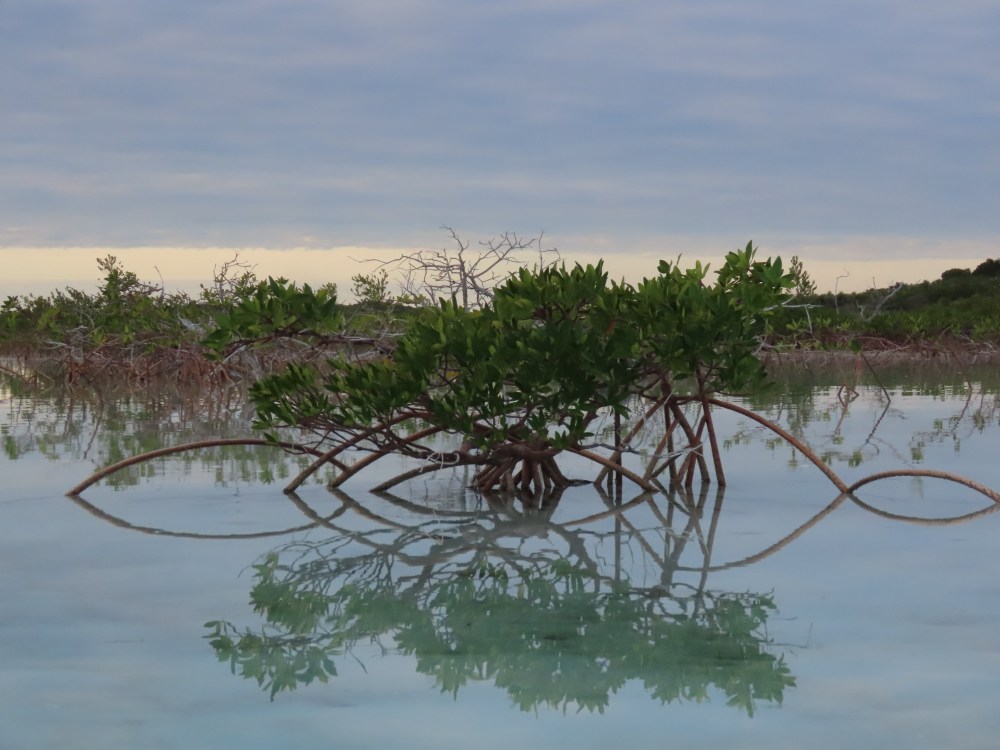
Shrouds Cay with its 1.5 mile inland mangrove creek cutting across the island, where we saw several 3’  turtles at the entrance and which we rowed most of the way in and back, catching a tow for the last leg.

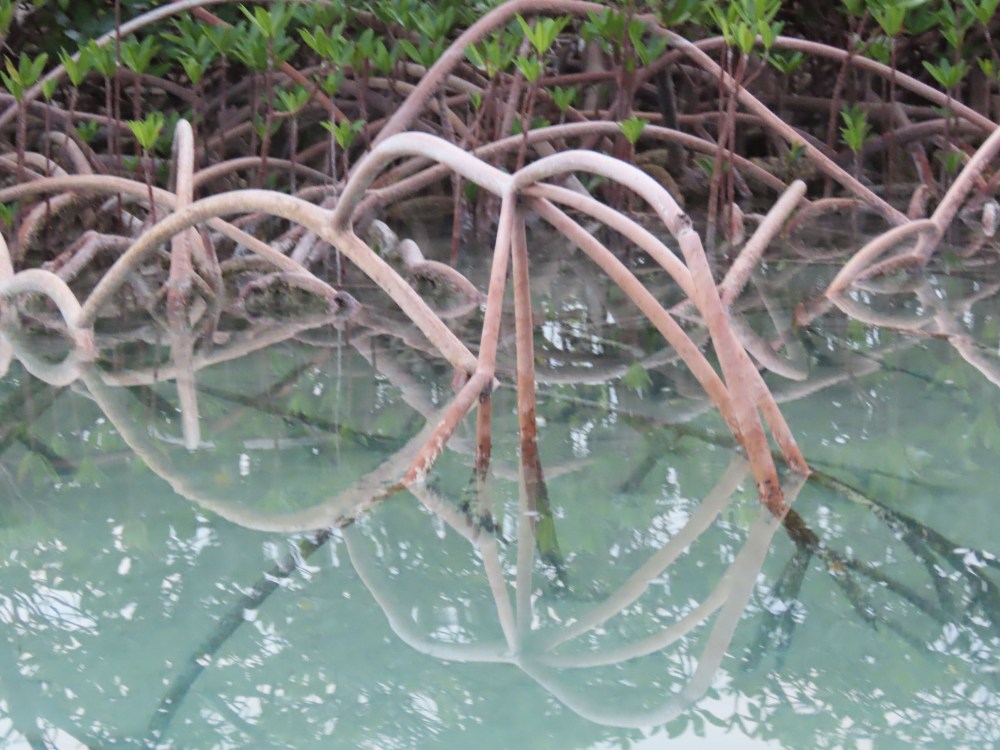
The row inspired this poem:

Azure ribbon
divides the land.
Mangrove roots
connected
entangled
reflected
submerged and exposed
in a twice daily dance.
The two of us
floating in between
following the current.

Warderick Wells with its long hiking paths up and down the island, stunning vistas, park HQ, and our first cruiser’s happy hour social gathering.

O’Brien Cay where we snorkeled in “the aquarium” and saw some super cool fish and coral. Staniel Cay where we tanked up and did some provisioning, including a quart of chocolate ice cream for lunch and then on to Blackpoint settlement on Great Guana Cay where we scored some fresh grouper and snapper from a fisherman on the dock and rode out some high winds with dozens of other boats.

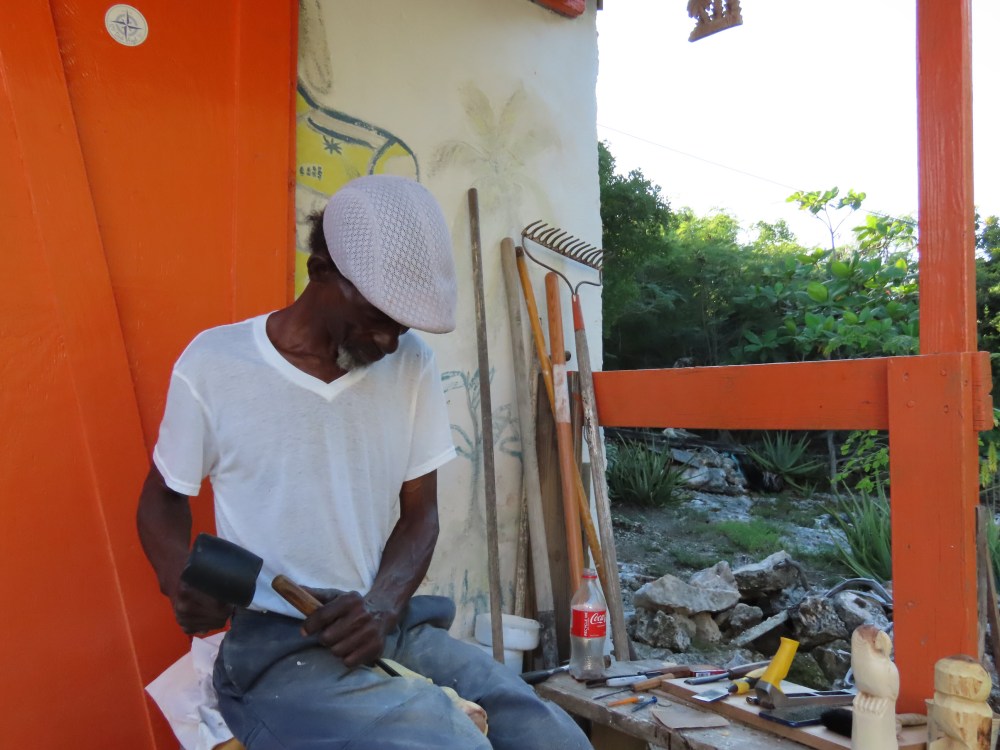
Little Farmer’s Cay, a super low-key island owned for generations by a handful of local families so thankfully no grand-scale development will happen. We hung out for an hour in Little Harbor while Dino made us conch salad, which involved picking up the conch from his stash in the harbor, waiting while he took some people snorkeling with the turtles, going to a local shop to buy the necessary ingredients, and assisting him by walking over to his restaurant to bring back salt, pepper, and a knife. We also had a long chat with an old timer who has been building and racing Bahamian sloops his whole life and a local wood carver who receives his artistic gift from God.

Next it was time to make tracks toward George Town where cousin Joanna was due to arrive in a couple of days for a visit.

George Town and Stocking Island

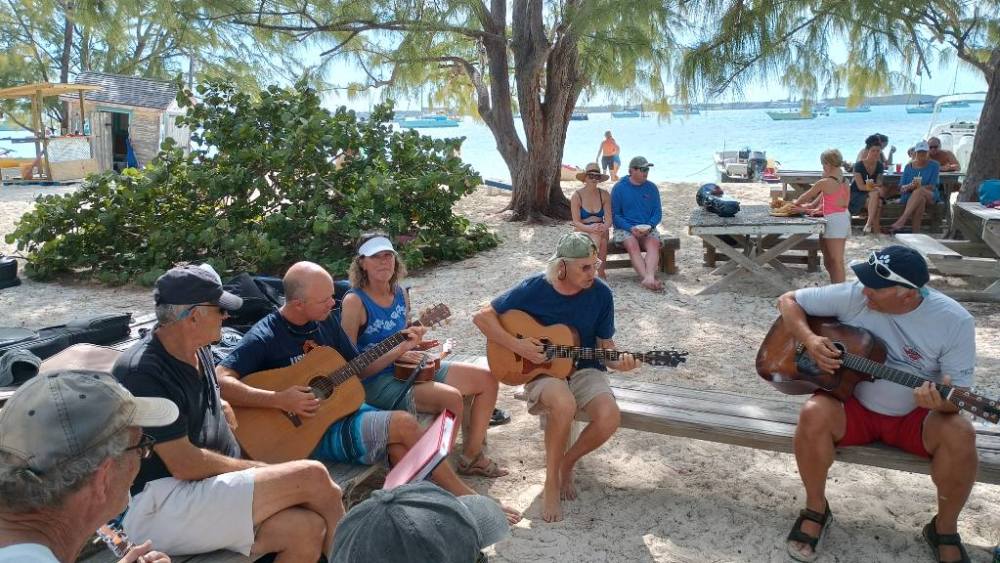
After a 45-mile sail, we arrived in Elizabeth Harbor, where we were greeted by over 300 boats anchored off Stocking Island, the barrier island providing excellent shelter from the prevailing winds and seas. When the first conch horn sounded to signal sundown and all the anchor lights went on, it literally felt like New York City with masts in all directions—quite a contrast from the quiet anchorages we’ve been experiencing. This harbor is The Destination for many cruising boats in the Bahamas, many of whom stay here for the whole winter. And why not? It’s like adult summer camp with endless opportunities for socializing, volleyball, playing music, and meeting up with other sailors at Chat ‘n Chill.

Each morning at 8AM, Mark on Puff gets on channel 72 and gives the weather, asks for new boat arrivals, asks if anyone needs information about anything, and gives a chance for people to buy and sell stuff that’s laying around their boats. So far, we’ve scored a ham radio, wifi booster antenna, and a can of red paint. We also helped some Canadians order some stuff online for their broken windlass since apparently American companies make it hard for Canadians to do so. To thank us, these folks took us in their fancy rubber dinghy the 1.5 miles across the harbor in what turned out to be a very wet ride, nonetheless; we took the water taxi back. In fact, we’ve encountered many of the Canadians we’d met along the way, chatted up some Mainers at a social gathering, complete with Whoopie pies, and connected with other sailors we know with one-degree of separation. I also organized a couple of beach dances which I’ve been sorely missing. All in all, it’s a pretty cool place that can definitely suck you in when you’re not watching.
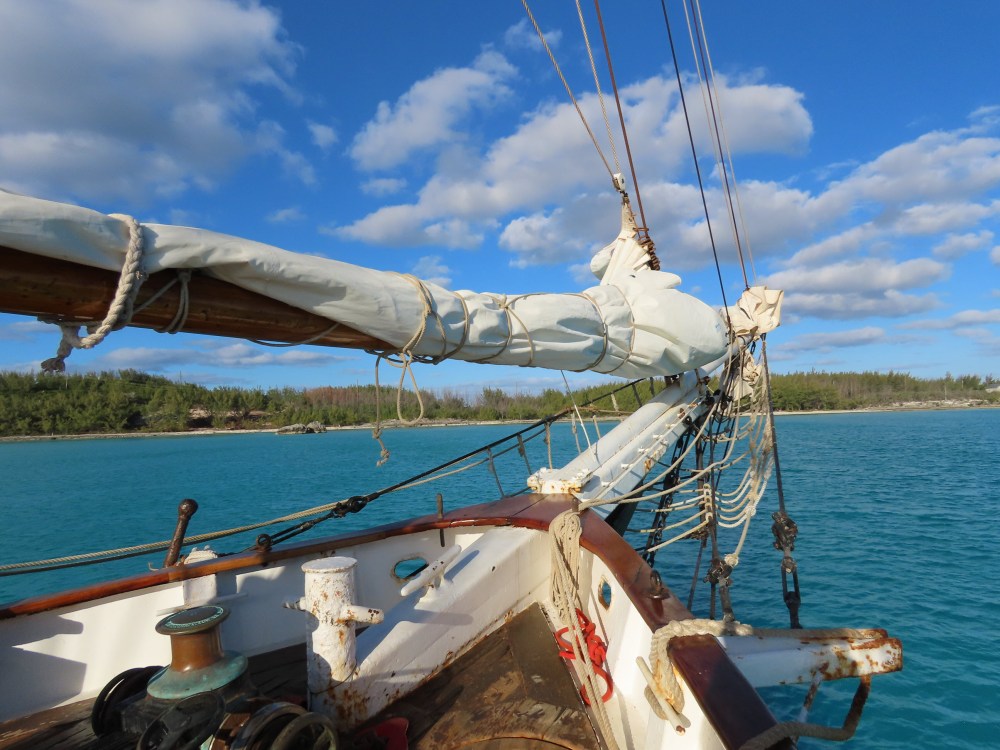
Lee Stocking Cay

After a few days in the harbor, we did some more provisioning and then set out 30 miles back up the chain to Lee Stocking Cay, a beautiful anchorage and island where we did some snorkeling, swimming, and walking the dramatic island paths. It was fun having another person on board to share our world, inspire a change of focus, and get us in the water to do more snorkeling, which we all enjoyed.

We dropped Joanna off at Emerald Bay Marina, where we were catapulted into another world as we had a farewell meal at a poolside resort—major culture shock! After a couple of nights at the marina where we enjoyed long showers, did some laundry, and I sat in rocking chair on land for hours on end, we agreed it was time to move on, so we headed back to George Town to ride out a long stretch of high winds and seas in the sheltered harbor.

* * *

So here we are again, chatting and chilling, and having some down time from all that this life entails—deciding where to go next, looking at the weather, route planning, and being both prepared for and open to all that you can’t predict, which is pretty much everything. For Will, it’s all an adventure that he’s happy to engage in all of the time. For me, I feel a sense of adventure, curiosity, enthusiasm, exhaustion, and trepidation, in different measure, depending on what the day brings. This requires a periodic recharging of my internal batteries as they become depleted over time with all the physical, mental, and emotional demands on my system. Luckily, Will is very sensitive, responsive, and accommodating as we shift, balance, and dance together on the rolling seas with Nirvana.

One thing we agree on: there’s a lot to love about the Bahamas! It’s immensely beautiful—the weather and water—the constant breezes dissipate the heat, and the people are super friendly. That said, it’s always painful to see how wealth and development affect a place like this with so much natural beauty. With the economy based on tourism and off-shore banking for what appears to be largely uber-rich Americans, it’s a double-edged sword that spurs more and more development that can seriously change a place, and has. As just one example, the uninhabited island of Little San Salvador was purchased 26 years ago by a cruise ship corporation that has developed 50 acres of what was a pristine landscape, disgorging tens of thousands of people each year. It’s pretty clear that the number of large and small boats visiting these islands has killed much of the coral, so we’re grateful for the protected areas. But we too are part of the problem, the thousands of people on boats who flood these waters each year. I’m sure the Bahamians would have a lot to say on the matter as their standard of living has increased over the decades, but we are left wondering whether the Bahamians need all the economic security our development dollars bring or were they better off 50 years ago before tourism ruled the day. But these are bigger questions for another day.