
Walking with the Dharma and Kamala

There’s something that happens when I walk in nature with the dharma and camera at the ready. The world opens up to my senses. More to the point, my senses open up to the world. It’s like an invitation for seeing and sensing the poignant beauty all around, without my questioning mind getting in the way. And the magical manifestations that arise before me time and again continue to astound.

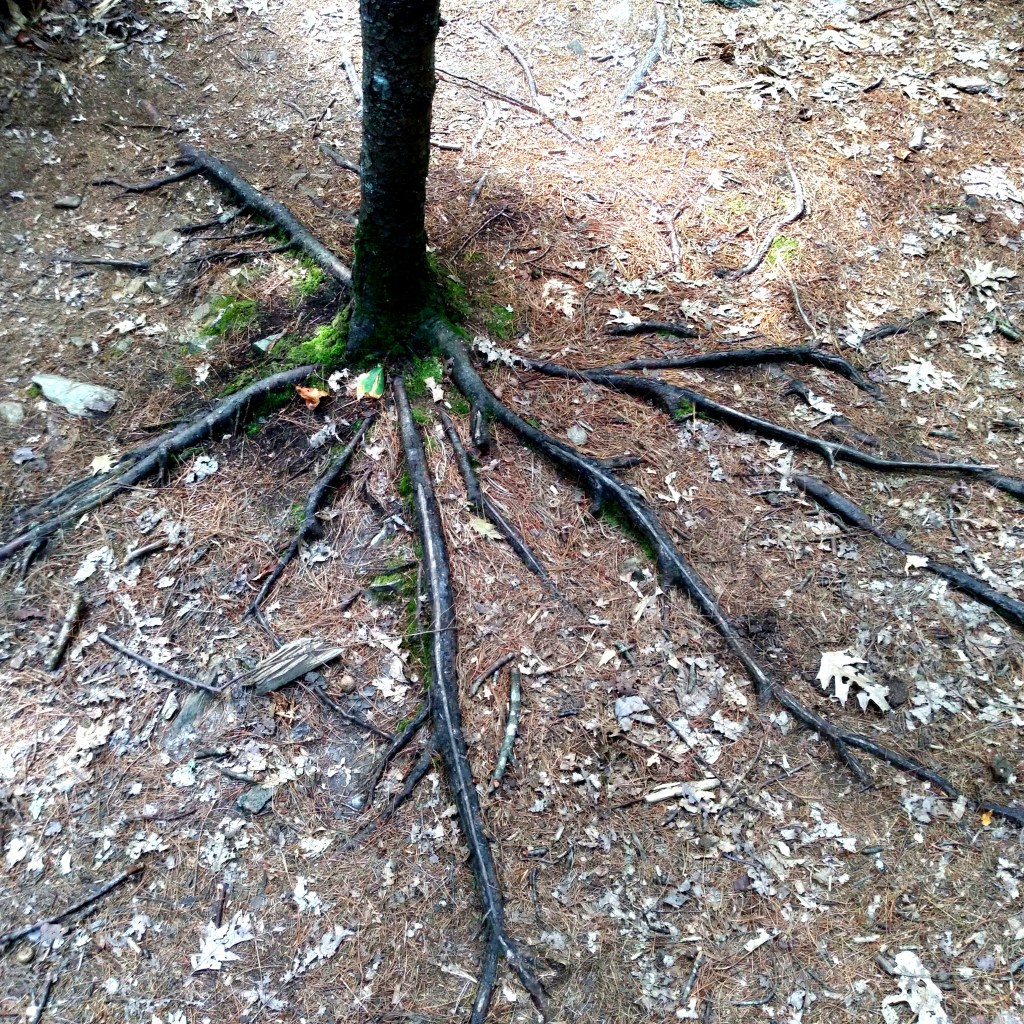
And so it was the that I went for a long walk with Roshi Joan Halifax, who was speaking on engaged Buddhism by way of encouragement for writing post cards to voters registered in swing states. With death as one of her biggest teachers, she points the way toward Bright Faith in the basic goodness of all beings, including ourselves, when we experience doubt in whatever form it arises. And right on queue, spread out before me on the pine needle floor, a ray of sunlight cast its brilliance on the exposed roots of a tree as it held its ground.

Her eloquence around meeting others with differing opinions in Harmony and Respect pointed to the middle way between extremes as a tiny leaf between two opposing giants drew my attention. I actually really do want to know how others feel and not demonize them, as we’ve been so trained in our liberal bubble to do of late.

And so it was with some dismay that I watched the debate and saw our beloved Kamala stooping to goading the man, rather than going higher, per Michelle. While she spoke to the issues with credible directness and told America how she plans to take care of us, she did so in between grimaces and a dismissiveness that I didn’t appreciate. Of course, I give her tons of credit for having come as far as she has in such a short period of time, but I expected more. I was frankly looking for her to project a little more of the beautiful lotus that she is. (Kamala means lotus in Sanskrit, another name for the goddess Lakshmi.)

And then I learned of all the negative ads that her campaign ran before the debate. Having given fifty dollars for the first time in my life to a political candidate, I’ve since been bombarded with requests for more, More, MORE! I get that this is a crucial election on every level, but this is why I hate politics. It’s a dirty game of power play that I want no part of. Arrrggghhh! Why does it have to be so complicated?

The next day’s walk with Nathan Glyde’s dharma talk was equally enlightening, which brought together the Buddha’s perspective on the Two Sorts of Thinking—the kind that leads to peace, ease, happiness, contentment, and freedom, and the kind that leads to dukkha (suffering)—and the Plutchik’s psychological Wheel of Emotions. The practice on tap is how do we work with our emotions when they arise, without identification, so as to allow more choice in our response? On the two sorts of thinking, “contraction is the felt sense of dukkha,” whereas openness, wide perspective, gentleness, and acceptance are the felt sense of contentment.

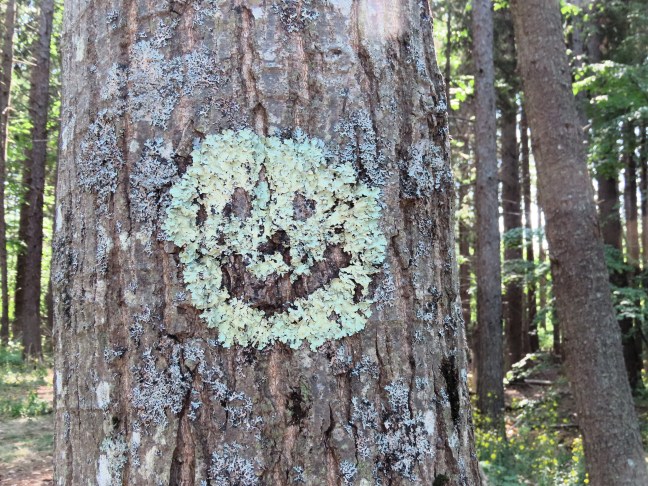
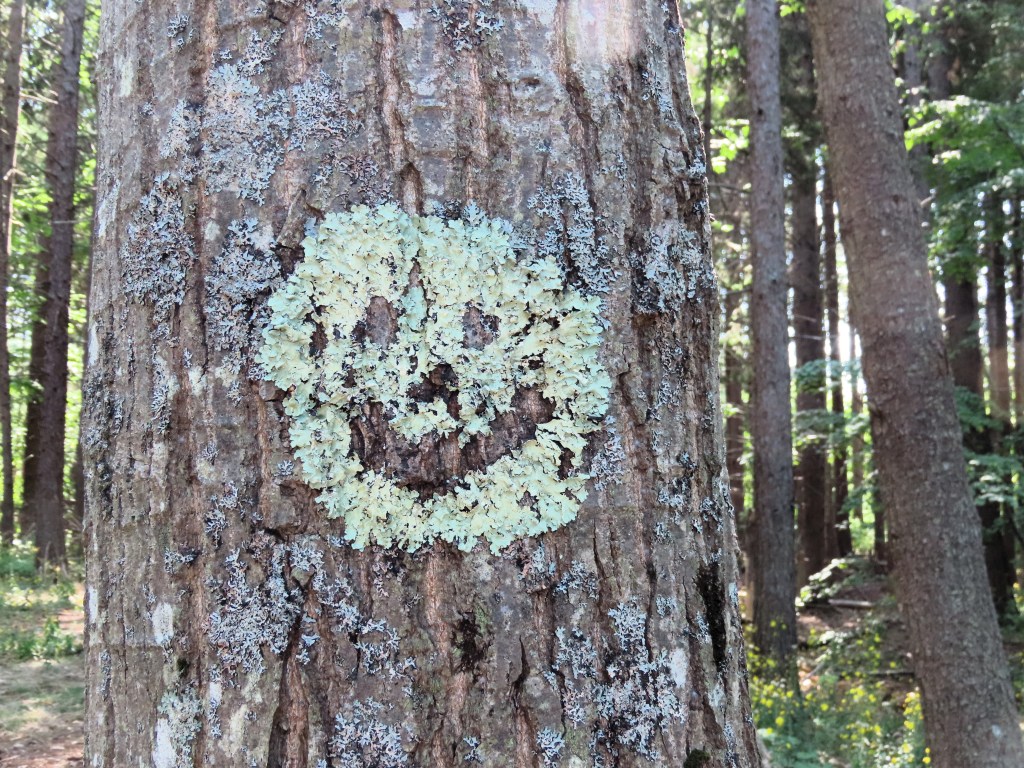
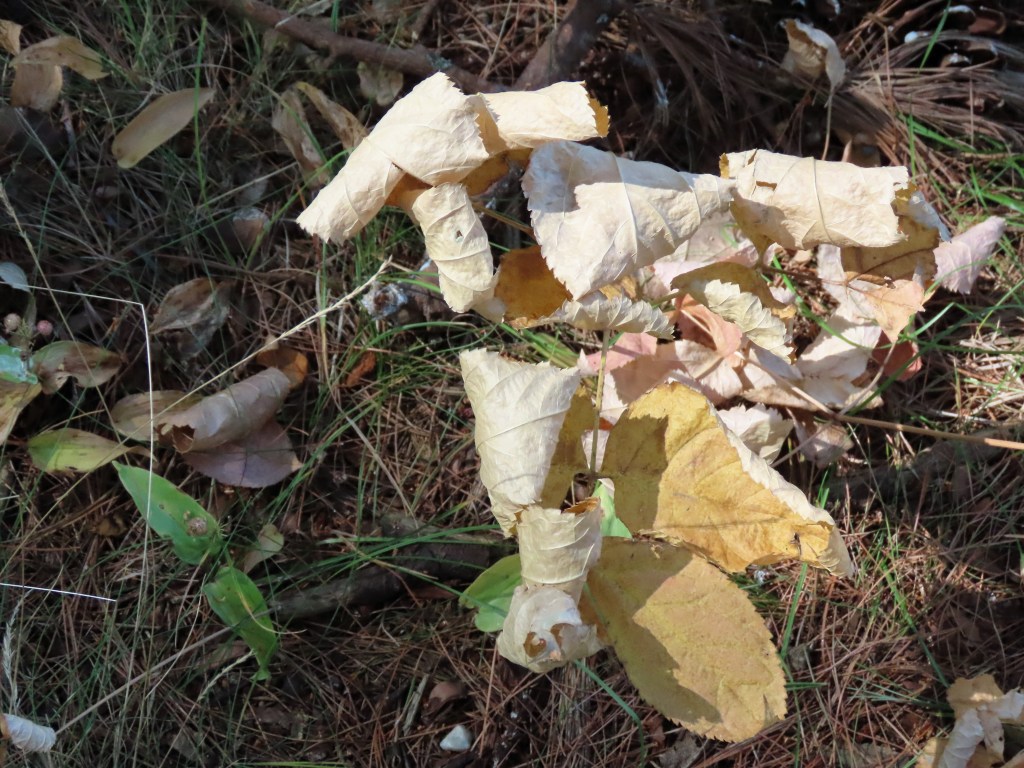
Then bam, a log, uprooted and cut off, stopped me in my tracks, and a family of dried, curled-up leaves stood sentinel by the side of the path. For leaves, contraction is the natural order of things, but as my own anthropomorphic, poetic sensibilities kicked in, I saw them as nature’s way of telling me to soften, relax, and open. At which point the mossy smiley face appeared on the path as a reminder of Joy.

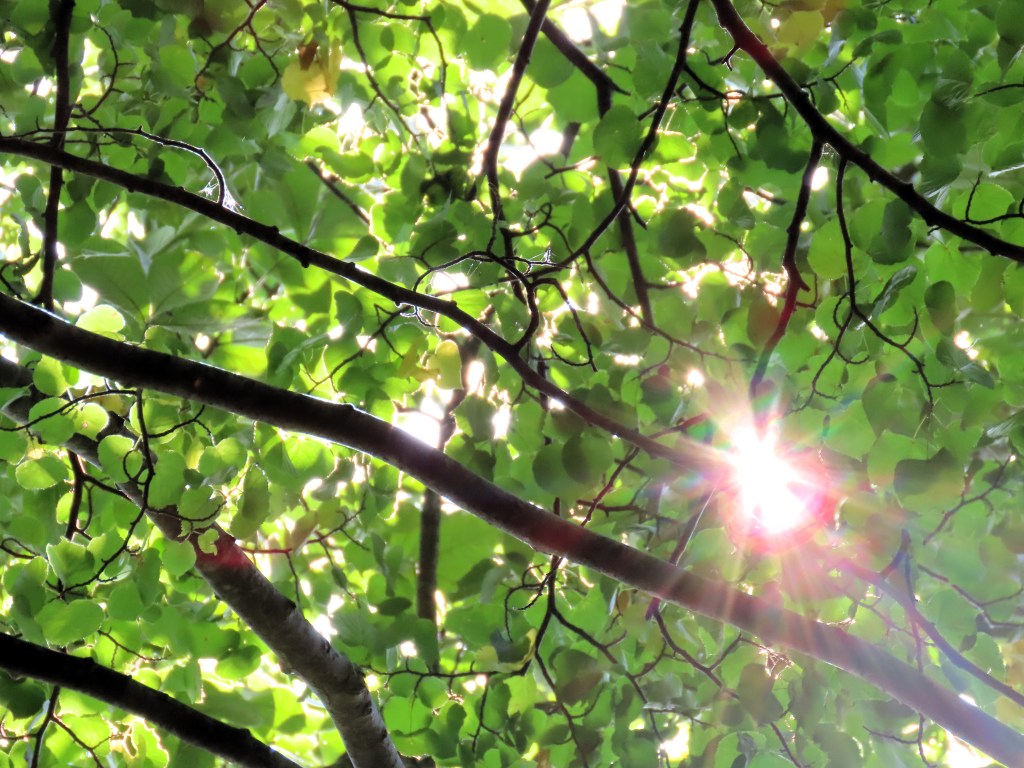
The whole-body breathing meditation that followed had me walking and breathing into the eddies and flows of the river of my being, like dusting cobwebs from the corners of my room or under the bed, those hidden places that haven’t been attended to in months. The energy and sense of well-being that flowed through me felt like breeze through the trees of my too-stationary bones and flesh. Then looking up, sunlight shone brilliantly through the canopy like the starlight magic that it is.

Self-doubt, politics, and the swirl of emotions now a dance in my awareness, I felt centered and grateful for all of it: the teachings, my poetic sensibilities, and the hope of Kamala, our next president.

Chant with me: KAAAAA MAAAAA LAAAAA

Not Totality, But Close

Yesterday was the total solar eclipse, the astrological event that had people scurrying across the country to get in the Path of Totality. Yes, the pictures looked amazing, and I’m delighted for those who fulfilled a wish to experience it. I kept closer to home, choosing at the last minute to drive to the beach ten minutes down the road where people are known to gather to watch the sunset in warmer weather. For me, it was a social event more than anything on the grassy point in Cape Elizabeth, Maine, and I used it as an opportunity to connect.

As a photographer myself, I chatted up Sean, who was there with his camera and tripod hoping to capture the 96% eclipse. Turns out he had been in the radio business in Massachusetts, back when there were local radio news stations. Now he works for Cintas, the uniform company, and only has time to use his camera when not working 9 – 5 and driving his son to baseball games.

Groups, families, and couples sat on blankets and chairs, bundled in hats and coats, which were insufficient to keep us warm at the water’s edge, despite the earlier temperatures in the sixties. Kids ran around and kicked balls as the moon eased its way across the sun without our notice. I didn’t have glasses, but my neighbor blanket said I could borrow theirs, and to my surprise, I saw that the moon had already begun to cross the path of the sun. Another blanket neighbor had made a camera obscura, which they offered a glance into. A mother with three kids had also made one out of a long tube, which projected a much bigger crescent-shape onto the tube’s round end. The coolest projection of all was through the lens of a colander, which produced dozens of tiny crescents huddled in groups on the blanket below, much like the gathering on the lawn.

At one point, a woman came around offering official sun-gazing glasses, courtesy of NASA, her employer. Gazing directly at the sun is a rare experience in and of itself, and watching our little sister eclipse its mighty parent was a strange juxtaposition. The miniscule eclipsing the G A R G A N T U A N was a powerful metaphor for what’s possible when things are in Right Alignment.

Generosity, kindness, and connection ruled the afternoon in a spirit of open-hearted communion as we all faced the mighty sun with varying degrees of awe, wonder, and perhaps a bit of reverence for the source of light, energy, and life on the planet we all call home. Whether everyone felt the connection that our cosmic neighbors were inviting us into I don’t know, but I felt it. It stirred me into a state of appreciation for being alive at this moment—a state of connected presence.

As I drove home, I took it all with me, back into my solitary life in a box, the one created by the hands and heads of man, the isolated spaces that both protect us and separate us, from nature and from one another—the totality and partiality of being, once again exposed to the light.

Ah, Retirement

I recently played squash with a 30-something at the Portland Squash Club, something I stumbled upon on a whim.

A few weeks earlier, I mentioned in passing to my partner, “I used to play squash.” “Really, so did I. Let’s play!” came his reply. So after more than 35 years of not picking up a racket, we both pranced into the synagogue-turned-squash-club-slash-community-center, grabbed one of the free rackets and protective eyewear, and started hitting the ball around. It was a blast! We missed 50% of the shots, but the ones we hit were satisfying. And every once in a while, I made a shot, not exactly planned, that sent him running. This was even more satisfying. We were mostly just playing for fun, trying to extend the volley for as long as possible. When the back-and-forth topped ten, we needed to stop for a breather and recover. “That’s good,” said he, the former soccer player/coach. “You’re getting an anaerobic workout.” Good to know I had at least ten in me. “OK, we quit when we hit eight shots in a row, three times,” came his challenge. “You’re on!” said I. Rather than scoring points, our goal was to hit it so our partner could return it, which trust me, is still a challenge. I call it Cooperative Squash.

After another few times in the court, solo and together, it all started coming back—the hard shot up the side, the soft, short shot in the front, the serve. The good news is that the balls are bouncier and the rackets bigger, so the shots that always used to drop like a stone or go straight through my small, round racket are much easier to return. “This is brilliant,” thought I. “I’m sweating and having fun.” As I’ve been wanting to amp up my exercise routine in retirement, I couldn’t have been happier to have rediscovered this feeling of exhaustion and exhilaration in one swell foop.

Since my partner is departing for parts unknown, leaving open, at a minimum, a squash partner, I signed up for the “Box League,” as recommended by the enthusiastic female coach at the club. I scheduled myself at the first opportunity for a match at 7 pm, admittedly not my best time. Having been assigned to the next-to-lowest box, I figured surely it would be a more or less even match. Not so. It was a rout. I was royally creamed in three games that took all of fifteen minutes, returning only two of her serves and gaining the serve only twice when she fumbled. Despite her occasional words of encouragement, it was truly depressing. I was back in junior high school when my ineptitude at sports caused me to retreat into photography, math team, and drama.

Without realizing it, I had inadvertently committed myself to five matches a month in which the top two winners advance to the next box and the bottom two losers are demoted to the lower box, in my case, the lowest. I found myself writing the box coordinator:

“I was not aware of what was involved in joining a “box.” Have you seen Barbie? Like her, I’m not too fond of being put into a box of any kind.”

“This is how these types of competitive leagues work,” my partner explained. Having played in the country’s largest amateur soccer league for years, he recounted the correlation between promotion/demotion and drinking: the individuals in teams that were promoted stayed healthy and fit while those on teams that were demoted became heavy drinkers. I found myself asking whether “healthy competition” is really healthy or a sure-fire way to fuel lack of self-esteem.

I don’t like competition, in any form. It encourages the “comparing mind” and labeling, where the winner is better than me at <fill in the blank>, which feels bad, and the loser is worse than you at <fill in the blank>, which feels bad. If you’re the loser, that’s one side of the same coin. Of course, I suppose the idea is that the “loser” is supposed to be “motivated” to “work hard” at “improving” and thereby become a “winner.”

Ooofff! That’s a lot of identification and effort that I for one want no part of! I’ve spent a whole lot of my later life endeavoring to dis-identify with labels, accept myself and others as we are, use discernment to choose what feels aligned with my authentic self, and promote that in my life and in the world. Frankly, I’ve been doing a pretty good job of it of late. Until the squash match.

All that said, the flip side of not wanting to compete or label is an ongoing feeling of “lack of accomplishment.” Having officially retired at the beginning of the year, I’m supremely busy with what I call “reinventing myself.” No longer tethered to a computer for hours of the day, I’m free to explore like a child. This often doesn’t feel like I’m accomplishing much. Yet, this morning’s journal entry had me recounting all the things I’ve done (accomplished?) over the past few months since returning home from living on a sailboat for two years (yes, that was an accomplishment!) so I could take it all in. And there was a lot there.

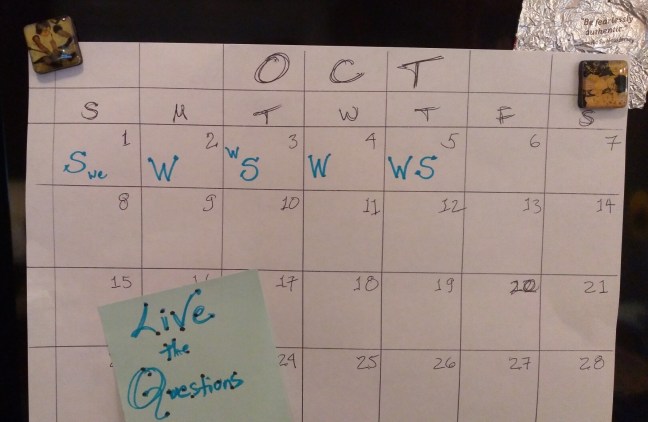
As such, part of my reinvention is the process of actively discovering, uncovering, and recovering what feeds my soul. Connecting with and supporting friends and family—including a new granddaughter—feels important. Allowing, trusting, and making time for my inner sense of wisdom to flow outwardly also feels important—witness, this blog. Exploring my creativity in ways that I haven’t had time to previously is up there. And prioritizing my physical well-being has become increasingly important—witness the calendar I now have on my fridge that tracks how many times I actually move my body each week.

One of my intentions of late is to “live the questions,” per Rilke, so I continually ask myself, “Am I stuck on the notion of accomplishment out of conditioning or is it something I truly desire?” Yes. “Is it externally or internally motivated, or both? Yes. “What does real accomplishment actually look and feel like anyway?” I’ll know it when I feel it. And sometimes I do.

Which brings me to this moment in time. Of course, my higher self knows that now is my opportunity to feel accomplished, or call it satisfied, or better yet content, or let’s try on happy, at peace, or bliss. Yes, that feels good, as a smile creeps across my face. And I am reminded once again of the Tao:

Contentment that derives from knowing when to be content is eternal contentment.”
—Tao Te Ching

I guess I’ll stick it out in the box league for the month and then go back to hitting the ball around myself and inviting friends to play Cooperative Squash. Wanna play, with emphasis on the word play?

Barbie Land: Moving Beyond Our Limited Mindset

I feel compelled to write about the Barbie movie, which I’ve now seen four times! Yes, I am truly obsessed.

The first was on opening night at the invitation to a friend’s 50th birthday party, which I accepted knowing nothing about it except that my friend is a liberated woman and the husbands were all going too so presumably it wasn’t just fluff. The second was with a friend and my partner, who agreed it was brilliant. The third was with friends, an older couple with a reluctant husband, who ended up appreciating it more than they imagined. And the fourth was with my 83-year-old mother where we dressed in pink, her with her rollator and me once again with my willing partner.

From the opening scene play on a 2001: A Space Odyssey; to the Mama Mia!-like dance numbers; to the numerous twists and turns of the storyline arc from pure matriarchy to disguised patriarchy (aka The Real World) to pure patriarchy to the seedlings of basic humanity; to the elevation of Weird Barbie as the woman who makes things happen; to the epic, heart-wrenching monologue by Gloria, whom I consider the heroine of the movie, about how hard it is to be a woman; to the powerful personal transformation of our endearing hero, Ken; to the brave and touching transition of our vulnerable and insightful Stereotypical Barbie in becoming fully human; to the real-life montage finale bringing everything down to earth—it was laugh-out-loud funny and cry-your-eyes-out poignant about the experience of being female in a mostly man’s world and ultimately about being human. Oh yes, it is deep, this movie about a doll that sparks indignation in some and ignites a sense of empowerment in others.

The outrage over the playboy-like figure of the doll is dealt a swift blow in the first scene where the film shows many of the Barbies that have been made: astronaut Barbie, doctor Barbie, pilot Barbie, engineer Barbie. Clearly, the doll was also meant to spark the imagination of what is possible for girls, beyond simply becoming a mother. Who knew? I never played with Barbie so didn’t have the preconceived disdain of some, like Sasha, the powerhouse teenager whose emotional arc is among the most touching in the movie. She opens with lambasting Barbie for “setting the feminist movement back fifty years” and ends by insisting that she and her “ordinary” Mom return to Barbie Land to save it from patriarchal takeover. “You can’t just give up, Mom!”

The dramatization of each of these worlds—Barbie Land, Kendom, and The Real World—along with the fantastical transitions between them by car, motorboat, spaceship, bicycle, campervan, and snowmobile, allow you to see just how different the world is/would be when taken to each extreme. But make no mistake, the Real World is still patriarchy, just papered over by the thin veil of feminist ideology that’s been allowed to eek by over the decades. Ken: “You’re not doing patriarchy very well.” Corporate guy: “We’re actually doing patriarchy very well. We’re just better at hiding it.”

Clearly none of these worlds is “the answer” to how to live together in harmony and flourish, where everyone is honored for who they are, gender aside. Women and men have different qualities that must be allowed their natural expression if we are to live together as fully human. And yet, empirically and historically, in general, while men in power have been busy building empires, whether civic, cultural, scientific, technological, religious, or economic, women in not-power have generally been busy creating and nurturing families. To the extent that women are part of these empires, they’ve done so within the patriarchy by seeking equality in a man’s world. While that’s certainly one way to go about it, it’s by no means the most effective way of creating a just society for all. You don’t have to look very hard to see that baked into the creation of these power-hungry empires is not only systemic inequality, injustice, and marginalization, but the seeds of destruction of the very foundation upon which they depend, nature itself.

As a perfect case in point, watch Oppenheimer and take note of what happens when men push their creative minds and might to their extremes in pursuit of what is often self-destructive power—in this case, the atomic bomb. With only three women appearing in the film, a wife, a lover, and a token nod to one of the key female scientists of the Manhattan Project, it’s a sobering reminder of what can and often does happen when men’s power goes unchecked. I have no doubt that the 640 women at Los Alamos, nearly half of whom were scientists, were thrilled to be involved in The Manhattan Project along side the men. But it does make me wonder how things might have turned out differently if they had been in charge.

As a thought experiment, imagine a world in which, instead of holding token positions in patriarchal institutions such as government, industry, finance, law, academia, and the arts, women were actually running the ship. Just let yourself take that in for a minute. No longer underlings in a male-dominated world, imagine women actually being able to make the decisions around “how things are done around here.” Just bring yourself to the Oval Office in Barbie Land and you’ll get the vibe. President Barbie: “Turn to the Barbie next to you. Compliment her. Tell her how much you love her!” OK, maybe not exactly that but somewhere along the spectrum closer to care, concern, connection, cooperation, collaboration, compassion, and compromise than say, control, competition, confrontation, coercion, and combativeness. Seriously, imagine a world where these values were the guiding principles behind our collective decision-making. To me, it sounds like a much better world.

Buying into matriarchy wholesale à la Barbie Land is no more the answer than wholesale patriarchy as each subjugates one gender over another. However, I believe the second-wave radical feminists had it right in their desire to eliminate male supremacy and oppression—from the boardroom to the bedroom. The question is, how do you accomplish this? Barbie, the movie, has proposed one way. Put women in charge. Let them set the tone of our civic, cultural, and economic values. And then codify these values into our laws and institutions until they become accepted as social norms by the culture at large. While it might seem far-fetched as described in Barbie Land, matriarchal cultures have a long history in human evolution.

However, it’s not just about putting women in charge, giving them power over men. Part of this radical shift means holding men accountable in their rampant pursuit of power all all levels—personal, political, economic, and sexual, among others. And how do you do that? By following the leadership of people like Jackson Katz, my high school classmate who advocates for men manning up to their responsibility in shifting social norms that perpetuate violence against women and girls and men and boys. By supporting organizations like Raising Voices, which delivers evidence-based activist training programs to prevent violence against women and children and where I had the privilege of working. And by being brave enough as a woman to express yourself authentically and fully in the face of it all.

These are big asks, to be sure. Yet all around the world, there is movement in this direction and positive change is happening that we don’t hear enough about. As what is already one of the biggest blockbuster movies of all time, Barbie, on the other hand, is a breath of fun-filled fresh air delivering up a whopping dose of inspiration to move beyond our existing, limited mindset. If we imagine it, we can create it.