NIRVANA S3:E1

Jun 26, 2022

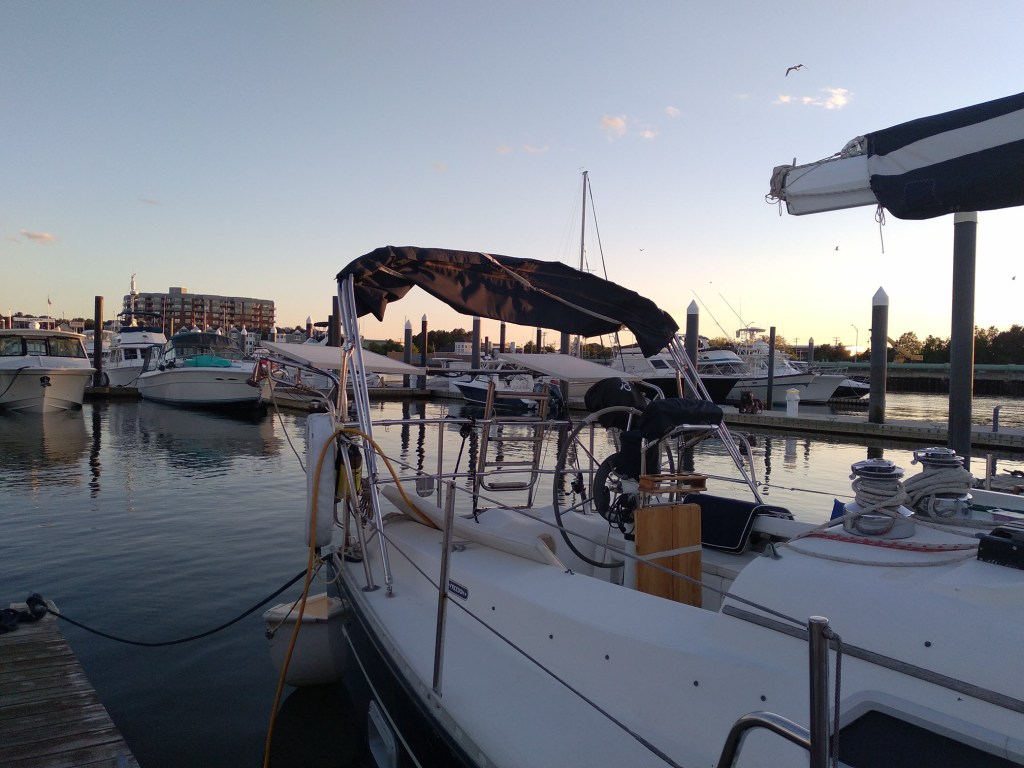
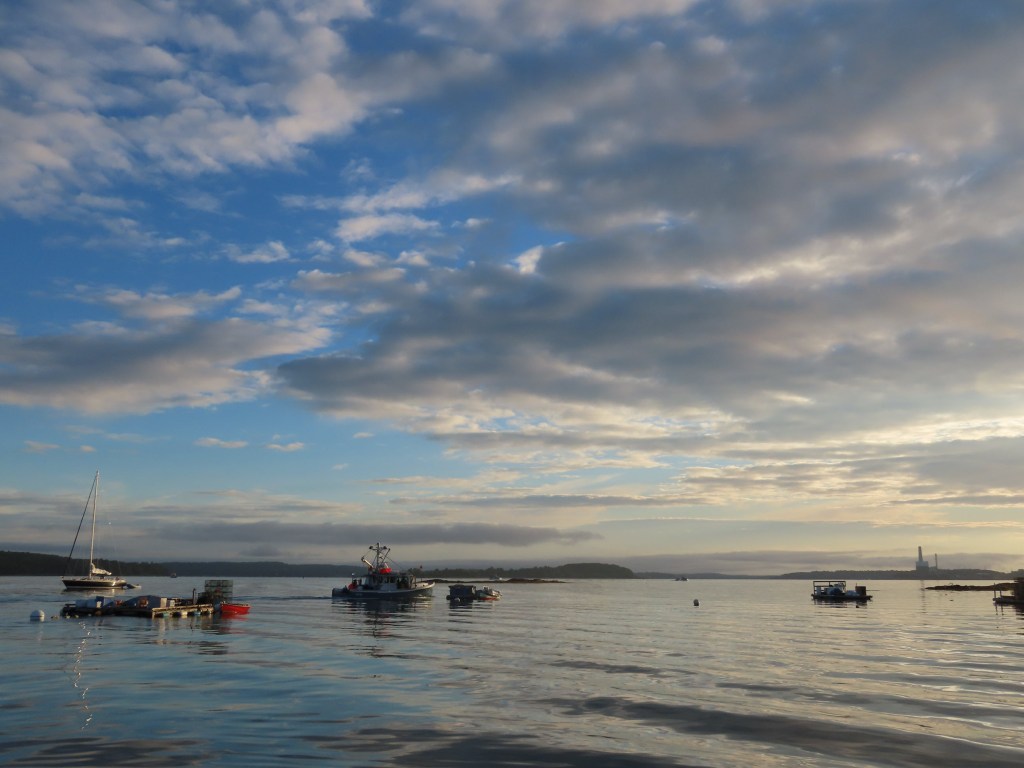
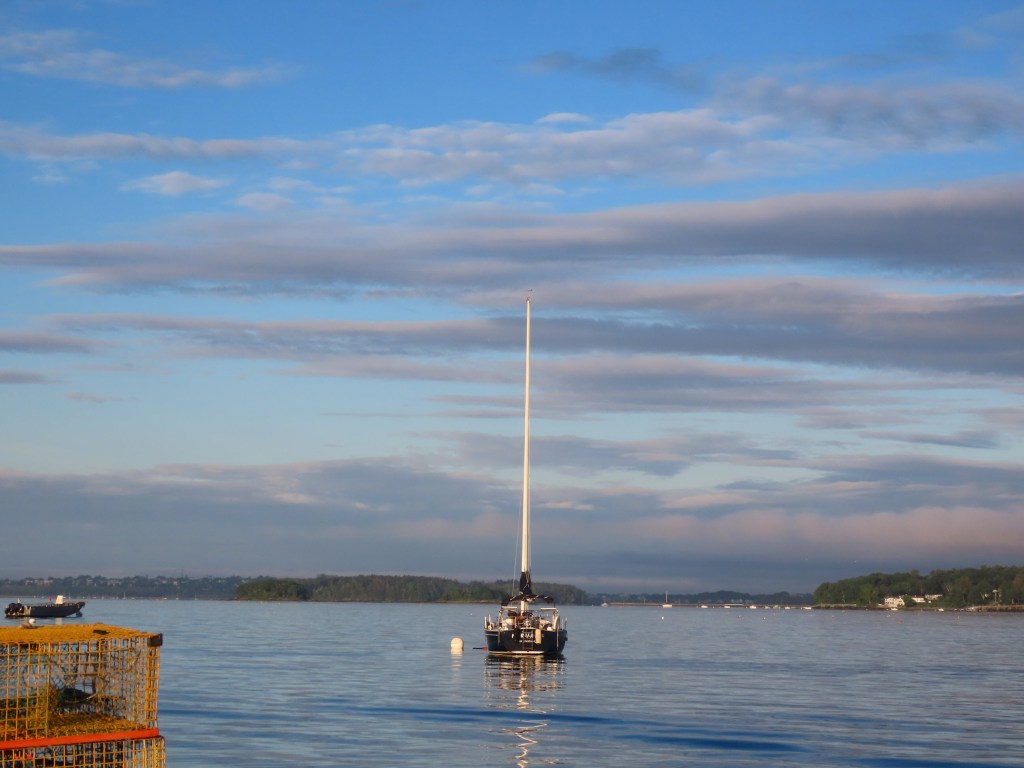
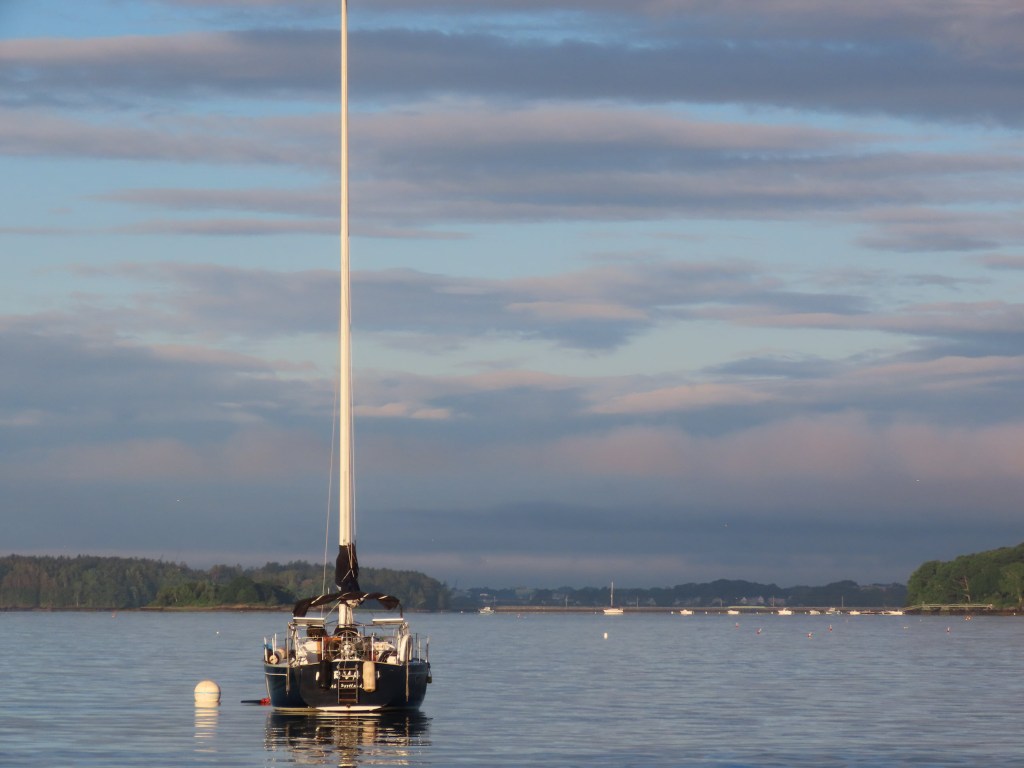
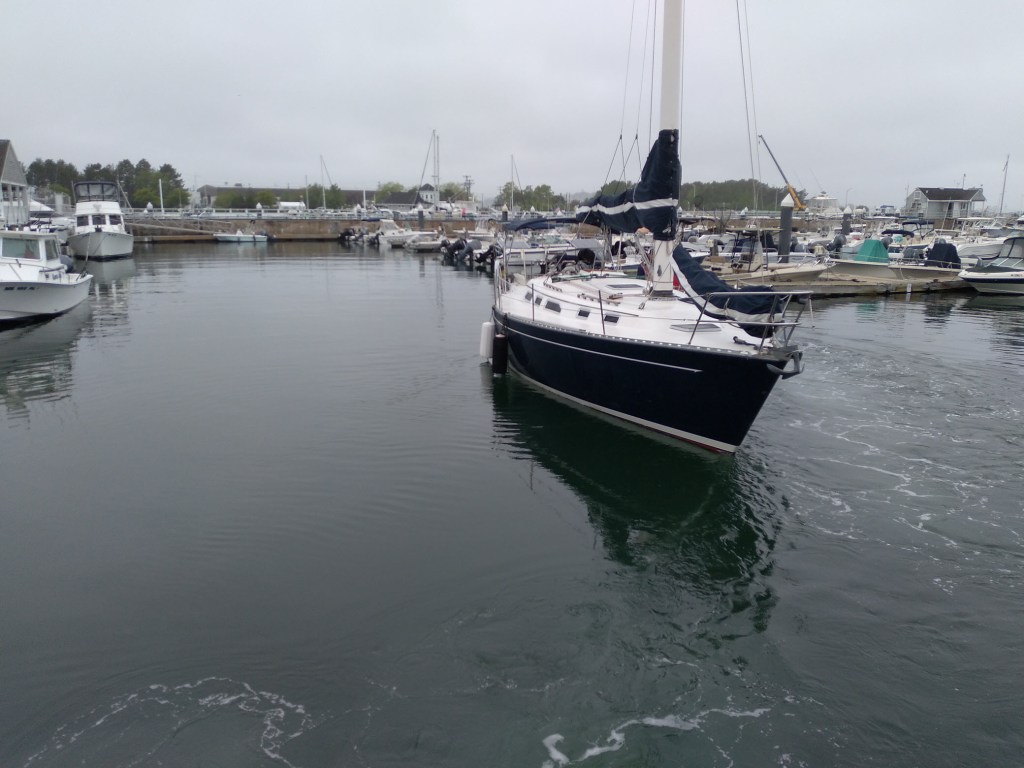
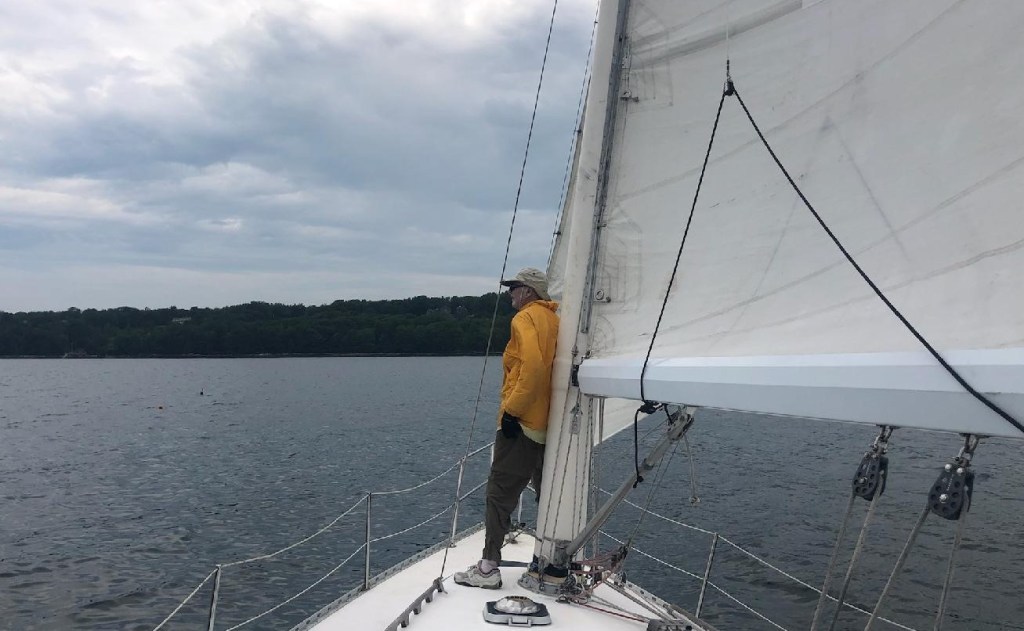
The beginning of the sailing season aboard sv NIRVANA has officially begun! After five weeks at Spring Point Marina in South Portland, we finally untethered from the dock on June 16. Living aboard at the marina allowed us to enjoy the proximity to Bug Light, downtown Portland, friends, and family, as well as to ready the boat for our second sailing season in Maine.
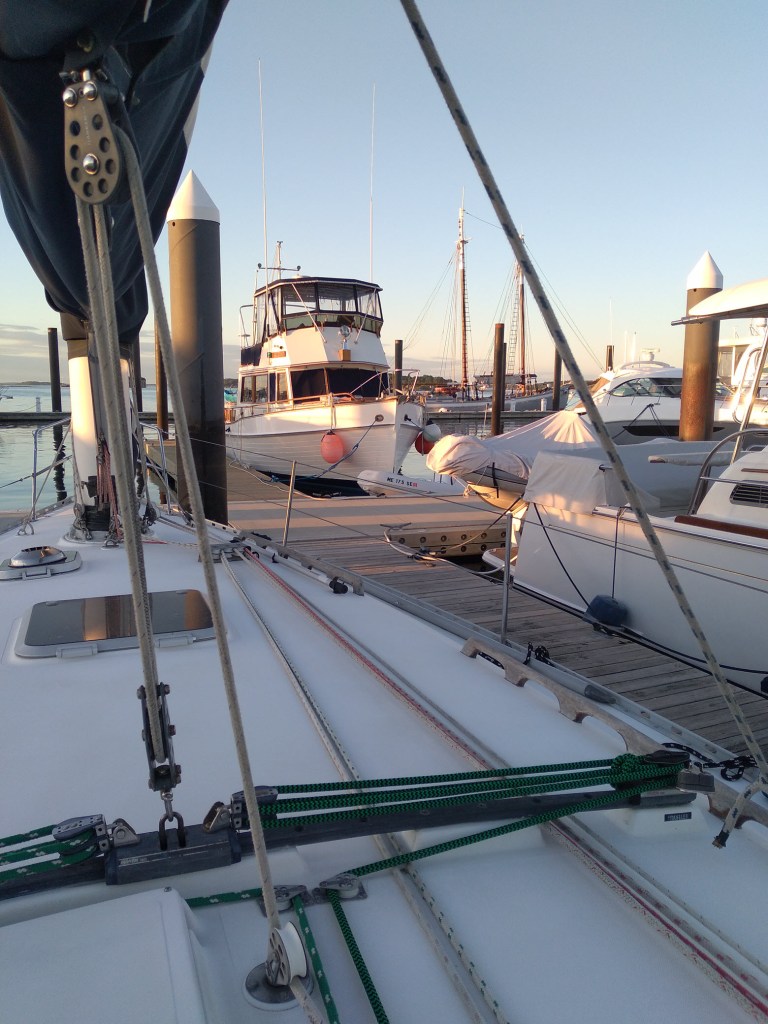
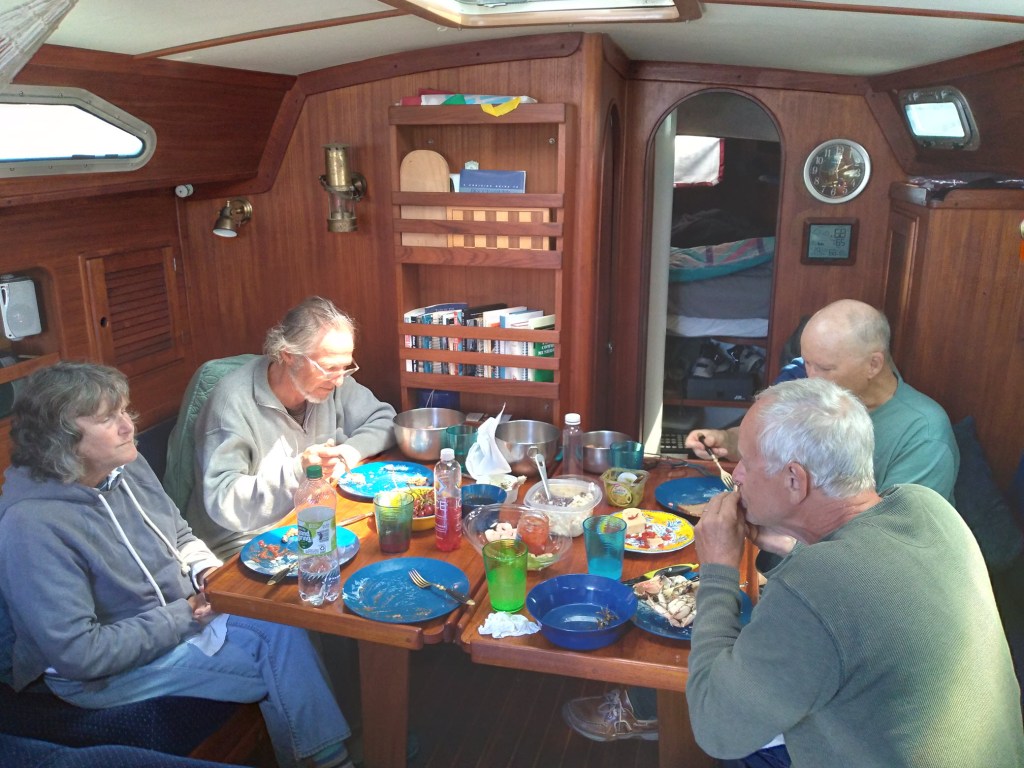
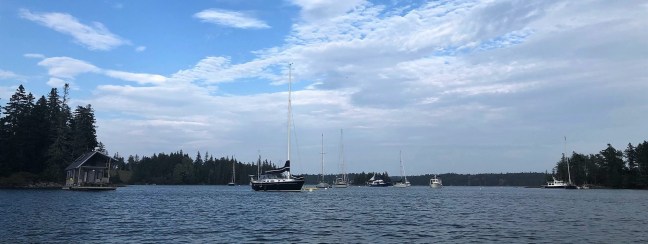
Our first cruise is an overnight to Jewell Island with our new friends Bill and Kristin, whom we met at DiMillo’s last winter. Although neither of them has much sailing experience, they bought a 49’ boat a year ago and have been rebuilding nearly every system and lived aboard most of the winter. We leave in a thunderstorm, have a short sail after the weather cleared, and then pull into the anchorage just as more rain descends. It’s fun showing them our ropes, grilling fish in the cockpit, feasting on fresh bread and pancakes, hiking around the island, and climbing the tall tower that gives a wonderful view of Casco Bay. Let the summer games begin!

We take various friends out for a sail locally in Casco Bay, including a birthday cruise to the Goslings and taking the dinghy ashore on the white sand beach on Long Island. After walking across the island, we discover a small café and buy a blueberry pie, which we share in the cockpit.
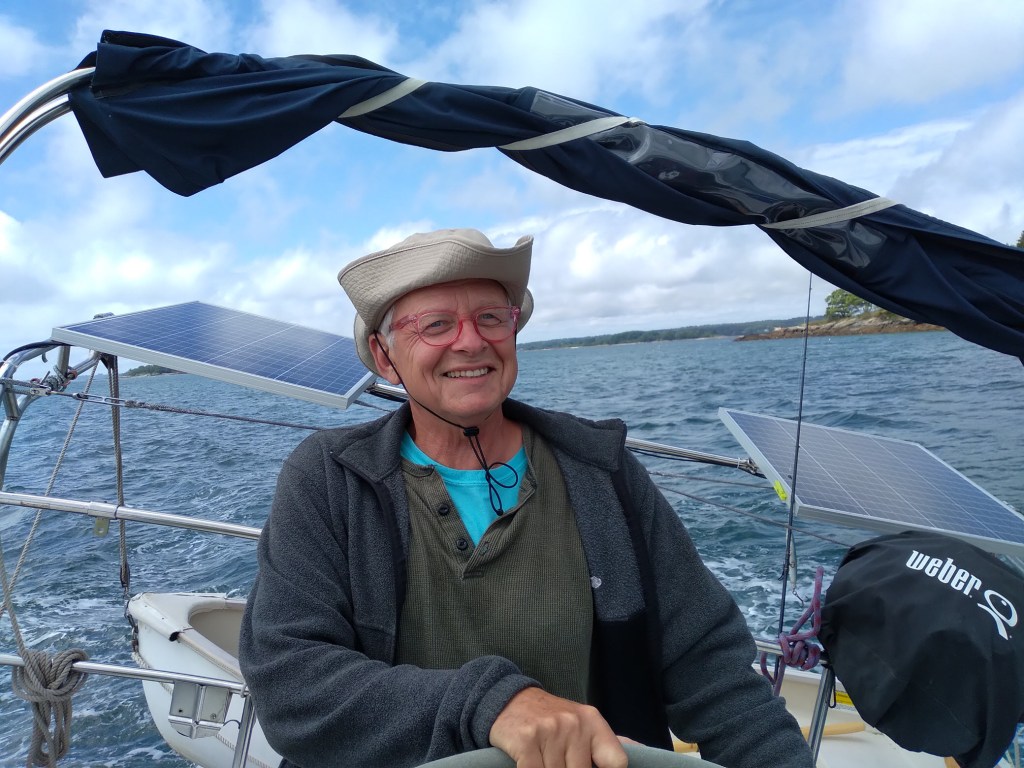
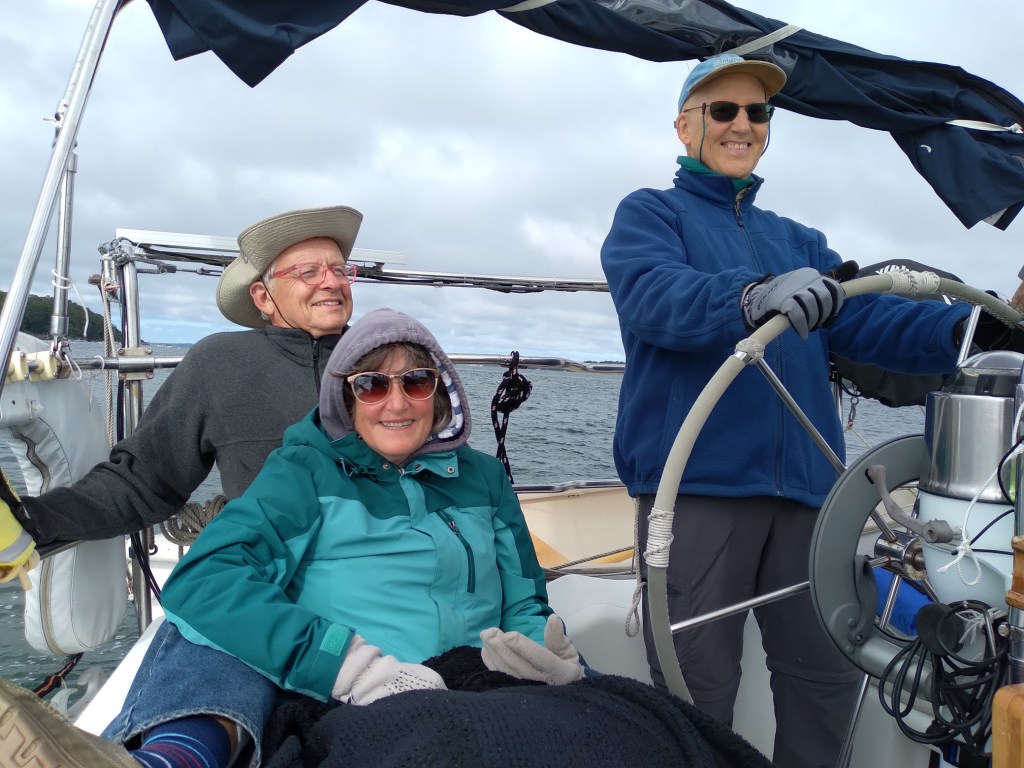
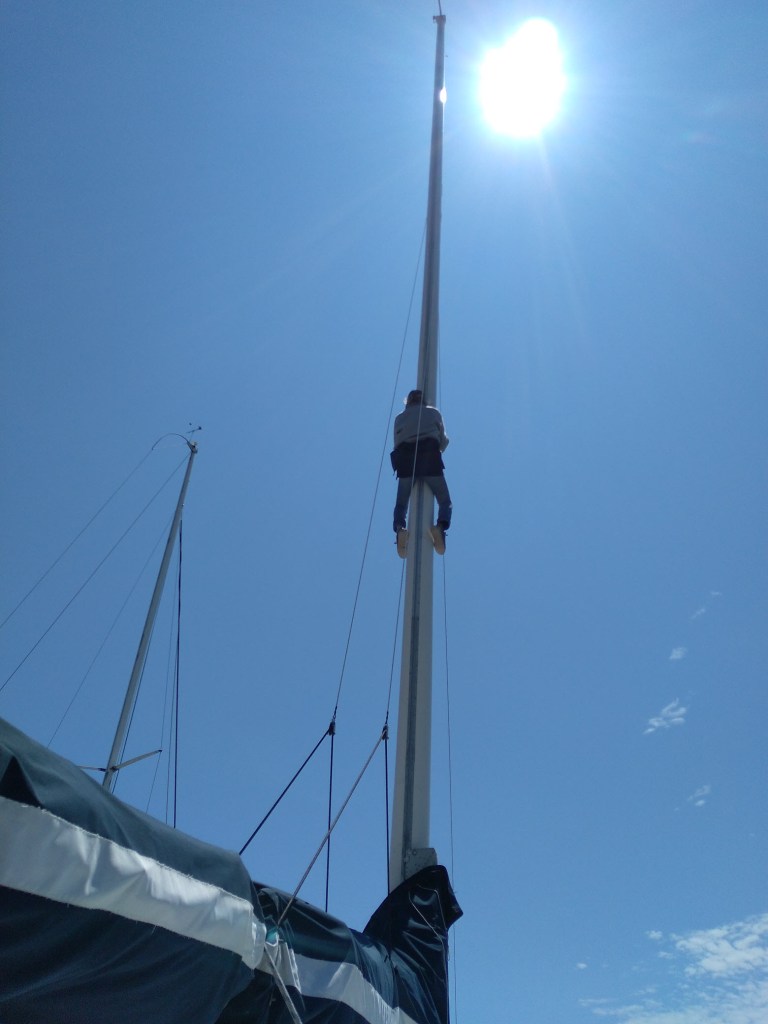
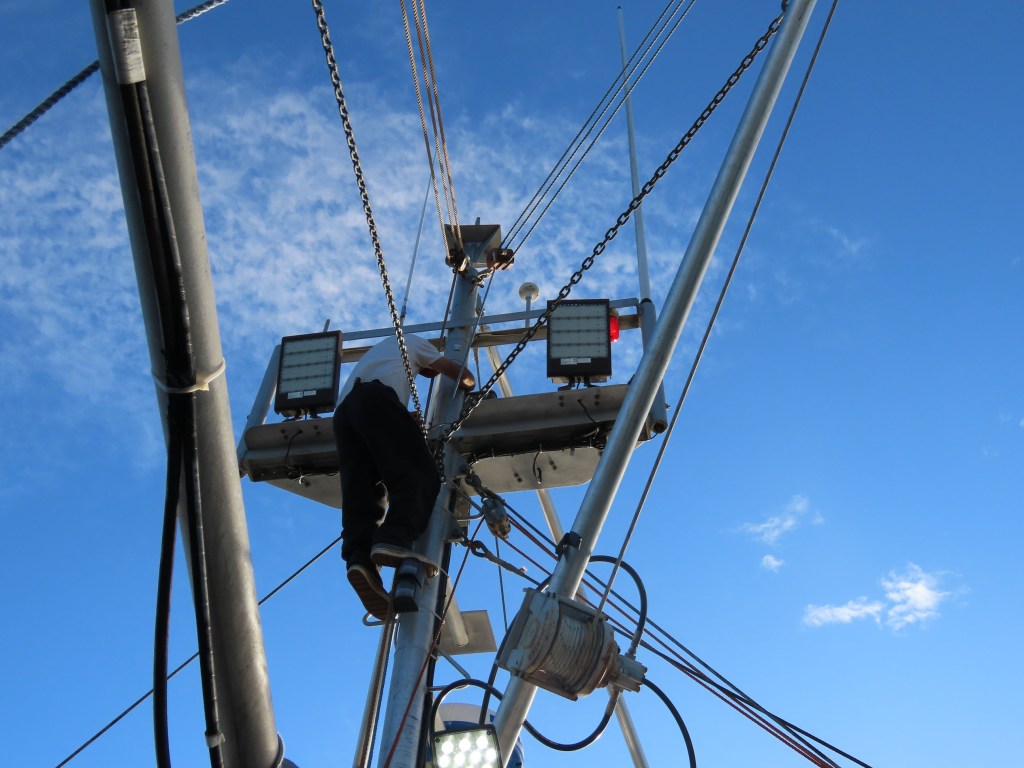
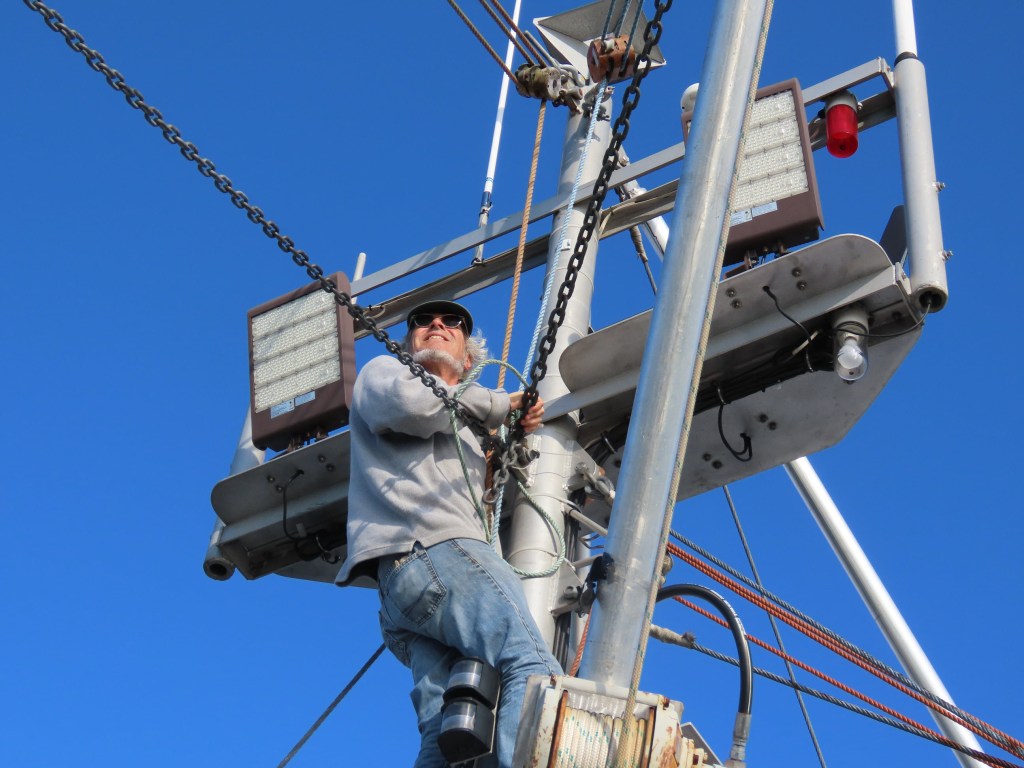
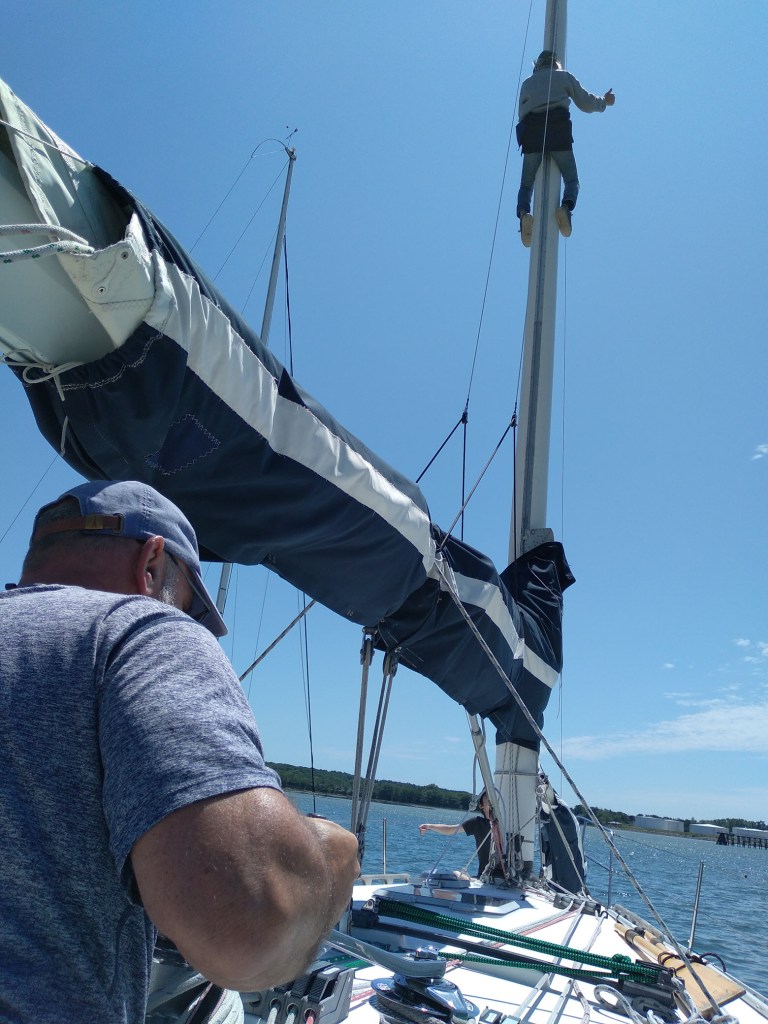
As we’re raising sail on the way back, we lose our jib halyard up the mast. Damn! Next day, Will makes arrangements with Bill to meet us at Knight’s Landing in South Portland to help haul him up the mast in the bosun’s chair to retrieve it. Will was calm and steady, and I was surprisingly nerve-free despite his height of at least 35 feet up.

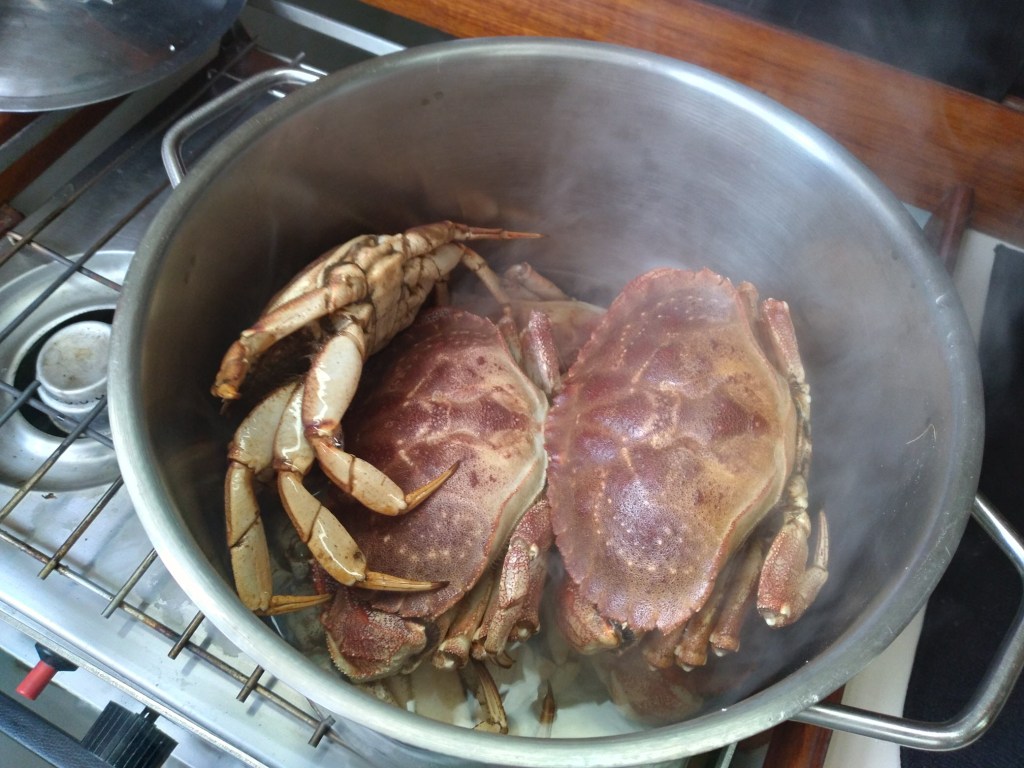
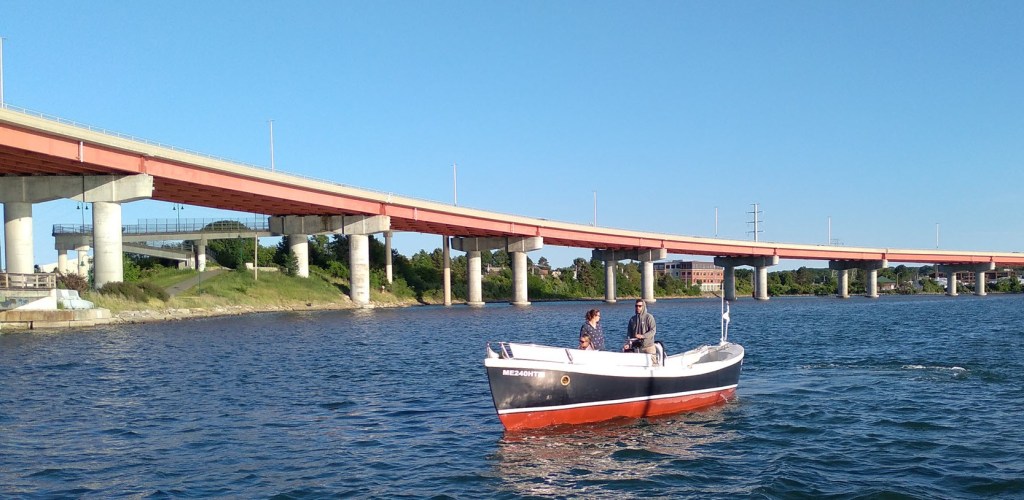
Knight’s Landing is a little hidden gem under the Casco Bay Bridge that connects Portland and South Portland where Will spent most of the summer two years ago with his former boat. The dock has a bird’s eye view of the oil tankers coming and going so has a very industrial feel and is a local haunt for those in the know, especially because you can stay overnight for free. We meet the usual cast of characters—a pair of fishermen brothers, one of whom has been living on his scrappy, demasted boat and gives us a half dozen crabs from his brother’s lobster boat; the guy who runs the South Portland Sailing School and happens to have bought our old mooring; and none other than Simon and Jill, my son and daughter-in-law, doing a Solstice sunset cruise on Jill’s boat, On the Rocks Cocktail Cruises. Jill got her captain’s license two years ago and is running her boat for the second year, this time with a liquor license.
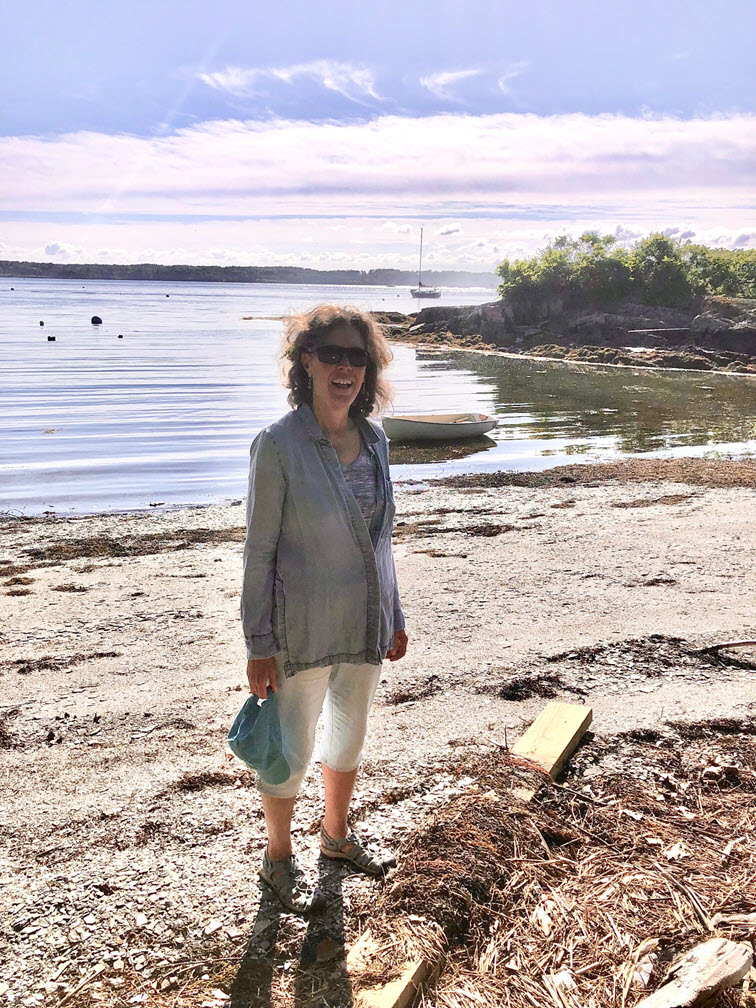
We spend a few low-key nights at Clapboard Island just across from Falmouth Foreside where I used to keep my Sabre 28 sailboat. Never having gone ashore here, we discover a sweet writer’s hut owned by the Maine Coast Heritage Trust, where we come across a book with a chapter dedicated to Alna, Maine, the town where my relatives have lived since the 1940’s.
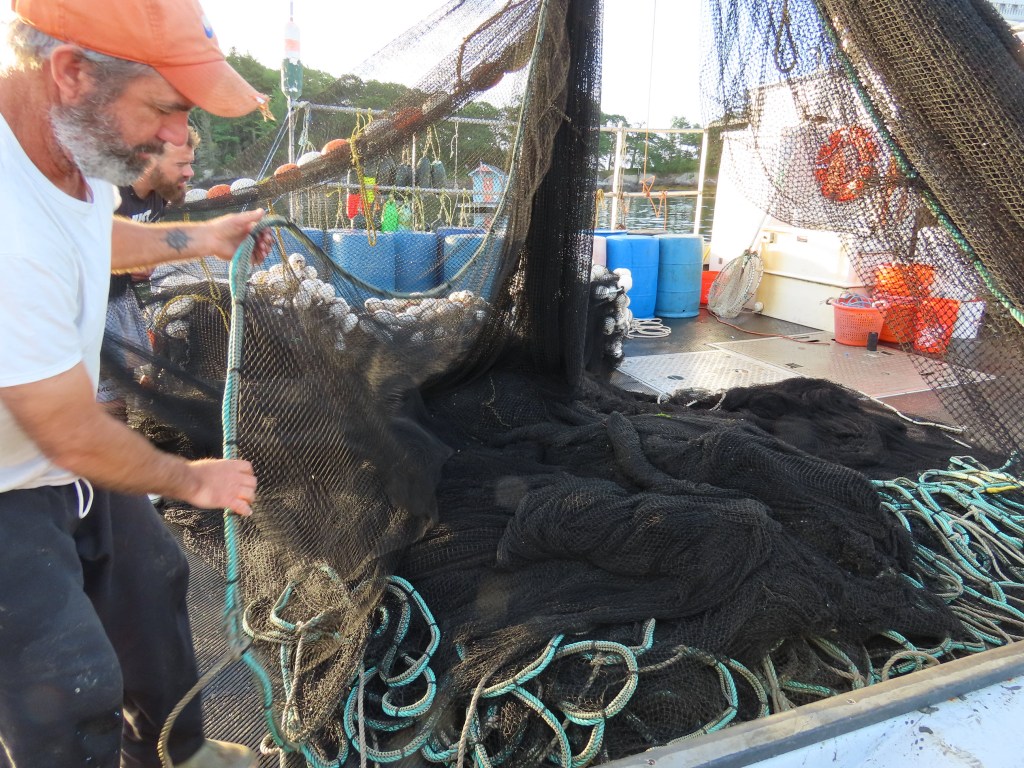
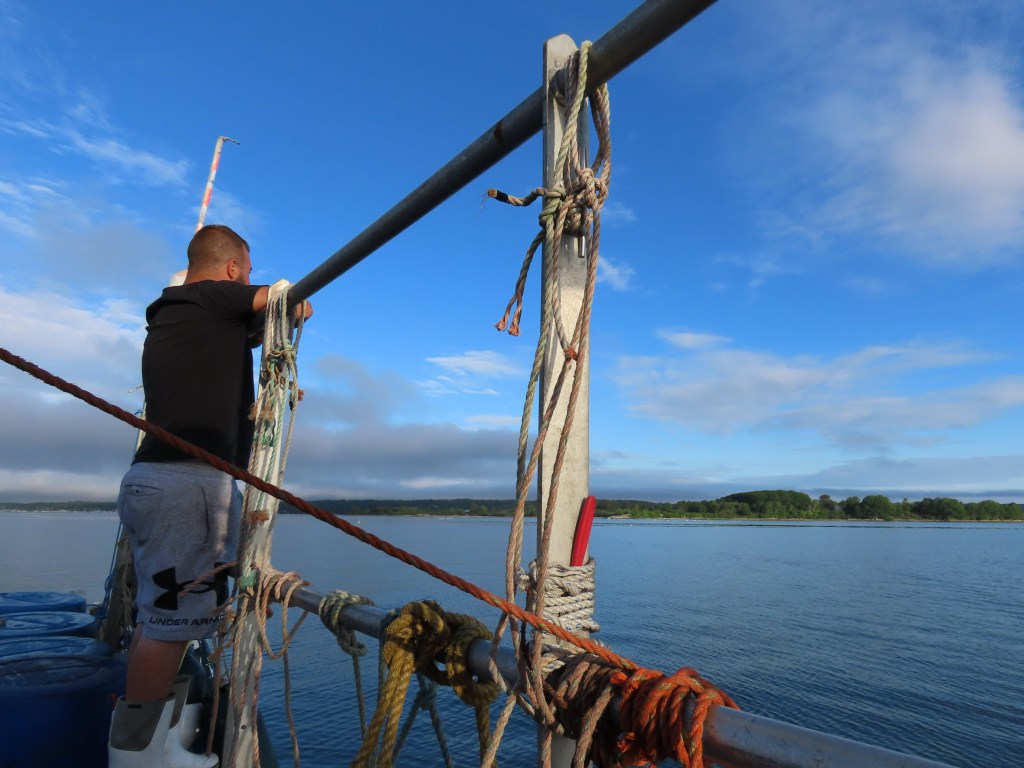
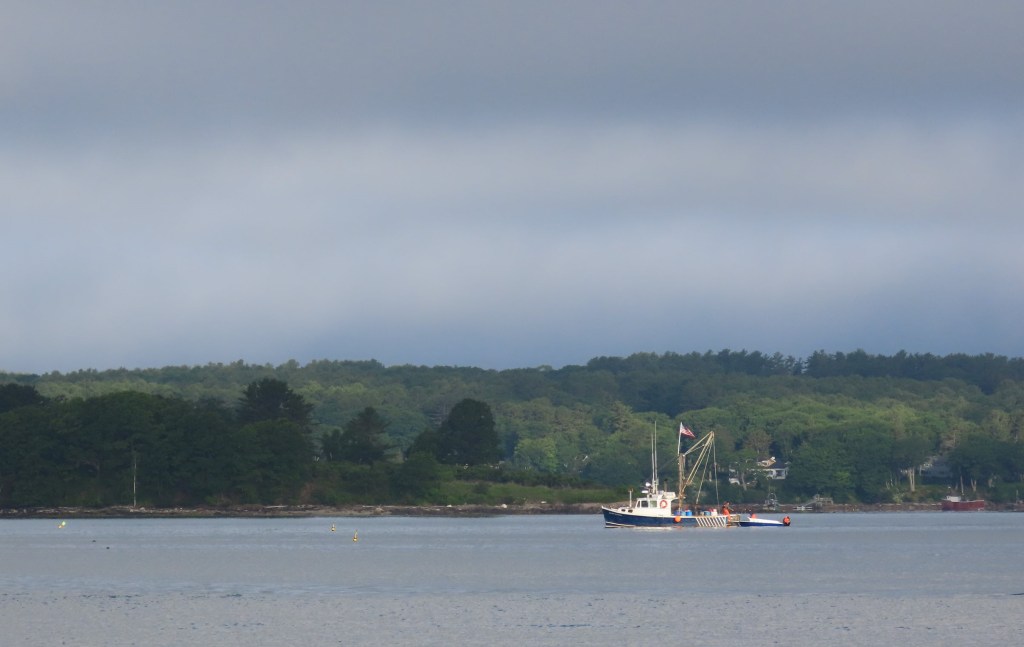
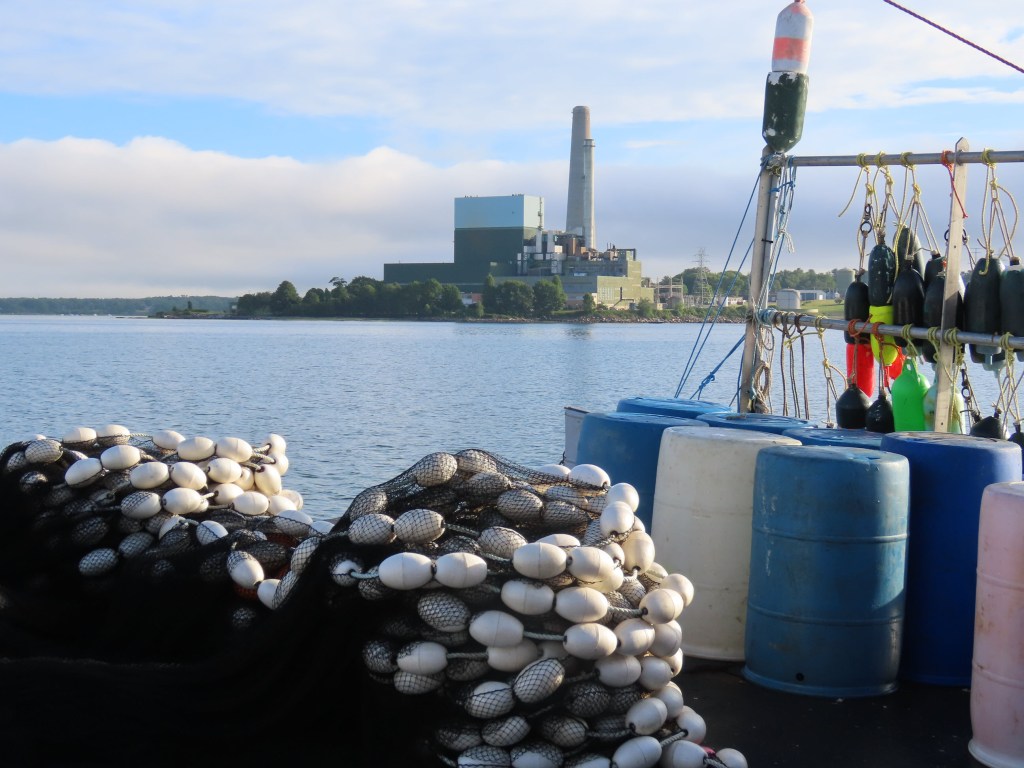
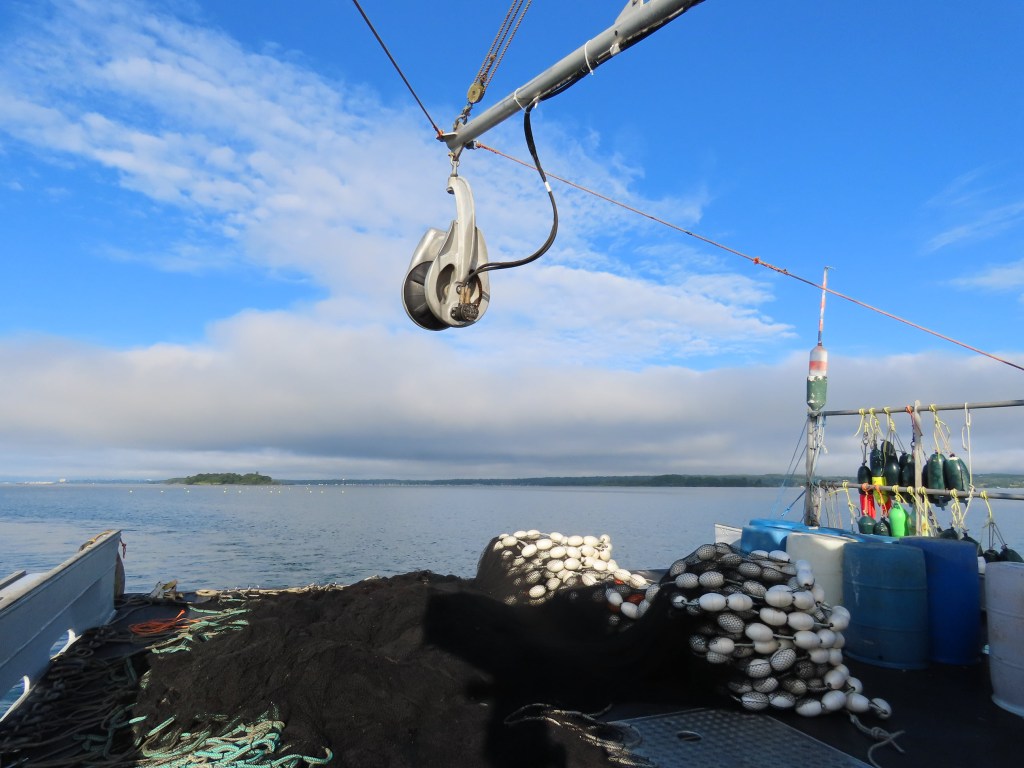
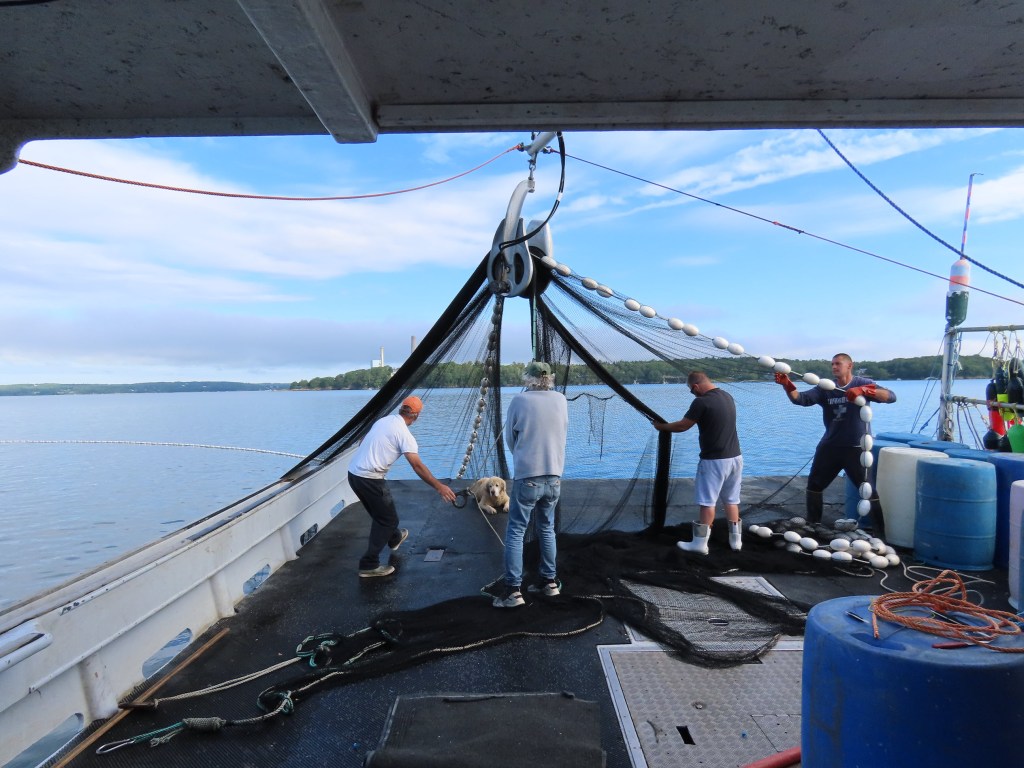
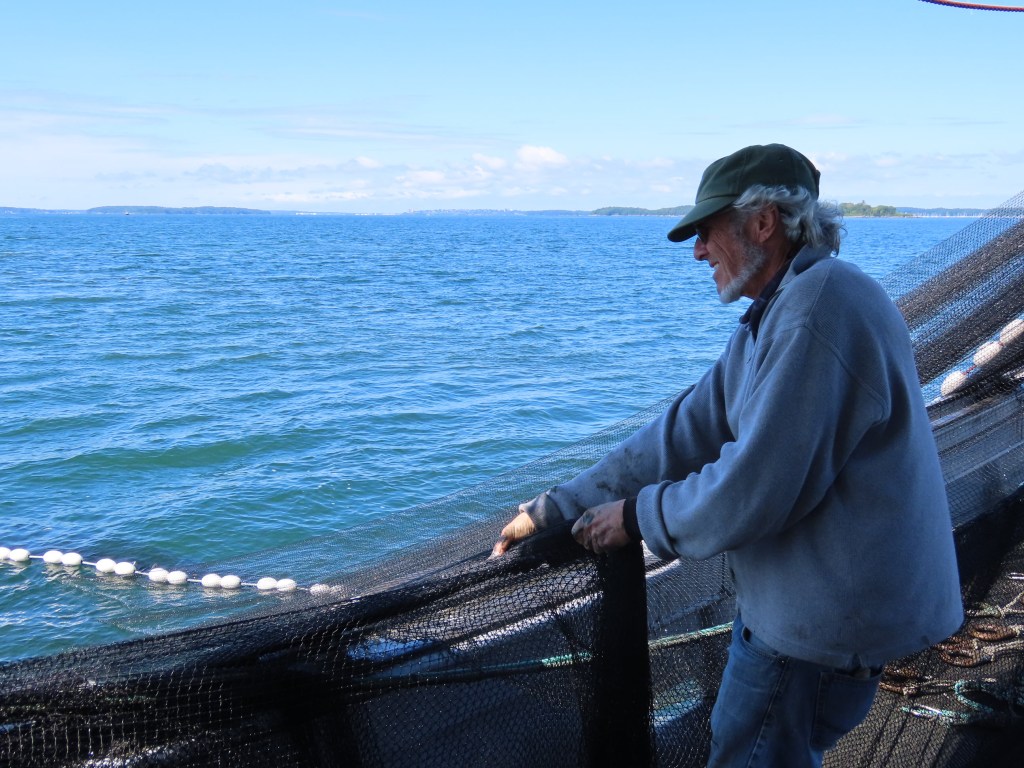
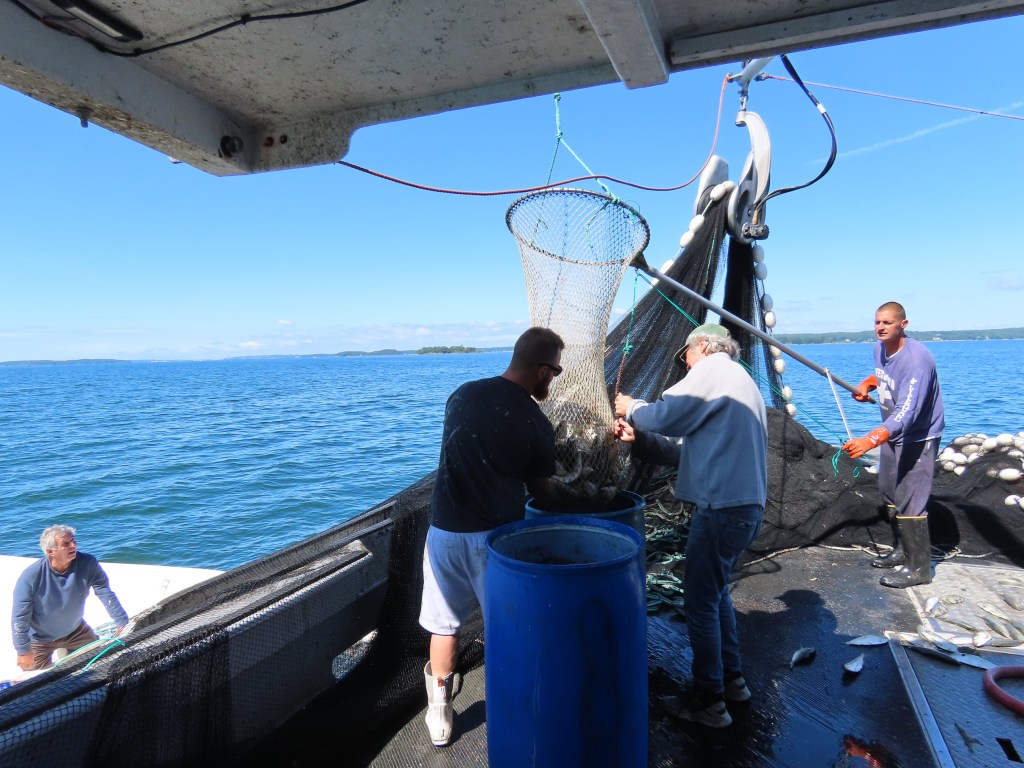
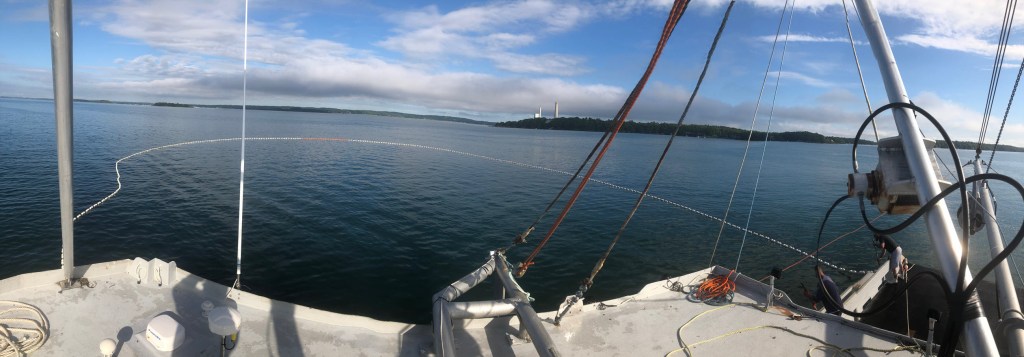
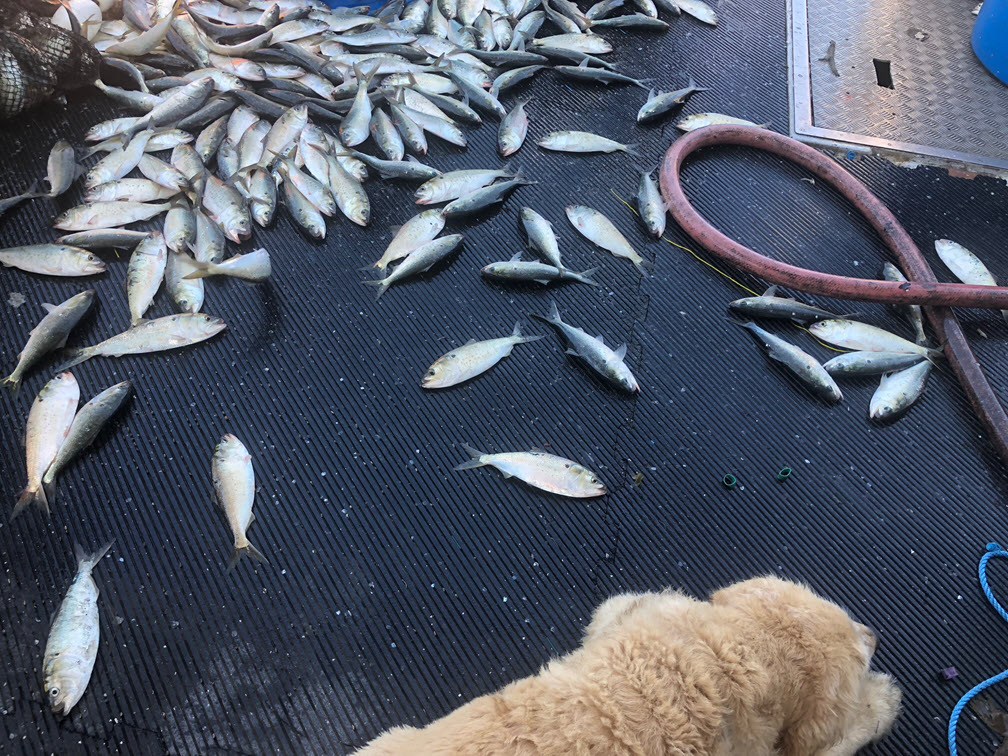
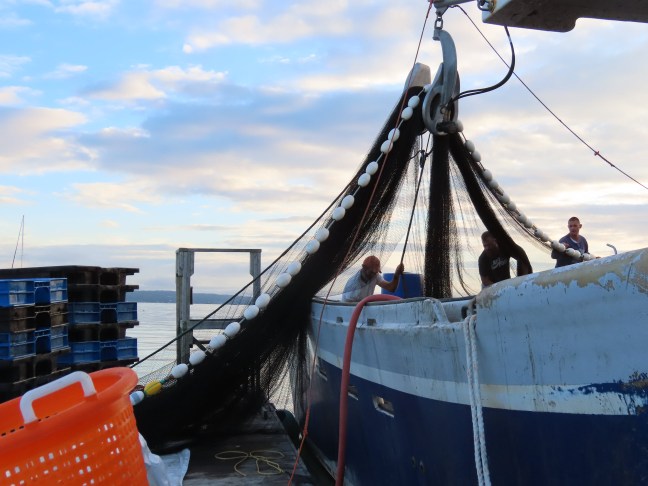
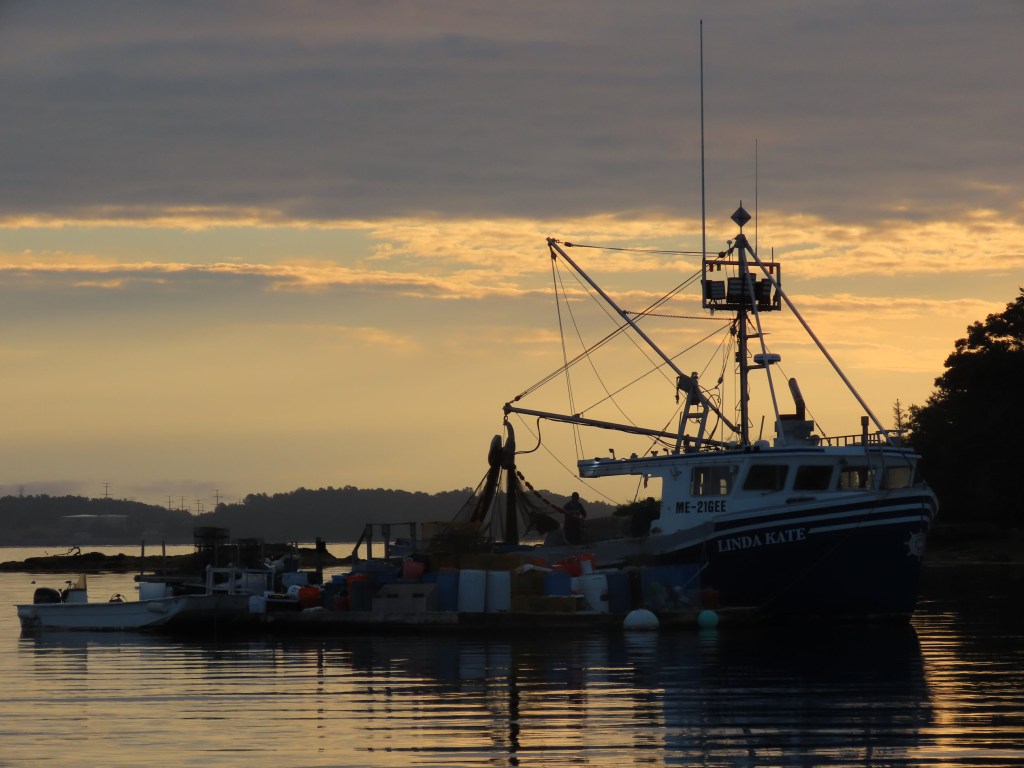
One morning we’re invited aboard the Linda Kate, a 40’ fishing boat whose captain Will got to know at DiMillo’s as he was preparing his boat for the season. In addition to lobstering, his boat is now outfitted for purse seining and scalloping to diversify his catch. His wife is one of the newest aquaculture farmers in the bay growing and harvesting sea kelp. He invites us aboard for a day of fishing and we readily accept. We wake at 5:30 AM and watch as they haul the huge net aboard for a day of pogie fishing. With two crew, Will who is willing to get his hands dirty, and me, the film crew, we have an extraordinary experience fishing for pogies, which is one of the primary bait fish for lobster. It takes a while to locate a school among the other fishing boats, but eventually he spots one based on the oily purplish water and “flips,” not to mention the seals who are circling for food. With great finesse, they drop the net being careful not to catch a foot in the line and begin to circle up the fish when the captain realizes he didn’t attach a line, so out pour all the fish! With the assistance of a hydraulic winch, they haul the net, carefully packing the floats and metal rings so it can again run free. Another hunting expedition and we regroup around the same school, set the net again, and this time, haul eight barrels, only half of the legal catch for each boat. We are regaled by his crew who is extremely knowledgeable about purse seining and lobstering and is on the verge of launching a new sustainable fishery business he’s invented for crabs, squid, and whelks. Impressive!
*     *     *

But lest you think that our pre-sailing season has been all smooth sailing, let us now share some of the experiential learning that has led up to our casting off from the dock. When it comes to boat preparation, I am someone who emphasizes planning, list-making, and methodical progress, and I dive in only when I feel sufficiently prepared. But how prepared can you really be when there’s still so much that’s unknown and we’re both still learning? Another approach is to simply “go for it” and figure it out as you go. Obviously, there’s a place for both, especially when so much depends on the unpredictable nature of nature, humans, and the material world!

*     *     *

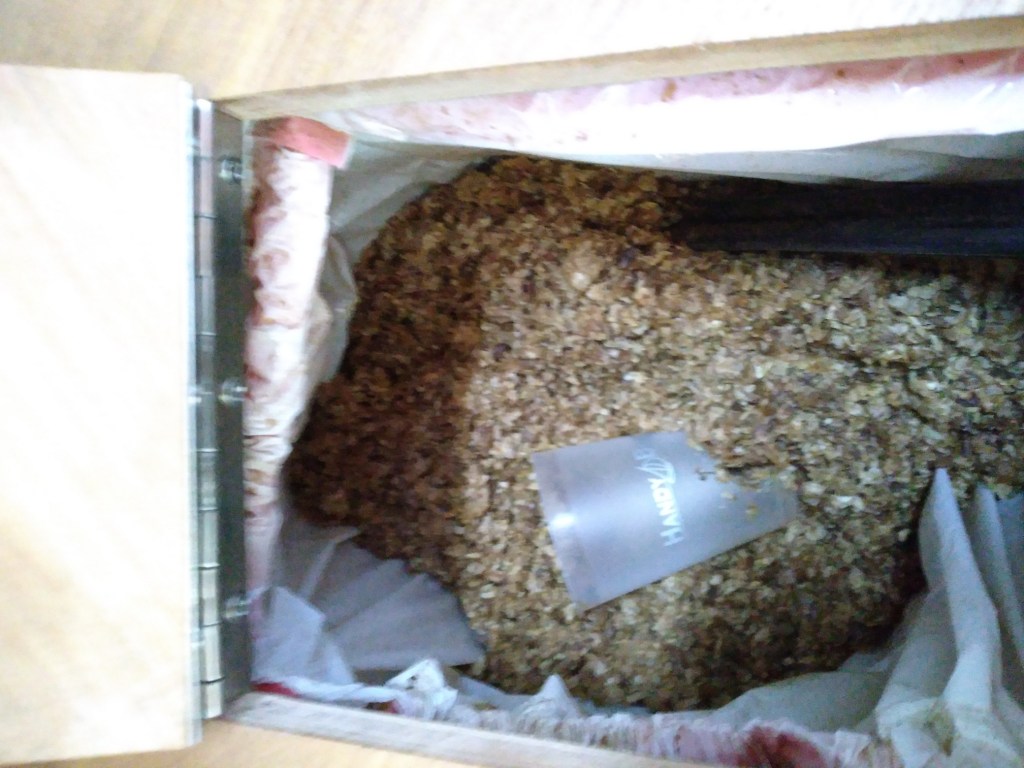
Our planning starts in February when we order a composting toilet kit to replace our head to avoid having to find places to pump out our holding tank while cruising. Will had experience with one on his previous boat and was a big advocate, so he dives in carving a 5-gallon bucket to fit the “pee diverter” and then carving a wedge out of the bottom of the bucket to place it closer to the curved wall of the hull. Next comes removing the existing head and hoses (thank you Will for taking on that nasty job), installing the bucket and hoses, and fitting a teak plywood cover over the whole area, complete with hinged openings for trash and the composting material, in our case, coffee chafe. This stuff is a bi-product of the coffee roasting process and can be obtained in huge quantities for free from our local coffee roaster in Portland. It’s light and fluffy, absorbs moisture, and you guessed it, smells like coffee, which is pretty sweet when blending with poop to absorb not only the moisture but the smell.

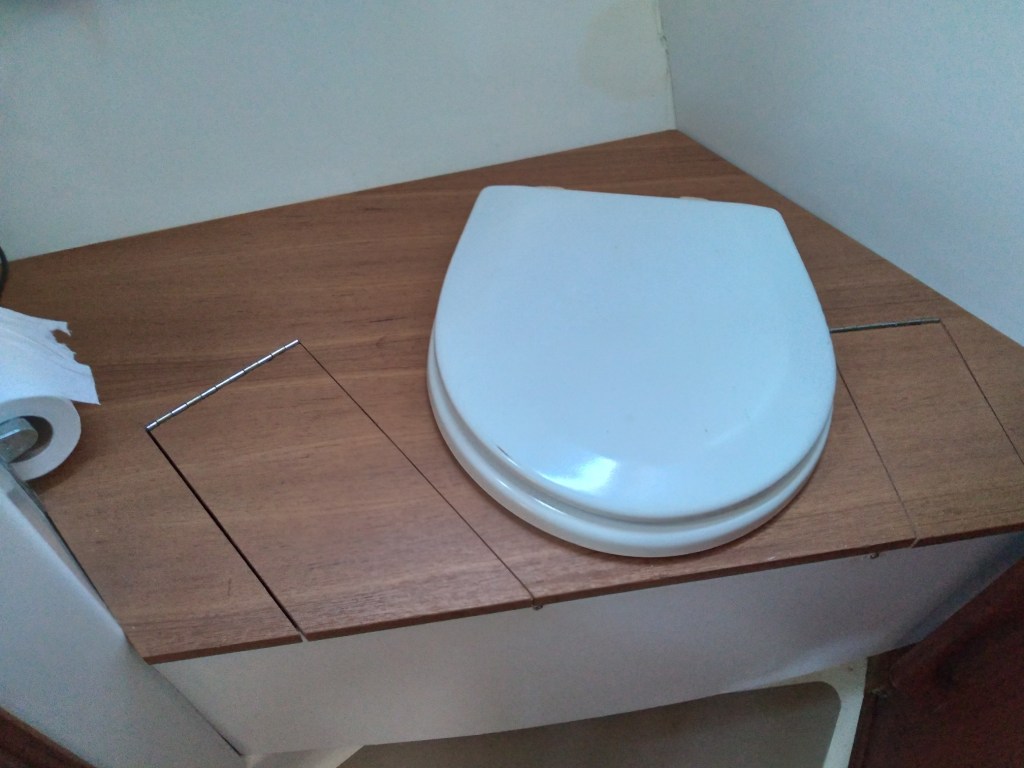
The last step is deciding what to do with the pee, which when separated from the poop doesn’t smell either, as long as you empty it regularly. Normally, composting toilets—or more accurately, dehydrating toilets—collect pee in a container that you then have to dump overboard, which, in case you’re wondering, is safe because it’s inert. In our case, after much debate, we decide to attach a hose to the diverter and plumb it directly into the waste hose below the sink, and out it goes with an electric pump. So now, we push a button to flush the pee directly overboard, along with a splash of fresh water we recycle from rinse water in the galley. What a great system! Well, except that sometimes water or pee spills over into the coffee-chafe-covered poop making it soggy. 😦 Will has since modified the diverter and extended the hose so it can hold more liquid before being pumped overboard.

We also installed a salt water foot pump for the galley sink for a first rinse of dishes. This hose connects to the through-hull that used to serve the head. This will save us a lot of fresh water and the “free” saltwater allow for generous rinsing of our cook- and place-ware.

Life is an experiment.

*     *     *

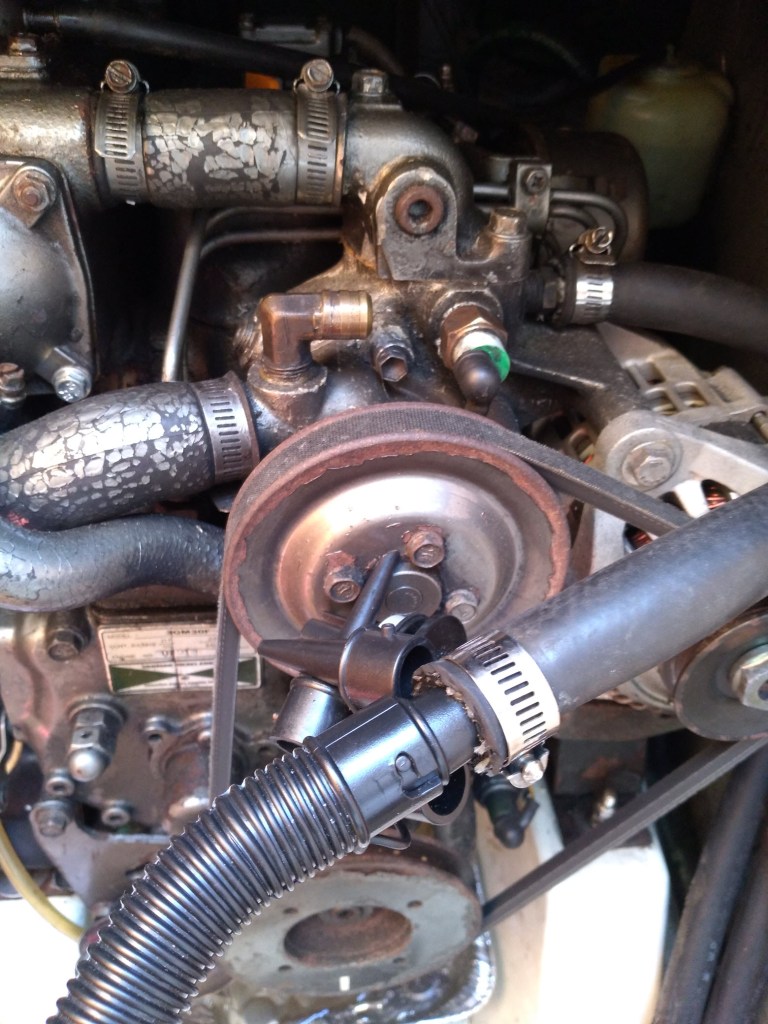
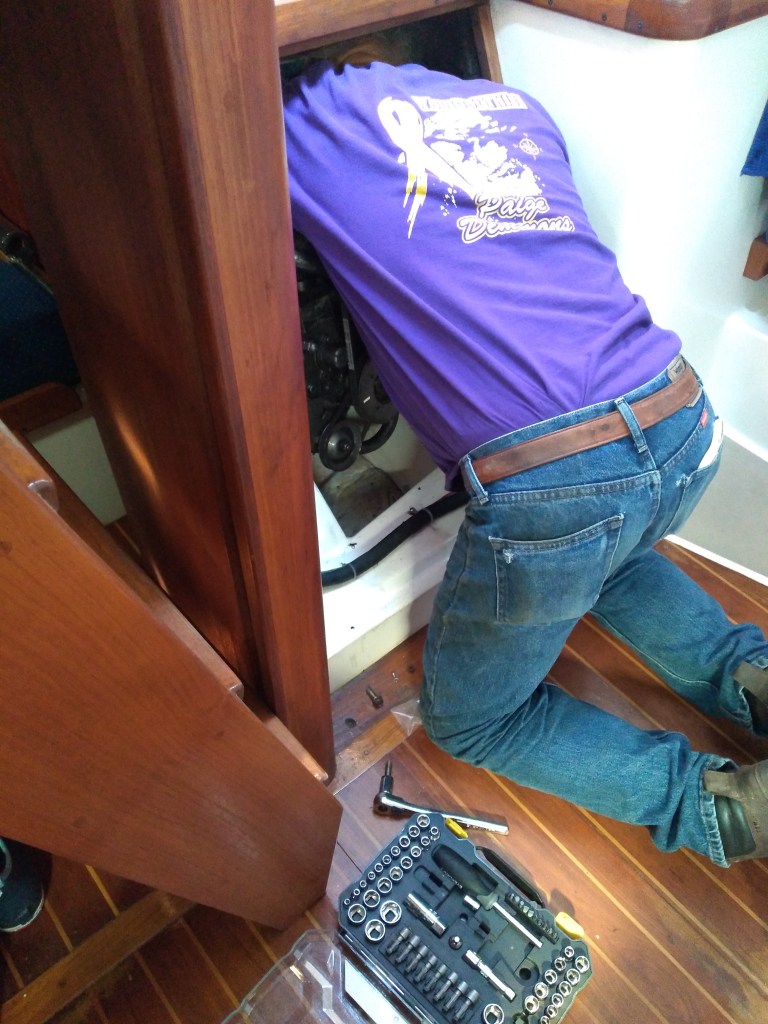
It’s April 15 and time to leave our winter slip at DiMillo’s and motor a mile across Portland Harbor to a temporary mooring at Spring Point in South Portland where we planned to leave the boat while we were gone for a few weeks out west. The mooring ball is due to go in a few days later, so we head to Spring Point Marina in South Portland for a couple days. We’d removed the shrink wrap a week earlier, retrieved the dinghy from the house, and changed the oil in preparation for the short trip across the harbor. After a winter of sitting idle, the engine fires up on the second try so we’re pleased and set off. Fifteen minutes later, a loud alarm sounds. Having just changed the oil, our minds immediately go to the oil pressure alarm, until smoke starts billowing out of the engine compartment. The sails aren’t bent on, so stopping the engine in the middle of the harbor doesn’t seem wise. The thought occurs to snag a mooring ball or hail a passing motor boat, but Will is busy trying to see what’s wrong and the boat hook is still stowed below. Instead, we push on for another ten minutes until we reach the dock, smoke pouring from the engine, neither one of us able to imagine what the cause might be.

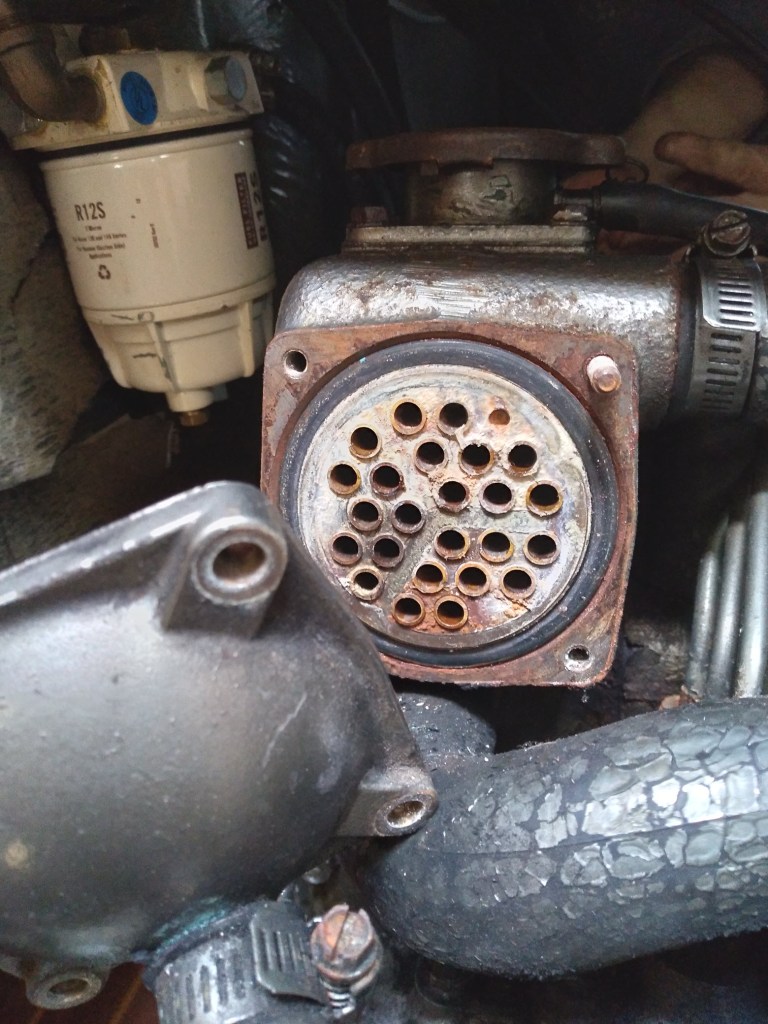
Will reaches out to our friendly mechanic Alec whom we met in Belfast and has been beyond helpful to us as we continue to learn about our diesel engine. His first question is, “Did you open the raw water sea cock?” “SHIT!” we both utter out loud when we realize that we’d made a major, rookie blunder. The all-important sea cock supplies sea water to the engine to help cool it while it’s running, along with fresh water coolant. No sea water and the engine overheats in a hurry, along with burning out the impeller, the little rubber gadget that circulates water through the engine, and melting the plastic 60-degree exhaust. OUCH! That is a painful learning experience that we will never repeat. The good news is that in the process, we learn how to replace the impeller, inspect and clean the heat exchanger, and flush the hoses of impeller debris, of which there was plenty.
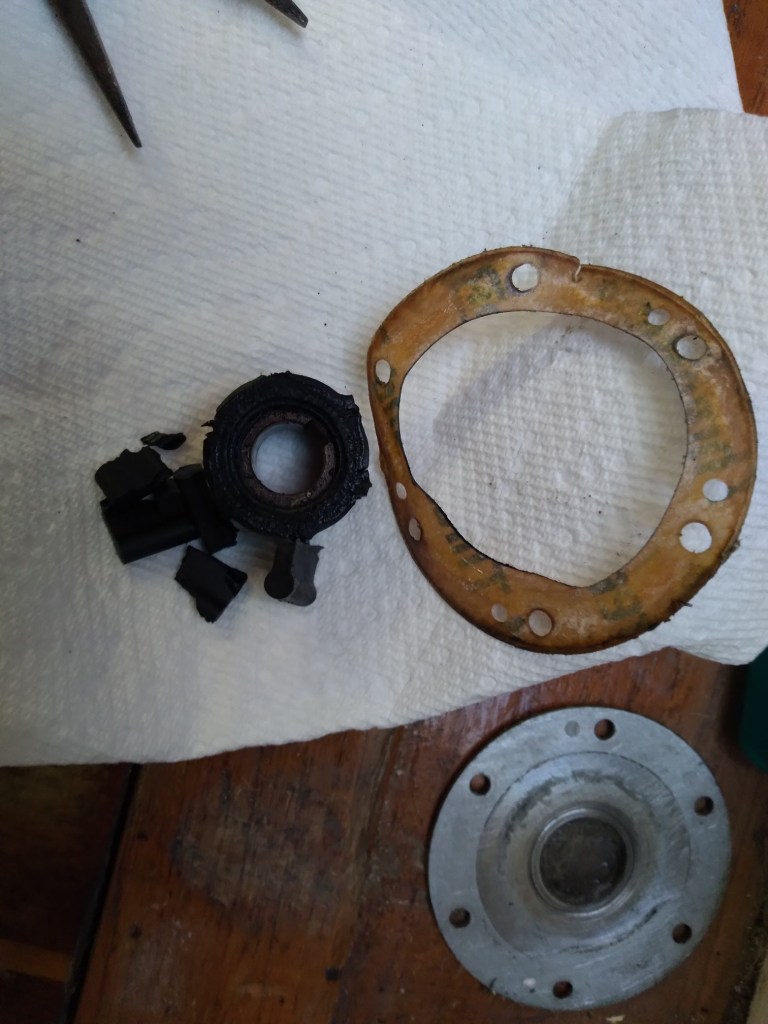
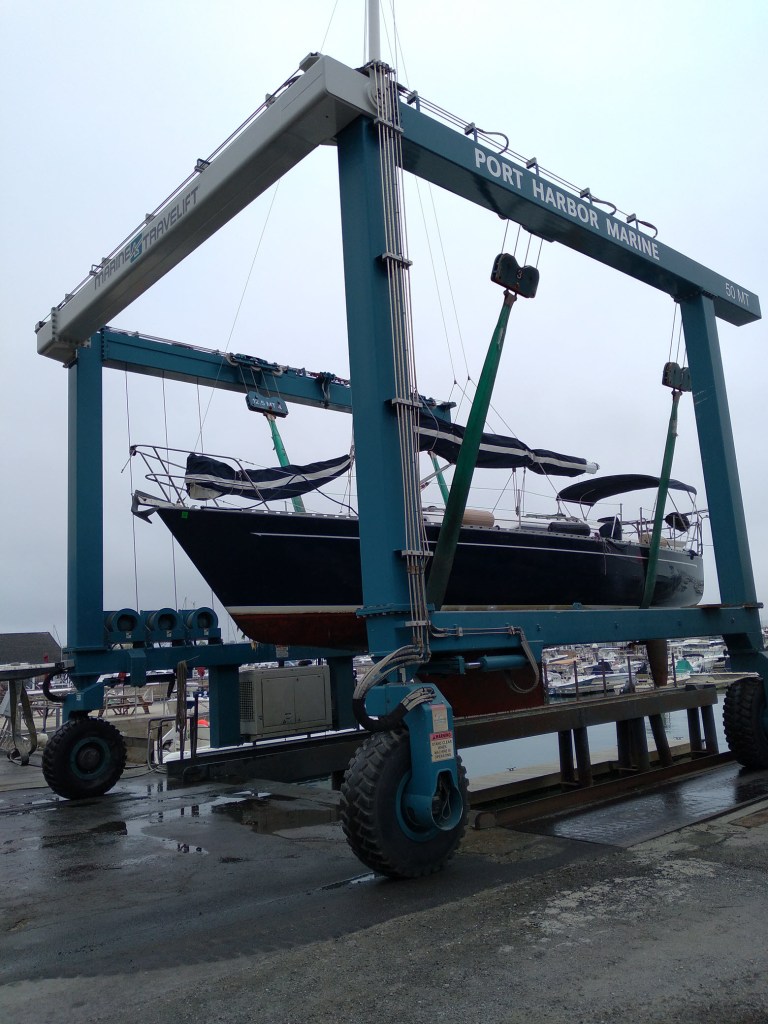
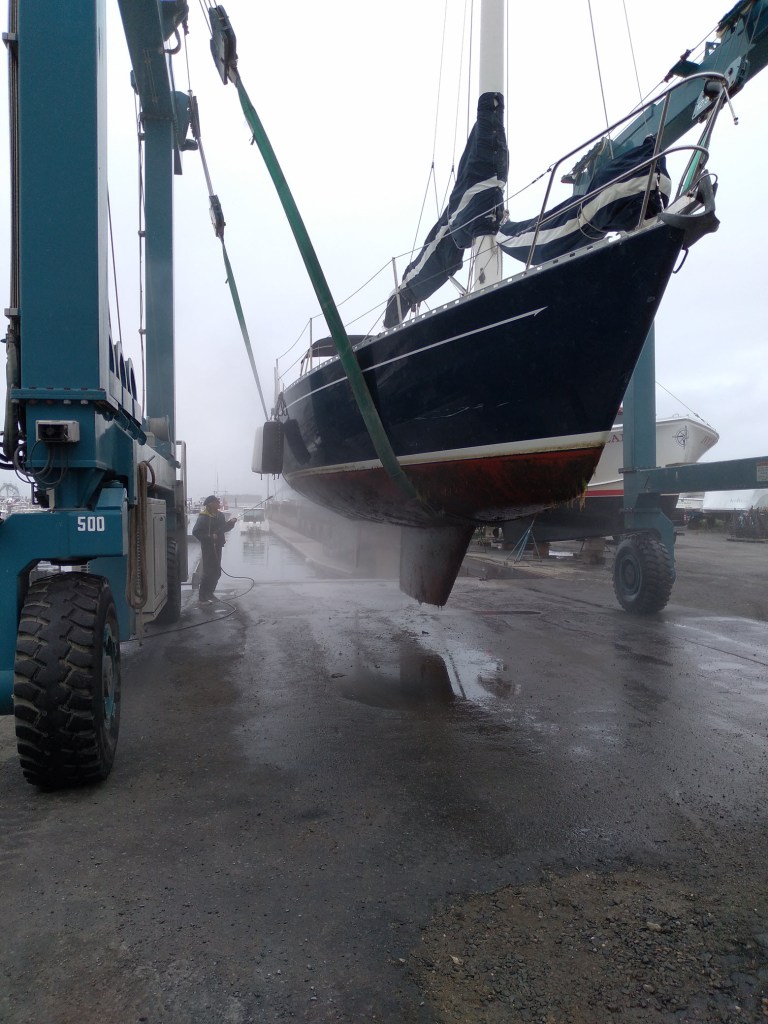
All these items back to square one and the sea cock now in the open position, we ready ourselves to motor ten minutes from the dock to the now-in-place mooring to leave the boat while we’re away on the West Coast. And wouldn’t you know it, the alarm goes on again, despite the care we had just given our poor engine, but we leave the next day and there’s no time to diagnose it. Upon our return, we run the engine a third time to haul the boat so we can clean the bottom and replace the zincs, and the alarm sounds again! The marina staff brings the boat back to our slip.
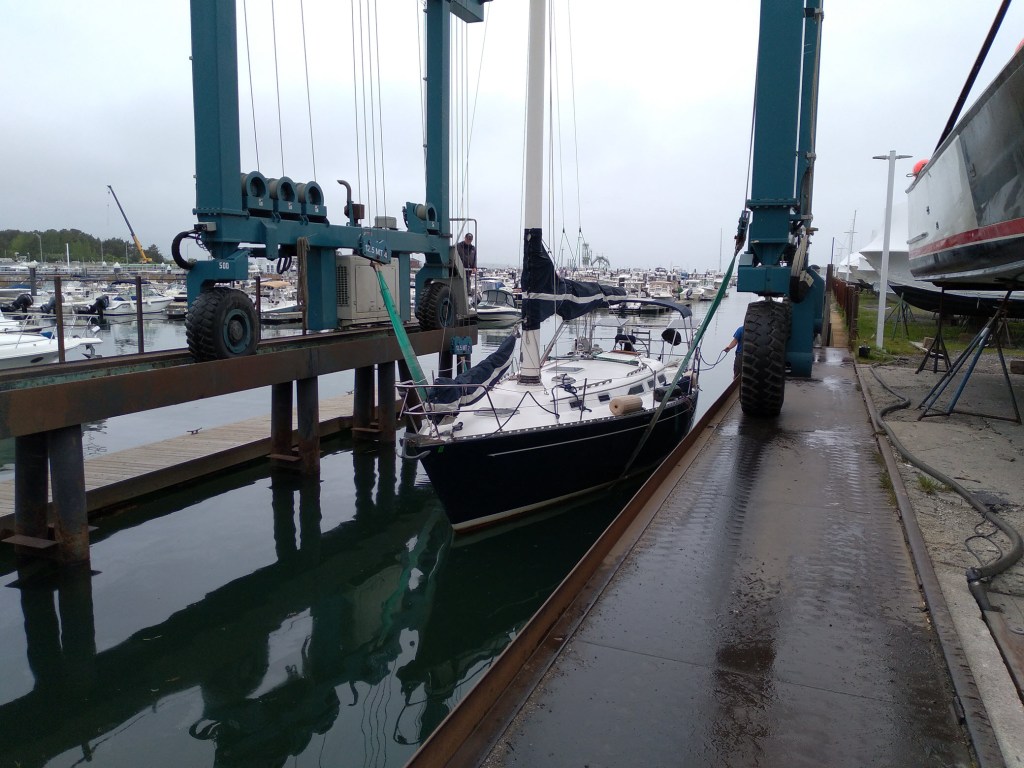
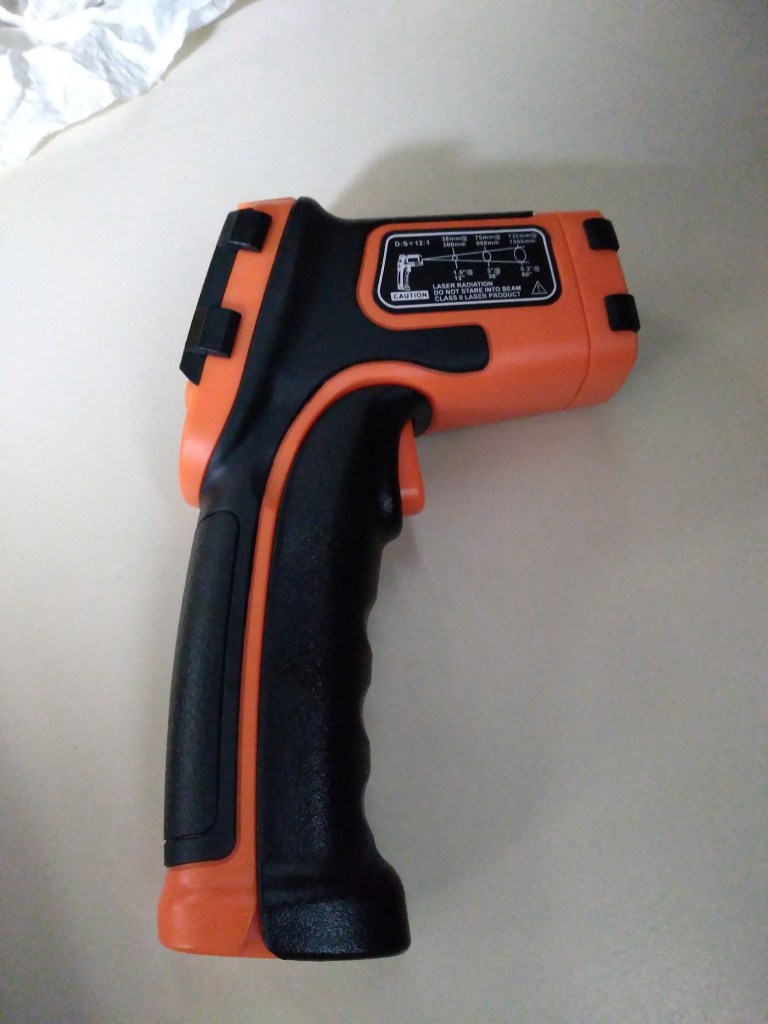
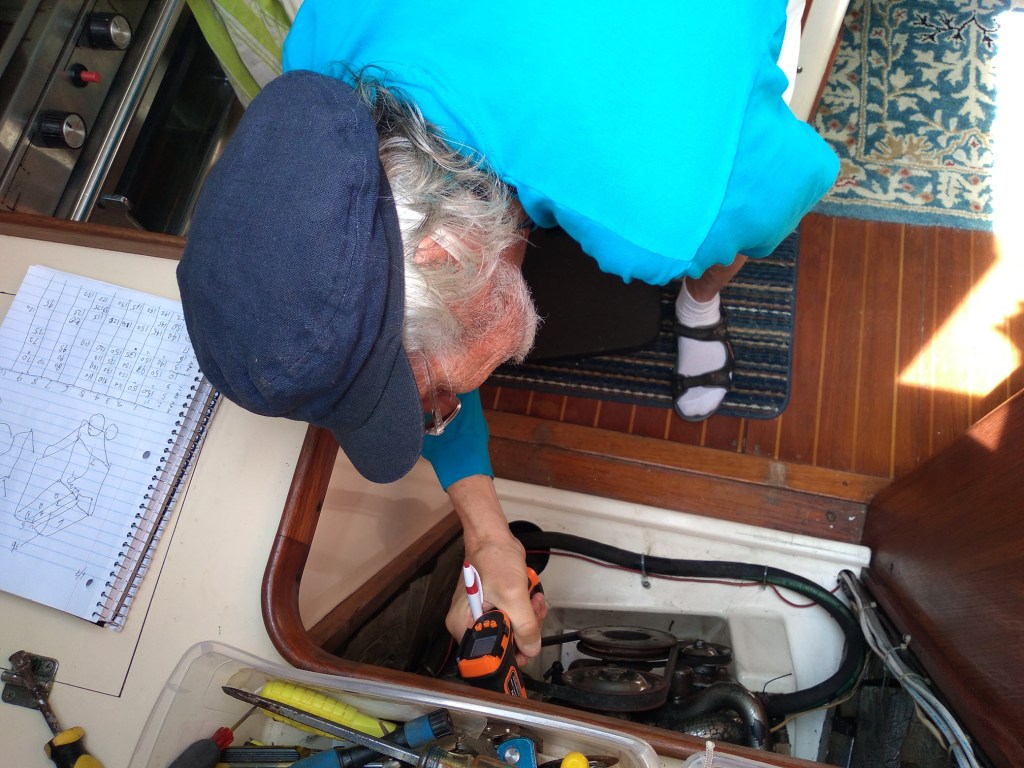
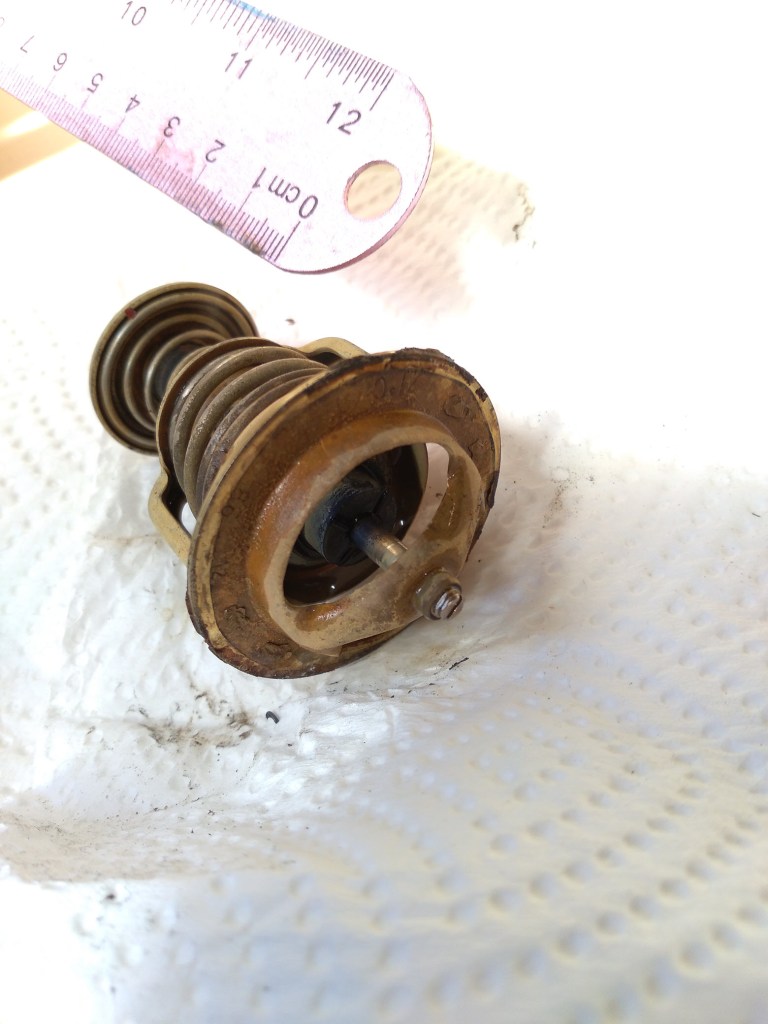
We add coolant, remove and test the thermostat, which is functioning as it should, and discover a broken seal on the radiator cap. We give it one more test, revving it up in reverse at the dock and using our new laser heat gun to test the temperature throughout the engine. No overheating! Next day we take it out circling close to the marina for 30 minutes and still no overheating.

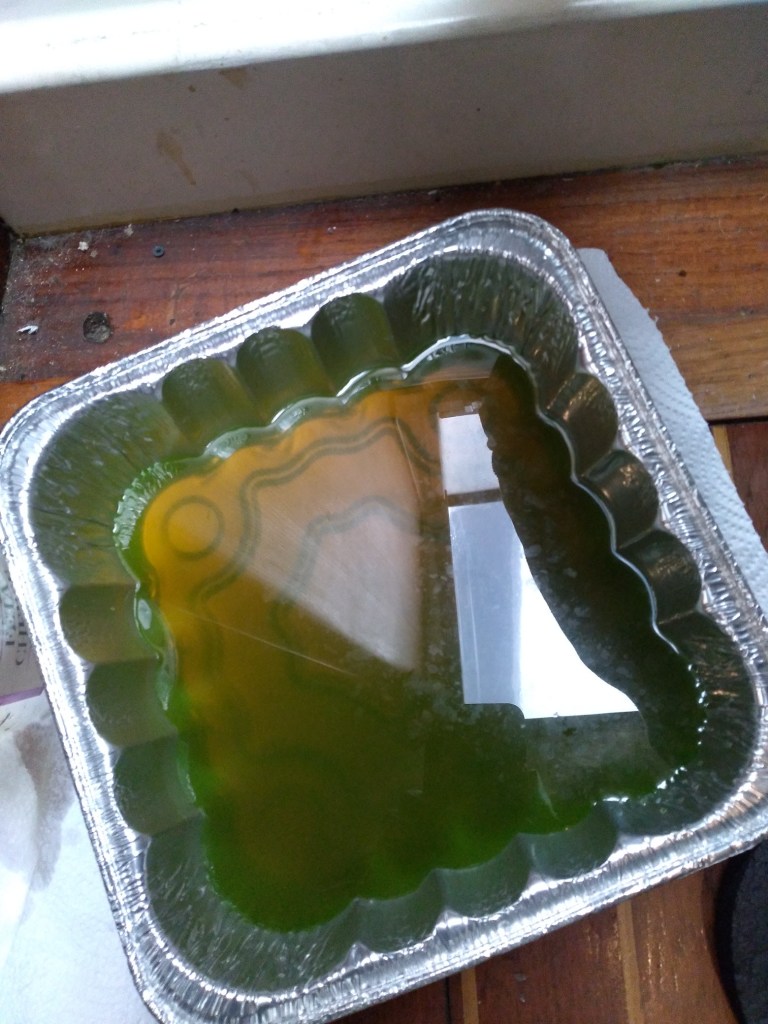
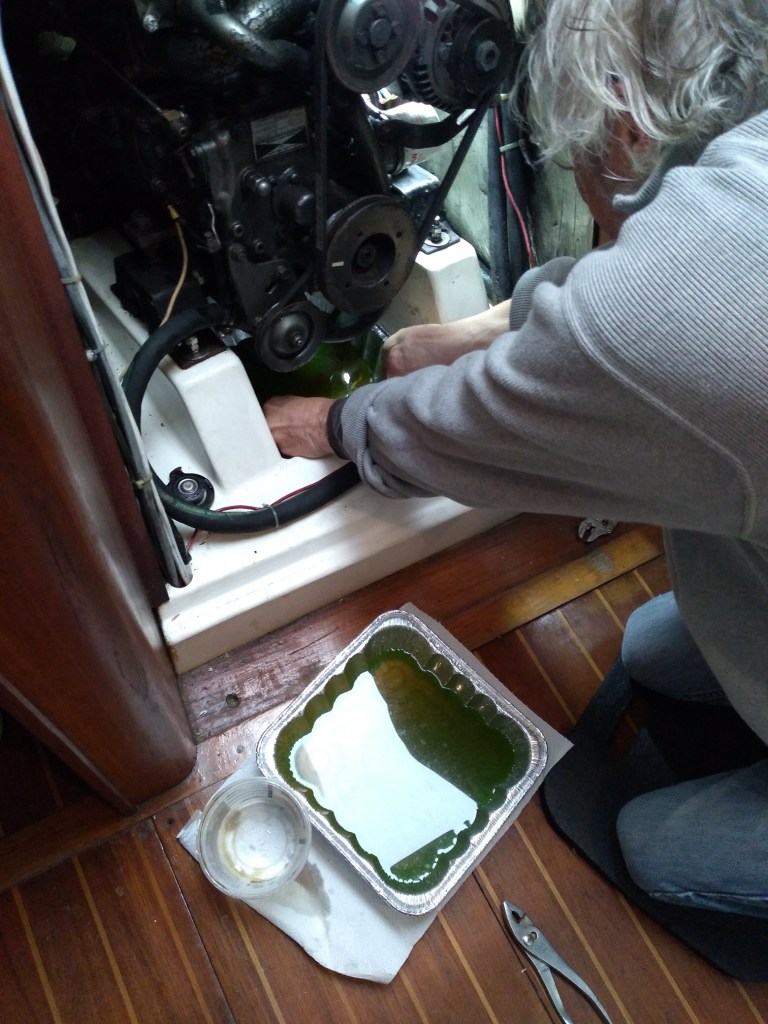
We’re feeling both relieved and emboldened by our newfound understanding of our cooling system and decide to take on the long overdue task of flushing the icky brown-green coolant and replacing it with the recommended extended life red stuff. Two days and five flushes later, we are savvy and quick at this procedure, our coolant is now a rosy red, and both we and our engine are calm, cool, and collected. The experiential learning continues!
*     *     *

We’re getting ready to move onto the boat and decide to install our bimini and dodger. The bimini had eluded us when we bought the boat so we never used it. This year we decide to try it again and realize the deck fittings that the thing attaches to were installed backwards such that there was no way it could attach. We reverse the fittings and voila, the bimini now slips directly into the slots as it should.

We move on to a minor repair of the cracked plastic windows on the dodger and install it, leaving two of the hooks detached so the repair can dry. That night, there are 35 mph winds. Next morning, we come back to the boat to a shredded dodger and a sinking feeling. We’re already planning on buying new sails later in the season and found a one man shop in Boothbay who still measures sails in the old-school way by stretching them out on the floor and with a block and tackle. We weren’t planning on a new dodger too, but I guess it aged out and needed replacing.

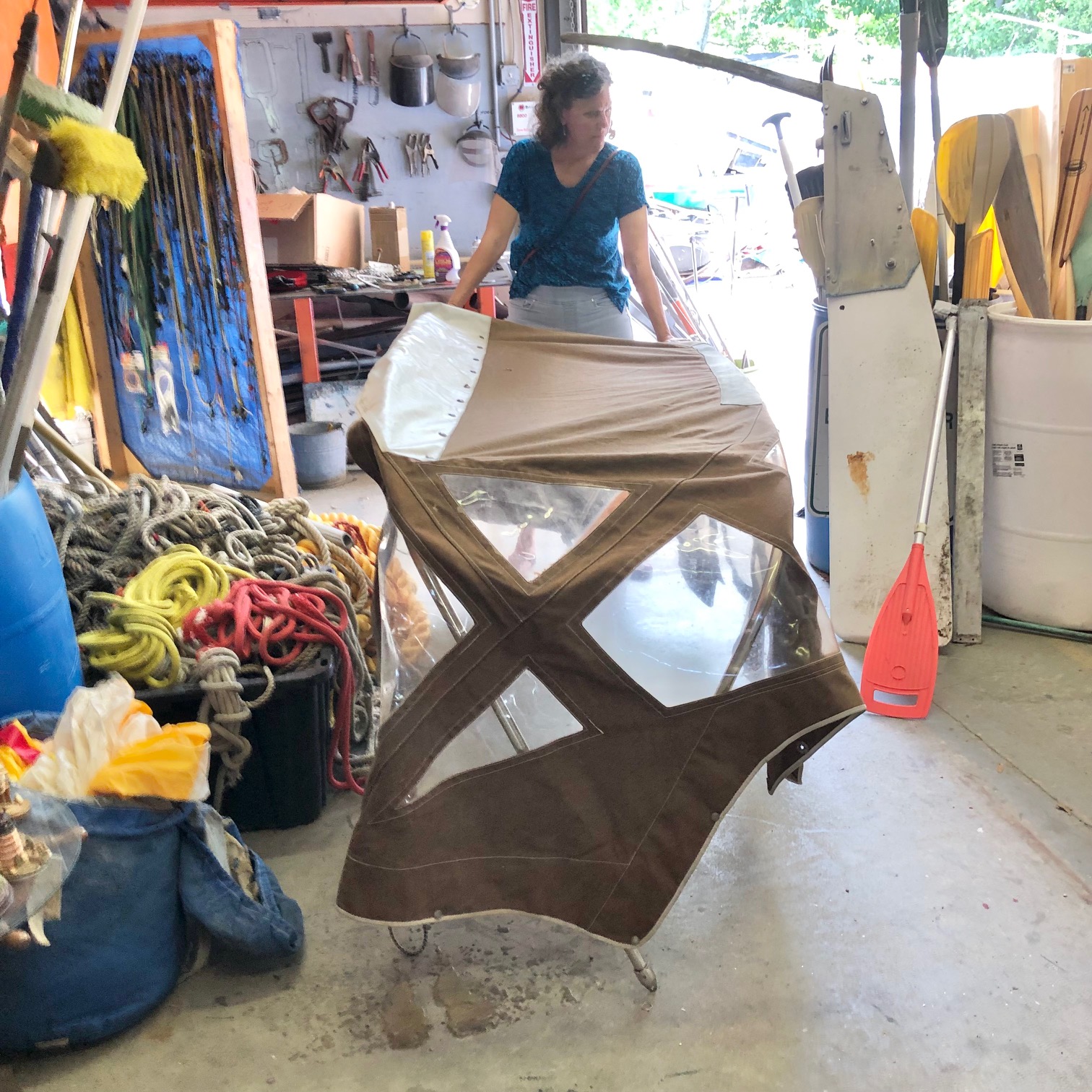
We race to find someone to get started on it before we leave for the west coast only to find the businesses are too busy or they quote outrageously high, though we find another guy who agrees to do it for almost half, but it won’t be ready until mid- to late-June. We get a call in early June saying he’s started making the dodger but is encountering issues because the old once didn’t quite fit the frame, so he unexpectedly abandons the project in the middle, refunding our deposit and giving us his work on the almost finished roof. We scramble and by stroke of luck find an 80-year-old guy who agrees to pick up the job in the middle. Amazingly he had the time and was up for the challenge. Now that’s our kind of guy! We pick up the dodger any day now and will install the snaps ourselves to make sure it fits. And the adventure continues!

*     *     *

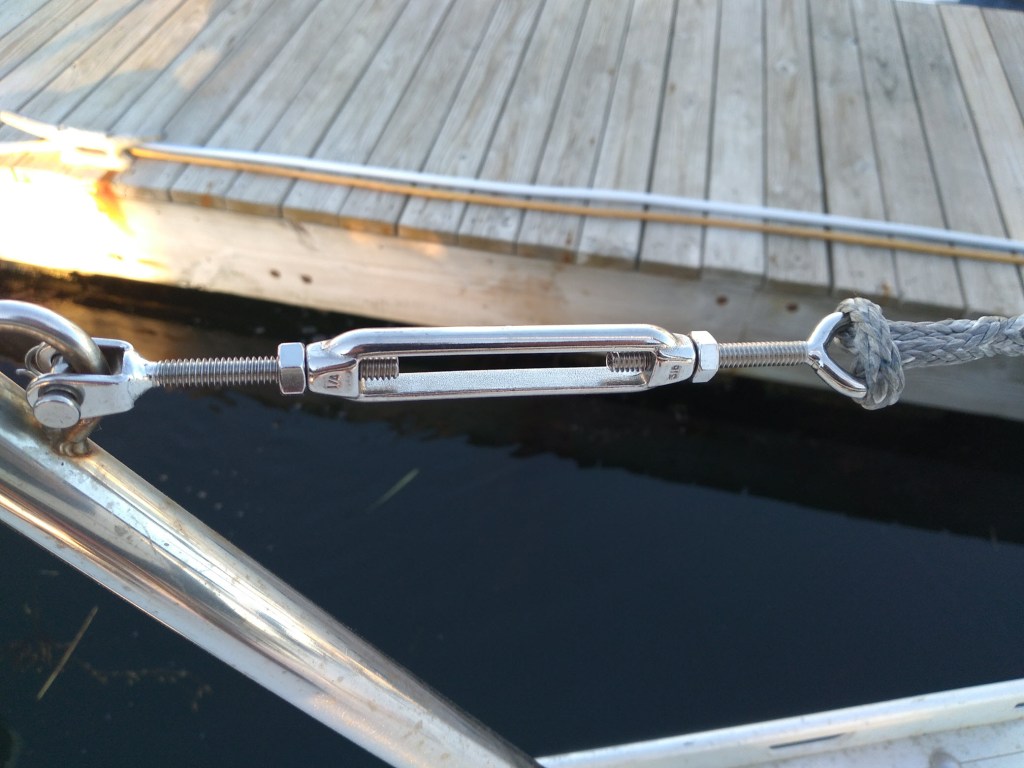
Next on the list is replacing our rusty, plastic-coated, wire lifelines with Dyneema, a braided rope made of fibers that are stronger than steel, making it an excellent choice for this application. We had bought the stuff on sale last year and had it in our “project box,” but first we had to learn a Brummel splice and buy the proper Swedish fids. Amazingly, when we were in Italy, out of the blue my brother Tyler said one day, “Want to learn a Brummel splice?” “We sure do!” So he taught us the basics and we got to practice a few splices on some line he had laying around.

However, as we find out, doing a single splice is significantly easier than figuring out how to turn pieces of Dyneema into lifelines! This project turns out to be far more challenging than we imagine as we puzzle through how to attach the lines to the stanchions when you need two ends to do a splice, making them the right length given shrinkage, and finding the right hardware for tensioning the lines. After much discussion and many YouTube videos and days of experimentation later, we’re now pretty proficient at the lock splice and bury, and we’ve exercised our hands-on spatial geometric reasoning to create eight beautiful new lifelines and cross-bracing to stabilize our davits! Through this process, we’ve learned a lot about how differently we approach such projects and the importance of hands-on experiential learning.

*     *     *

And if all that wasn’t enough, one night, we return to the boat to the sound of the CO alarm. Mystified, we open the hatches and wait for the alarm to turn off. On the next night sleeping aboard the boat, we’re suddenly awakened by the alarm again. Now we’re getting nervous as we know carbon monoxide is an invisible killer, thus the alarm. But we’re not burning any fuel so can’t imagine what it could be. We open the hatches and sleep with extra blankets. This happens several more times until we learn that charging our lead acid batteries generates hydrogen gas, which the CO monitor registers along with CO. Common knowledge? Not for us, but now we know and bring the alarm in our cabin instead of right over the batteries where the hydrogen likely won’t reach. Experiential learning strikes again!

*     *     *

All this is to say that along with significant planning, list-making, and doing on both our parts, there’s been plenty of experiential learning along the way—about our boat, about our process, about each other, and about ourselves. We’ve appreciated all of it as we launch ourselves into our new season aboard sv NIRVANA for another summer of sailing and adventure, the outcome of which is as yet unknown!

Remembering Roland

. . . and speaking of bookends. . . our last blog ended with us showing up in South Freeport for our community dance, which was where we started back in June . . .

. . . and it is also, sadly, the day my beloved uncle Roland Barth died. You can read his obituary here:

Roland S. Barth Obituary

A week later, his extended family and many friends participated in a beautiful memorial at the Head Tide Church in Alna, Maine, the town where he and many of my relatives have lived for decades.

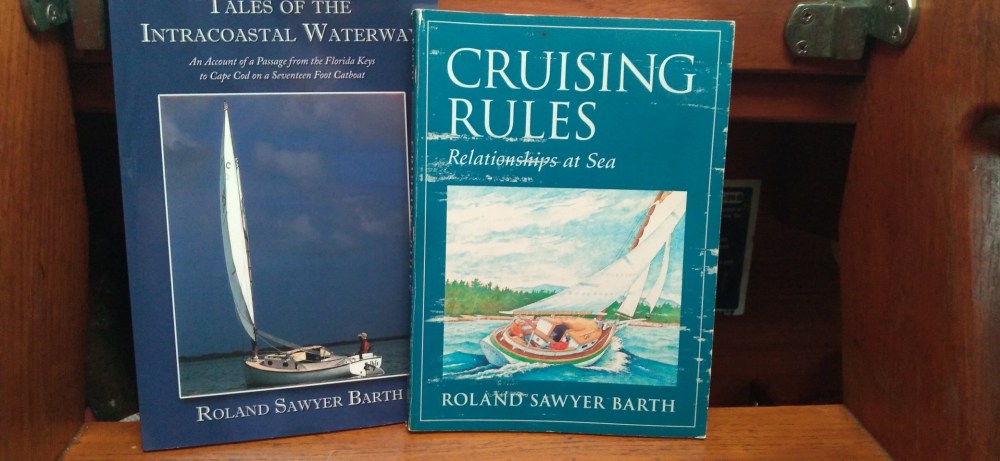
I want to take this opportunity to acknowledge my Uncle Roland by sharing this memory of him, which I spoke at his memorial. Not only was he a lifelong sailor and author of two wonderful books on sailing—along with numerous books on education—he was a great mentor and support to me in my journey on the sea.

* * *

Eight years ago, September, Roland and I sailed Mare’s Tale from Camden to Round Pond. He had just had an episode of transient global amnesia cruising Penobscot Bay with Barbara, and he needed someone to help sail the boat back with him, since he vowed never to sail alone again. I was happy to accompany him on such a long trip as I was actively looking to buy a cruising sailboat of my own. Among the boats I was considering was a Contessa 26, so it was a great opportunity for me to try out the boat. What I didn’t anticipate was Roland broaching the subject of possibly co-owning his boat given his new condition.

We had a delightful sail as we played with the possibilities of co-ownership. As we approached the bar between Hog and Louds at just past half high tide, he asked, “Now what would you have done if the tide had been just before half high?” Being a prudent sailor, I said, “I would have waited until half tide or better.” Right answer! I had passed the test. So now I had to look inside myself to see if what I really wanted was to co-own a 26’ sailboat with my uncle. While I was honored and seriously considered it, in the end, I decided that was exactly what I didn’t want: to co-own a boat with a father-like figure. Instead, I wanted to experience it for myself, which is after all what “learning by heart” is all about. It was very clarifying, and he understood completely. So I took a leap off a cliff and bought a Sabre 28, a boat of my own. And through it all, Roland has been one of my biggest supporters, first as I became Captain of My Own Ship and now, as I craft my own Cruising Rules for my current relationship at sea, living aboard with my partner Will.

In reviewing old emails, I was astonished to find so many from my dear Uncle Roland over the course of owning Maverick solo and now NIRVANA with Will. When I signed the contract on my new boat, he wrote, “Way to go, Tasha! A great vessel at a great price.” Both of our boats now in Round Pond, we bailed each other’s dinghies, and I checked Mare’s Tail’s waterline given a slow leak. After recommending the documentary Maidentrip about a 14-year-old girl sailing solo around the world, he wrote, “You next for around the globe on Maverick?” When I thought I lost my dinghy because I was distracted by a man, he wrote, “Moral of the story: never turn over command of your dinghy…or your life…to some guy!” And after wavering whether to launch one year because it felt too daunting to do it alone and then changing the oil in the engine for the first time, he wrote, “Great to see your hands in the oil, Tasha. So pleased that this little vessel has become such an important part of your life…and to have played a very minor role in that.” More than playing a minor role, he’s been an inspiration.

In 2018, we went on our first Uncle-Niece cruise in Casco Bay, and just after he sold Mare’s Tail in 2019, we went on our second. From his gushing email of gratitude, he wrote, “Thanks for arresting my grieving at not being able to sail my own boat…and providing the leadership and modeling of what a good captain should be.” You have no idea how much that email meant to me, coming from him.

Happy Roland at the Helm, 2019

Having since sold my Sabre and bought a Freedom 36 with Will, we had the honor and great good fortune to have taken Roland on his last sail of Muscongus Bay with Joanna. On that occasion, he passed along his personal copy of Cruising Rules that he carried with him on Mare’s Tale for 25 years, with this inscription, “To captains Tasha and Will, with gratitude for our little cruise, Harbor Island, Monhegan, and the George’s Islands, and in anticipation of new cruising you two will craft together.” There was a moment at the helm when Joanna asked, “On a scale of one to ten, how much pain are you in Dad?” His response: “I’ve got my hands on the wheel and I’m sailing. My pain is a zero.” If I were to turn that into a cruising rule it would be: When in any kind of pain, get out on the water and go sailing!

As I’ve made the transition from life on land to life on the sea, I couldn’t have asked for a more supportive and loving uncle on my shoulder along the way. So I’ve created a cruising rule in honor of Roland, which I shared with him several years ago. For all the sailors out there, perhaps you’re familiar with the misogynist acronym for finding your compass course given true, variation, and deviation: True Virgins Make Dull Company, Add Whisky, Subtract Ethics. Instead, I offer this one for finding your course through life, relationships—on land and sea—and all the chartered and uncharted waters we inevitably encounter along the way:

True Value Manifests Deep Connection, Add Wisdom, Subtract Ego

That’s my uncle Roland.

Sept 18, 2021

Up Perry Creek Without a Starter

September 1, 2021

For the past week, we’ve been up Perry Creek without a starter. The good news is that we could have been up shit’s creek without a paddle. Instead, we’ve spent a delightful six days in a lovely cove only one mile from J. O. Brown boat yard where we’ve had two mobile mechanics and a neighborhood full of friendly, generous people who’ve helped us beyond measure. And the reason we’re here without a starter, instead of Matinicus, a lonely outpost in the Gulf of Maine, is due to a mistake.

Wednesday

Our “plan” is to provision, fill up our water tank, and top off our diesel before heading out to the barren Brimstone island off Vinalhaven and then on to Matinicus, a remote island 15 miles out to sea. Arriving in the early evening, we tie up to the town dock and get a ride from the owner of the store to the well-stocked Island Grocer. Because it’s nearly dark, we motor one mile to Perry Creek for an overnight—right next to our favorite floating tiny house—with plans to motor to J.O. Brown in the morning. Our fuel was only down a quarter tank, but our water was virtually empty. We’d called earlier about fuel availability only to learn that they were out. “It should be arriving tomorrow by boat on the next high tide,” Linda, the office manager said. Good, that will give us some time in Perry Creek, which we’d missed last time.

Thursday

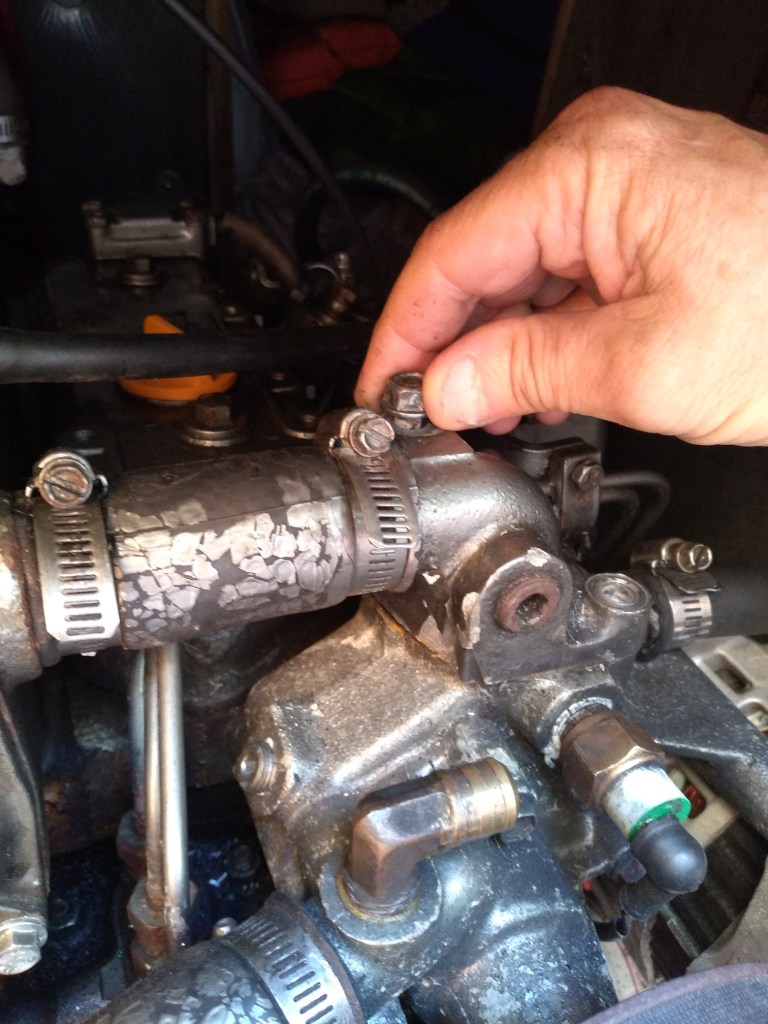
By mid-afternoon, it was approaching high tide, so before motoring across, Will decides to check the oil, which we’d been tracking all summer and chooses to fill it. With confidence, he opens the cap on top of the engine block, which looks like every other radiator cap he’d ever seen but mistakes it for an oil fill and starts pouring. After a few seconds he remarks, “That’s weird. It’s already overflowing.” I know right away something isn’t right, so I ask, “Which cap did you use, because there are two.” Indeed, he had put the oil into the radiator cap instead of the oil fill! My stomach does that somersault it does when something I imagine to be disastrous happens. I say nothing and take the news with great equanimity.

Will immediately acknowledges his mistake and starts sopping up oil with paper towels. He gets on the phone with Alec, the wonderful mobile mechanic who came on board in Belfast to replace our solenoid. He suggests using an oil absorbent pad as the oil should be floating on top of the coolant. He says that he could come out on Tuesday to drain the coolant but meanwhile, if we could remove most of it, we’d probably be fine to motor over to J. O. Brown and have them replace it. We call the boat yard and tell them our problem, and wouldn’t you know, a couple hours later, a guy shows up from the yard to have a look. He says the same thing and tells us Foy Brown would be around tomorrow to help us out. Good, not a disaster and we have a “plan.”

Meanwhile our water supply is now super low, and we are washing dishes in salt water, so I suggest rowing over to our neighbor boat and asking if they might spare some water for our tanks. They are more than happy to accommodate, bringing us two deliveries of five gallons each, along with an extra oil absorbent pad. Rick and Valerie couldn’t be nicer, confessing that he too had done something similar in years past. With some water and a plan, there’s nothing else to do until the next day. To Will, it’s a defining moment when Tasha, instead of slouching into moroseness suggests that we smoke some pot and go for a hike

* * *

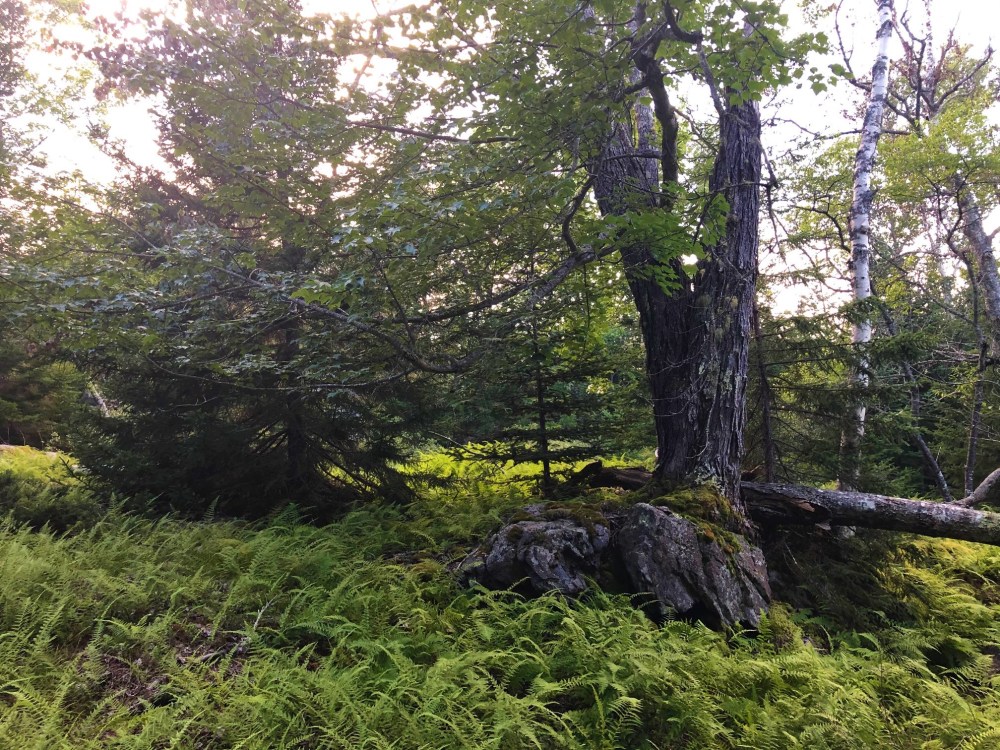
The beautiful, rooted staircases and pine needle gravel-filled paths that perfectly match the contours make every step sublime. Encyclopedia Brown and Harriet the Spy have their moment in the sun at the overlook, first wondering if the buttoned-up dandelions had yet to deliver their wispy seeds to the wind or not. Given the season and the barren granite, where would they alight? Picking one apart, we witness them getting swept off rock faces to bumble along. The inch-long wisps culminate in a seed—a kernel (that is, “a kernel of truth”)—quintessential–as in the found example where every single corn-silk wisp manages to break away with the tiniest sliver of seed at the end. Did the DNA replicate so well that the barest paint-thin shaving is enough?

And on to the pinecone, hypnotizing when viewed from the top. Does Fibonacci matter? Sure, there are natural growths that display a perfect Fibonacci ratio, the nautilus shell, for instance, as it grows at every single tangent of its spinning out. But what about less-rigorous pronouncements, the plant parts or patterns that aren’t exactly 1.382 times the previous one? Here we recognize the power of an “idea” that we then want to “see,” regardless of the proof to the contrary. For me (Will), it is enough that Fibonacci works even once; it’s not necessary to do more. The other innumerable growth patterns may one day get their day in the sun—or maybe we will “get over” ourselves and quit trying to “classify” and reduceor try to anywaynature to something it really isn’t.

*    *    *

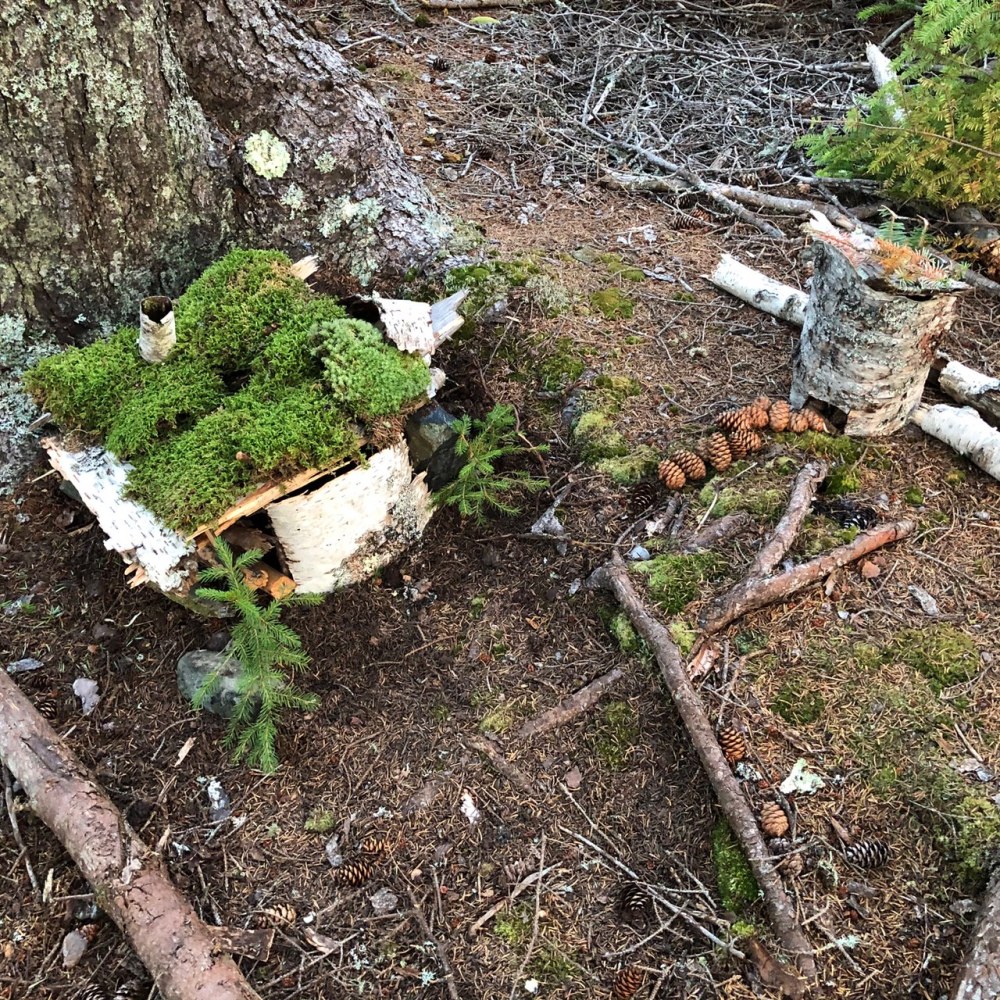
On the last leg of the hike, inspired by all the fairy houses we’d seen on the way in, I exclaim, “I want to build a fairy house!” A hollowed out birch bark cylinder appears tucked between two trees. The question is whether to leave it where it is where it probably wouldn’t be seen or move it closer to the trail. After some inner debate, I decide to move it and then set to decorating the top with moss-covered bark and laying sticks along one side to form an outdoor porch. In front of the opening is a bright red mushroom, and I place a yellow fungus-covered stick in front as the other portal. Will suggests putting a large rock inside, which I do and then switch into engineer mode wondering if I need to make it more structurally sound. “Build from your eight-year-old self,” he suggests, and I switch back to that mode finishing off the house with a minimum of adornments. We riff on the architectural elements of two other fairy houses we see in a clearing, wondering whether adult or child was at play when building them.

Yes, it is quite an outing! Needless to say, we’re no longer worried about the oil issue.

Friday

With most of the oil removed, we get an early start to motor over to J. O. Brown. I push the start button, once and get a little cranking, twice, a little less, and a third time, nothing. We check the batteries which are relatively low without much solar giving them a charge so early in the morning, so we run the generator for half an hour and try again. This time, we get absolutely nothing pushing the starter button.

Rick on the neighboring boat notices our troubles and hails us asking if he can help, so I row over and tell him of our plight. Fifteen minutes later he arrives, tool bag in hand, ready to help, along with yet another five gallons of water. Knowing more about these things than we do, he climbs down into the lazarette and tests the power to the solenoid, which is fine. He then takes a large screwdriver and holds it between the two terminals on the solenoid, bypassing it to send power directly to the starter. Nothing. We also notice two lose wires which he tries connecting. Nothing. Then he tries attaching one end of a small jumper cable to the starter and the other end to the engine block. Will questions it in his mind as he does it. Poof! Smoke comes pouring out as the wire melts, at which point he says, “Well, I’ve reached the end of my knowledge.”

Before departing he asks, “I don’t suppose you have Nigel Calder’s Mechanical and Electrical book on board?” “We sure do!” I say and tell him he’s a friend. We then spend another half hour pouring over his troubleshooting section and learning the steps to debug the system, most of which we’ve done. The net result is even though it’s rarely the starter, in our case, that’s what it points to. We called J. O. Brown once more to tell them of our new, more pressing issue. Linda says she’ll pass it along to Foy.

Meanwhile, Bunny rows by and we chat her up about living aboard, which she and her husband Bill have been doing since 1994, mostly in the waters around Turkey and Greece. She too offers to bring us some water, which we graciously accept. “Do you need anything else? Food? Wine?” she asks. Will says, “We could always use bacon. Just kidding.” Next thing you know, there’s Bunny, water and bacon in hand! Nothing more to do but go for another hike, this time to the summit, where we have a magnificent view over East Penobscot Bay to the Camden Hills. A bit of exercise does us a lot of good after all this waiting around.

Saturday

We wait on board to hear from Foy, hoping his schedule isn’t too full to get to us. Evan, the tile guy from Vinalhaven comes by in his Boston Whaler wanting to chat. He often comes to Perry Creek on the weekends to see where all the boats are from and get to know people. He too asks if we need anything, and we say, “Well, since we’re probably going to be here for another couple of days, we’d gladly accept some more water.” He says he’ll bring some out tomorrow.

We meet another lovely couple on a wooden boat he’d built himself and whom we’d met on Swan’s Island at the music festival. We chat people up as they come in and the harbor fills up with a dozen boats. Late in the afternoon, Foy shows up to have a look. He performs the same tests Rick did only in about ten minutes with the same results. He then removes the starter to have a look and learns that it’s only spinning in one direction instead of both. “It’s toast,” he declares. OK then! “I can probably order one for you on Monday, get here on Tuesday.” Alright then! We have more of a plan. We continue to wait.
Sunday

In the afternoon, Bunny stops by with yet another gallon of water. Happy to engage with “someone other than my husband,” she stays a while to chat when Evan comes back with three five-gallon containers full of water, and we invite him aboard as well. A super friendly gadfly, Evan tells us about the various social circles on Vinalhaven and how he’s managed to touch most but stay outside of all of them. “It’s better that way,” he says. He also commented, “Fishermen are always crying crocodile tears. The gold in the pot in front of them is never shiny enough for them.” He’s seen a construction boom on Vinalhaven from people “from away” and has no lack of business as the lone tile guy on the island. “And they spare no expense,” he said. “I’ve put in tile that costs $50 per square foot!” When I learn he’s single, I play matchmaker and try fixing him up with a friend.

Bunny invites us over for cocktails on their Norsman 447 with the couple on the wooden boat, and we see what a $200k cruising boat feels like, complete with enclosed cockpit to keep out the elements. I bring a fresh batch of garlicy hummus that I’d just made in the food processor, and we sit around the cockpit table laden with hors d’oeuvres as Bill, 82, holds forth with sailing stories and Bunny passes around the popcorn.

Back on NIRVANA, Will says, “Any who is sealing out that much nature shouldn’t be on a sailboat!”

Monday

At 9:00 AM, we’re awoken by a loud motor passing by us and then a sudden BANG against our hull. Will pops his head up through the hatch and hears, “Watch out for the sailboat!” and “Pull that boat in!” and then from the crew, “I can’t!” I jump out of bed, put on some clothes, and go up to the cockpit as I watch a large fishing boat steaming past us after cutting between us and the tiny house. “Sorry I clipped your kayak,” the captain yells to the boat astern of us. I wave my arms and yell, “Did you hit us?” but he’s moving too fast to hear and doesn’t turn around.

We are only slightly shaken and not too concerned until half an hour later we’re visited by a neighboring boat saying he had called the Marine Patrol and we’d probably get a visit soon. He saw the whole thing, including the skiff hitting our boat, and felt the captain was behaving recklessly. We check our boat and discover a few gouges left by the skiff’s outboard that was trailing behind on a long tether. Later, Brandon from Marine Patrol comes by in 20’ Whaler with a bad ass outboard in his grey uniform and badges. He inquires about what happened and asks us each for a written statement so he can report the incident. We also get a statement from the boat to our stern. At first he is all official and then lets down his guard as we start talking about fishing and the eel we’d seen earlier in the day. He later realizes it’s a matter for the Coast Guard since it involved a commercial vessel.

One by one, the boats in Perry Creek start leaving. We take another hike ashore, this time on the north side, all the way to the head of Perry Creek. This is when Will realizes there are no houses around the shore—such a pleasure. This has been our home for almost a week now. We’ve seen high drama, low drama, we’ve waited and walked, and we’ve experienced plenty of neighborly kindness.

Tuesday

By noon, all boats have left the harbor except John McCloud, the Scotsman from Vermont who lives aboard his Nordic trawler and is the de facto “mayor” of Perry Creek, having set half a dozen moorings for people to use and contributed significantly to the trails that line the creek.

It’s mid-afternoon and we decide to call to see if there’s any progress. Linda answers. “The UPS truck just arrived. I haven’t seen Foy since before lunch, but I’ll tell him you were asking.” Remember, we’re on an island, so we had to wait for the mail boat for the UPS truck. An hour later, we see a lone skiff motoring in. It’s Foy with our new starter, straight from China via Newburyport, MA. Apparently, he’d tried three other places before finding someone who had the type we needed. He climbs into the engine compartment and with Will’s help from the lazarette, and a couple of under-his-breath swears, attaches the motor. Will cranks it over and the engine hums like a baby! Rejoicing all around.

We allow as to how we—and everyone else—have been admiring his tiny house, which we’re moored right next to and we learned he built for his wife ten years ago. I boldly ask if we can see it and he says, “Sure! Hop on in!” He motors us over and gives us a tour. The thing is beautiful inside, complete with kitchen, sleeping loft, pickled diagonal siding, freshwater tank, composting toilette, beautiful rugs, furnishings, and artwork, and an outdoor shower with on-demand hot water. Such an inspiration for tiny house living! And he’s built several of them for some of his workers, which he keeps on trailers up the road from his shop.

Wednesday

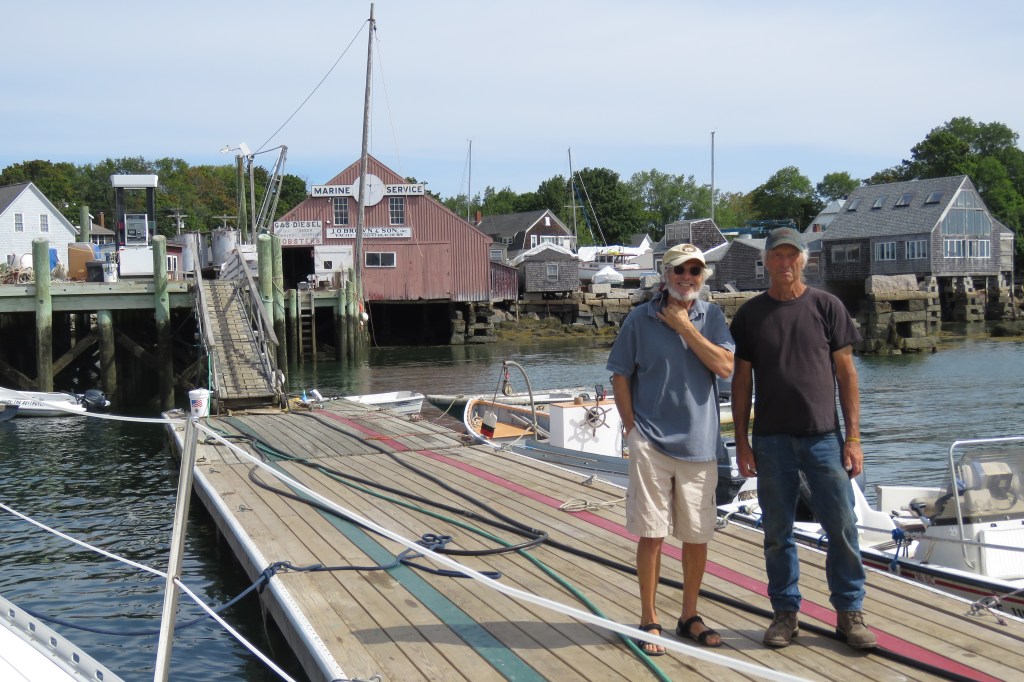
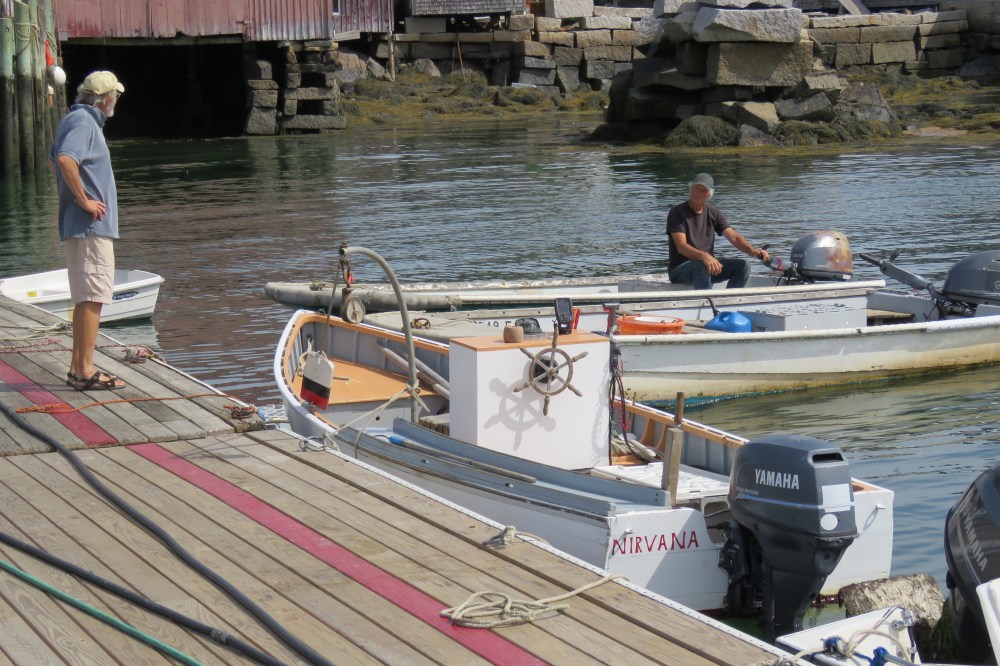
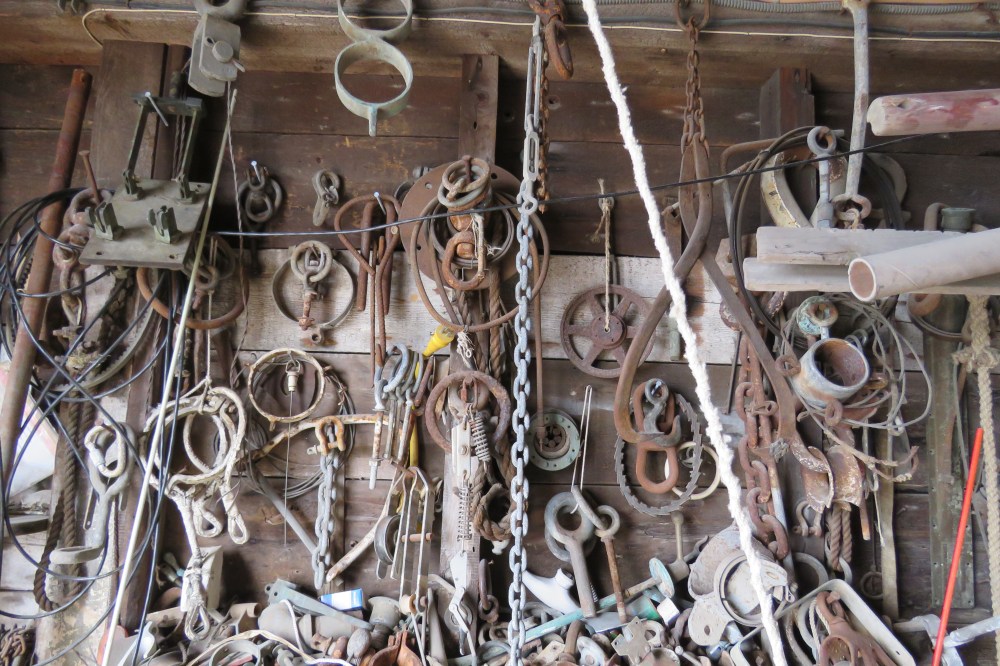
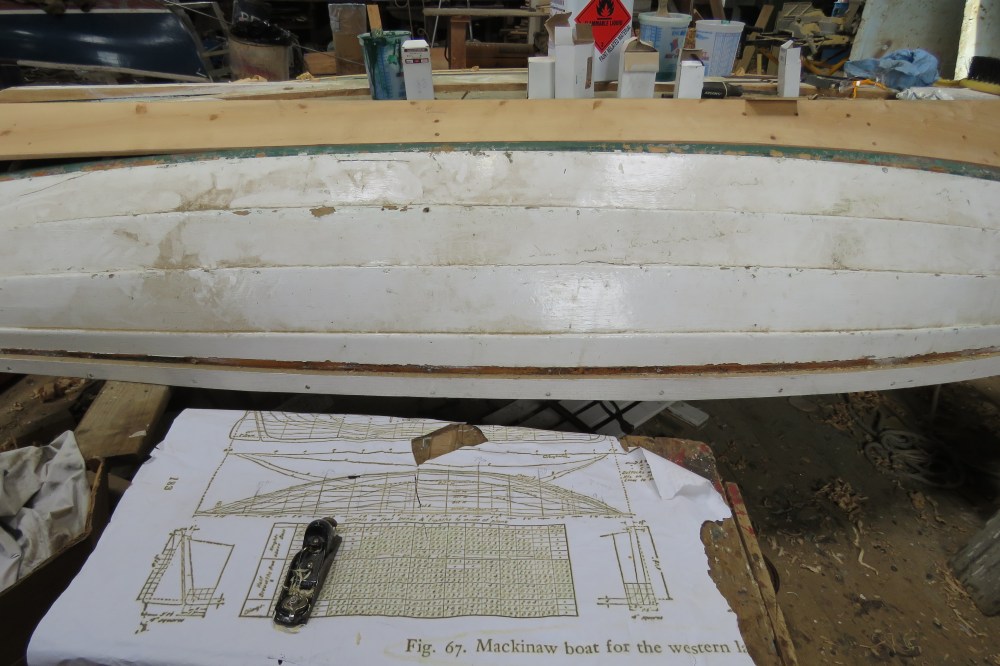
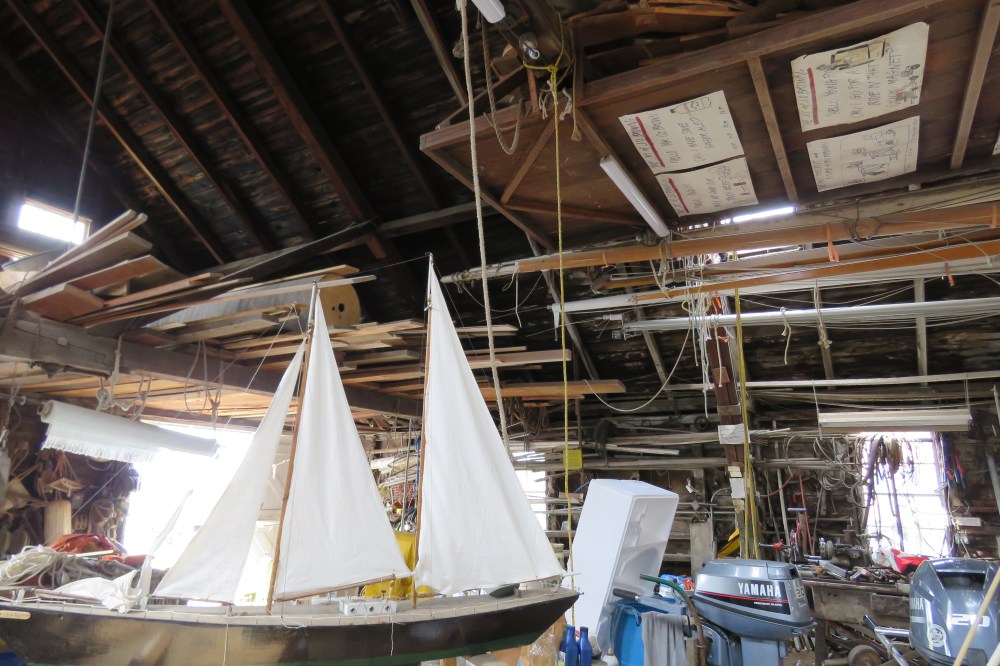
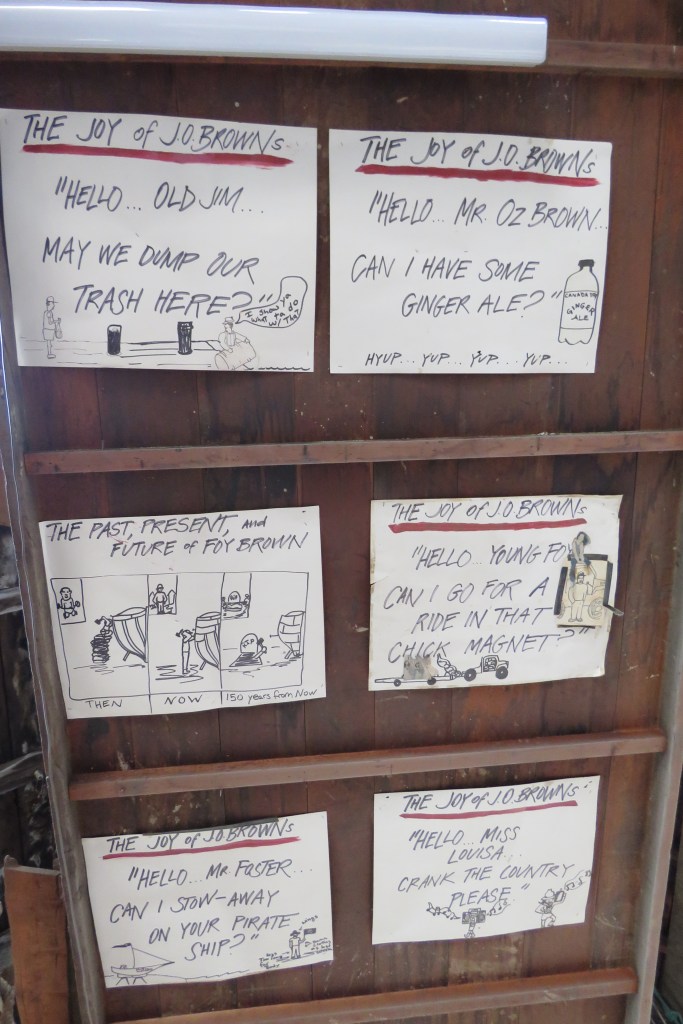
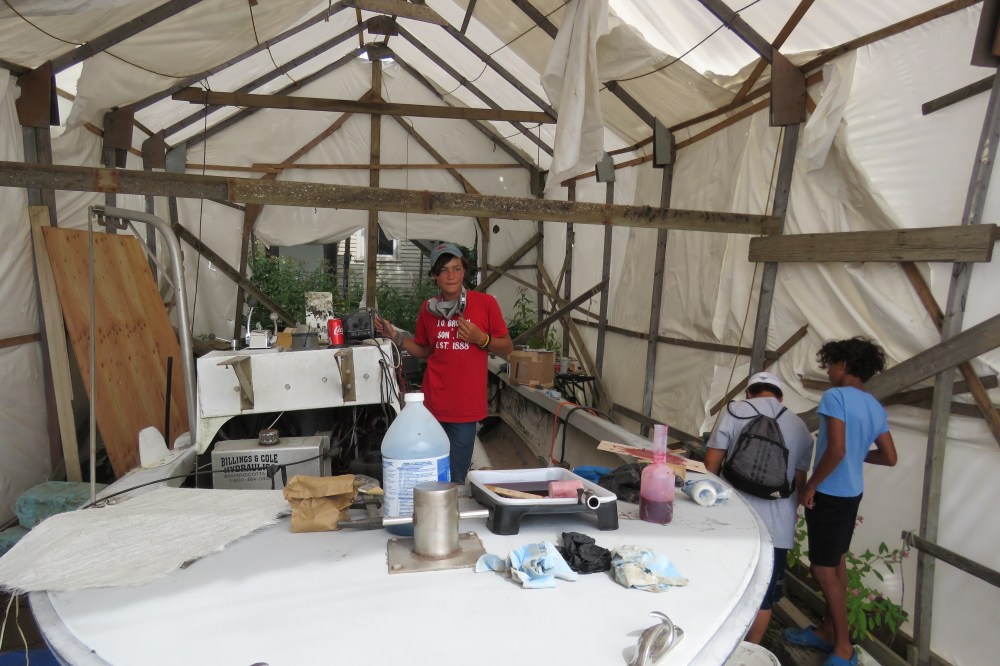
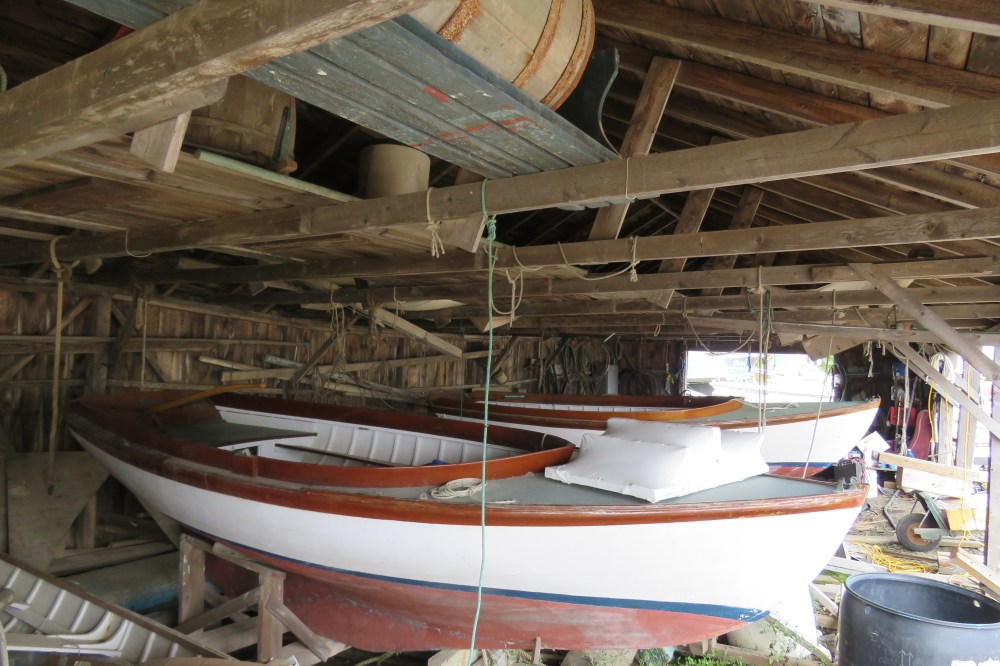
We’re finally ready to leave our home for a week, and with a tinge of sadness we drop the mooring and head over to the yard to fuel and water up—our intention of a week ago—and pay our bill. With $550 for the starter plus UPS and 2.5 hours of labor at $60/hr, we’re glad to be back to square one. We take a self-guided tour of the numerous buildings at the large compound that is J. O. Brown. The place is chock full of all manner of stuff strewn about the shop in what can only be described as complete chaos. And yet, you can just tell that Foy Brown and his son and his nephew and his nieces, like his father and grandfather and great-grandfather before him are enjoying the hell out of working there. And his grandson Silas at age 13 whom we also met is as accomplished a boat builder as anyone there and has numerous boat models in various stages of completion. And the name of his lobster boat? Nirvana.

And as for oil in the coolant? “That shouldn’t harm you any. It might even oil up the water pump!” says Foy.

*     *     *

And so, because F. O. Brown was out of fuel on Wednesday, and because Will poured oil into the radiator on Thursday, and because our starter didn’t work on Friday, we were in Perry Creek when our starter died rather than Matinicus, which meant Foy Brown was able to travel a mere one mile from his top-notch boatyard to our boat to fix it. And as a result, we were able to meet some of the nicest, most generous people we’ve met all summer!

So once again, three times over, something that seemed bad at the time turned out to be good for us in the end. And who knows, maybe because we were hit by another boat, the insurance claim will exceed the cost of our new starter!

Tasha & Will

Frailty and Responsibility

My former manfriend had a blog that he wrote every week called Loose Canon, and he was. Just over a year ago, he died of cancer after a year and a half of a slow decline that was simultaneously excruciating to experience and a gift to participate in. I sat with his daughter just after he passed reading TS Eliot’s Four Quartets, a poem he had spent nearly all ten years I knew him memorizing. “The past is all deception and the future futureless.”  “What we call the beginning is often the end. And to make an end is to make a beginning. The end is where we start from.”

Last week, my mother went into the hospital for the second time in a month, this time with a shoulder fracture having fallen in the middle of the night. She doesn’t remember falling, only the excruciating pain as she lay on the floor, for hours, nearing hypothermia, before her neighbor finally heard her calling out and called 911. I received a call that she was in the emergency room and found her with a shoulder the size of a football.

Just over eleven years ago, my nineteen year old son died in a car crash. He was driving too fast, spun out on a sharp curve five miles from home, and hit a telephone pole. Despite driving a Volvo, a car my ex-husband insisted was the safest thing around, he died instantly. The hardest moment in my life was going into the funeral parlor with my younger son and together, saying goodbye to his cold, stiff body, his hand raised up in the air as if clutching a steering wheel. When I went to visit my mother’s neighbors to thank them for finding her on the floor, I had a visceral flashback to the time I called on the people whose power went out when my son hit the pole in front of their house, rushed outside and found him dead, and called the police. It lasted for ninety seconds, which according to Jill Bolte Taylor, author of My Stroke of Insight, is the natural amount of time for human emotion to flood the system when it is not being conflated by what the Buddhists call “the second arrow,” that is, not pure, natural, healing grief, but suffering, which is a choice.

Other than that moment, I’ve been holding up remarkably well through my mother’s recent episode as I spend hours and hours every day plotting her next move from home to hospital to rehab to assisted living. If you have done this, you know what’s involved. If not, I will spare you the details, but suffice it to say, it is human complexity of the highest order. Take system (the human body), apply specialty after specialty at different pay scales, put together in a small, institutional room with wires, tubes, and beeping boxes, and shake and bake. Add the megalomania that is the health insurance industry that charges $24 for an aspirin and you know what I’m talking about.

I am someone who abhors drugs and hospitals and all things medical. Now I know my mother’s drug list and diagnoses as if I were a physician. I can navigate the Medicare and MaineCare systems as if I were a social worker. And I am becoming steeped in the extraordinarily large business that is helping the gigantic aging population in this country go from “independence” to “assisted living” to “skilled nursing” to the grave. Today we called on a family friend who happens to be a partner at a fancy law firm in town to draw up a “durable power of attorney” so I can take charge of my mother’s financial affairs, as well as her medical decisions when the time comes with the “health care proxy” I signed some months ago with the home health social worker. Over the course of her past two hospitalizations, I’ve been asked a dozen times what my mother’s “wishes” are. You better know what they are, because you don’t want to be dragged through that system any more than you sign up for. Or if you do, you better have insurance to cover it.

The episode with my mother is following on the year and a half of navigating my friends demise from cancer, with similar tenaciousness, despite the fact that we were no longer a couple. The day he couldn’t move from his chair in excruciating pain, I’m the one he called and said, “Please come. I don’t want to die alone.” I was there through it all: radiation, chemotherapy, caregivers, social workers, hospice, family, friends. And the long, slow process of watching a man who up until age 77, stubbornly rode his bicycle everywhere through all manner of weather, groceries piled into a large backpack, decline to a state of shuffling across the floor with a cane, skin and bones, drugged out on morphine, talking nonsense half the time and weeping the other half.

Virtually every industry is in on it, the living and dying game, big time. Is one human life really worth that much money? A friend of mine told me that in the last year of his mother’s life, the hospital bills totaled $940,000! I tend to be an isolationist, a hide-your-head-in-the-sand kind of girl who wants no part of any of it. I’d rather be writing poetry and sailing off into the sunset with a lover. And yet here I am, right smack in the middle of what George Harrison called “Living in a Material World” or as Pierre Teilhard de Chardin said, “We are spiritual beings having a human experience.” And I will now invoke Joni Mitchell, “my favorite theme,” and bring me back to my reference point, “We are stardust, we are golden.” And we are each worth lightyears more than what money can value, which I believe is my point.

Needless to say, none of these are worlds I have chosen to visit – the death of my son, the demise of my friend, the decline of my mother – but this is what is called RESPONSIBILITY. Last year at a 5Rhythms dance retreat called The Holy Actor, that word was on the altar of the hall. My immediate reaction was ICK, cross my fingers in front of it, please don’t remind me of THAT while I’m here practicing freedom! Until my friend told me what someone had pointed out to him, a reframe on the word: responsibility is THE ABILITY TO RESPOND. It is that ability that I have been cultivating a lot of late. The ability to see what is, as it is, and to respond in the moment with what is needed, without judgement or drama, and without REACTING from a place of FIGHT, FLIGHT, or FEAR, that is, from the limbic part of the brain, the part that is conditioned by past experience. Add to that list the other key players of the primitive brain that run much of our lives SUBMIT and ATTACH. I learned these new ones from my therapist and clearly see how they too have played out in my life. The twenty-two years of my marriage and the ten years following with the man who died were examples of both.

The key to waking up, to rising above these habitual responses to higher levels of consciousness is AWARENESS, aka MINDFULNESS. The fact that this word is becoming mainstream is a pretty cool thing. And yet, as those of us who try and practice it know, it’s easier said than done. Until you just get it. You simply wake up one day and say, oh yeah, I am not reacting, I am responding. I am doing what needs to be done without my primitive-brain-emotional-drama-self driving the bus. And when they start to move from the back of the bus to the driver seat, I am conscious enough to know what that feels like in my body, and I put on the brakes, stop the bus, and step outside.

I recently went for a walk in the woods with the Mindfulness Meetup, and it was the most amazing experience. To  practice noticing, in detail, what the senses were taking in: the towering trees, the chirping birds, the cold air on my skin, my heartbeat. And once again I was reminded how much I love the woods. How being in nature makes me see things differently, with an artist’s eye. How collecting bark and moss and pinecones makes me feel like a child. And how all of it comes together as a poem in my heart that uplifts me like a song. As for the title, that’s for another day.

SARASWATI

Walking in noble silence
mindful of the sense doors
thoughts replaced by
pinecones and driftwood

a spring chill penetrates
skin to bone
blood pulsing freely
feeds the soul-body

a family of trees
urge each step
protecting from above
supporting from below

no distinction between
living and dead
form and formless
earth feeds earth

reflections dance
in flowing pools
a moving masterpiece
of creation.

I Hereby Surrender

4 AM. My mind activates with ideas that seem profound enough to want to get up and write them down.

A couple of years ago I bought this domain name surrendertotheabundance.com after an “intention map” workshop I did at the start of the year. It started with a Tarot reading and then moved into intuitive collaging about the coming year. Mine was a large, circular, two-sided hanging piece. On one side was a colorful array of lusciousness of the senses – lips, tulips, wine – with various cards with music, art, relaxation, and playfulness protruding from the edges like a child’s drawing of rays of sunshine, a flamboyant peacock at the center. On the other side was a monk sitting in meditation, a serene scene of calm water behind him and a smooth, white stone below him with the word Surrender at his feet. This map become known to me as Surrender to the Abundance and was my theme for 2017. I even made up “calling cards” with the website that reads: A sailor, dancer, actor, singer, photographer, and writer living in the mystery.

You see, for several years, I have had themes to each of my years. It started in 2013, again at a New Year’s Day community celebration where we sang rounds, read poetry, and did art projects. That year I created a scroll with the words “If Not Now, When,” which hung on a door in my house for a year and acted as a daily reminder. That is the year I took a leap off a cliff and bought a 28’ sailboat.

As for the calling cards, I haven’t handed out a single one. I have never felt ready to identify myself as any of those things. And yet, I have spent a lifetime become each and every one of them. So when do you get to start calling yourself something that you want to be? When you decide it’s time? When you choose to put yourself out there as opposed to hiding yourself under a bushel? When you choose transformation over safety? When you choose to rise yourself up like Maya Angelou as opposed to putting yourself down? When you choose to surrender to the abundance as opposed to attempt to control what cannot be controlled?

So today, at 4AM, I once again call on the theme of “If Not Now When” to officially start this blog. I call on forces larger than myself and trust that I have something worthy enough to say that someone else might want to read. I am constantly inspired by people and things I encounter in this life. Along with water, air, and food, it is my fuel. I’ve been at it long enough, this obsession to find what will buoy me up when times are hard and what will take me to higher levels of consciousness when I can see my way clear through the dust storms of ego.

I hereby surrender to the abundance and share it with you. May you be inspired.